
Lieferung heute & morgen

Qualitätsgarantie

Willkommens-Angebote freischalten: KOSTENLOSE Lieferung | Bis zu 80 % RABATT | Kostenlose 30-Tage-JoyPlus-Testphase
App herunterladen
A desk organiser should keep documents, stationery and office accessories neatly stored without taking up too much of your work surface. In practice, though, some common buying decisions can lead to disappointment: a small pen holder may not be big enough for everyday use, an unstable document tray may tip over when fully loaded, or a desk shelf may not fit your existing desktop.
This guide explains what to consider before you buy, whether you work from home, study, teach or work in an office. We focus on clear information about storage, dimensions, materials, load capacity, mobility and assembly.
Many desk organisers look spacious in product photos, but in reality have only a few small compartments. Before you buy, think about what you want to store:
An office organiser with drawers is better suited to small items. For paper, an open desk tray, a filing tray or a compartment system with sufficient internal height is a more practical choice.
A stated total load capacity doesn't tell you much if heavy ring binders will be placed in just one compartment. Check the load capacity of each compartment or drawer, the material thickness and how evenly the weight is distributed. For tall shelves, also make sure the structure stands securely on a level surface.
Clamp-on shelves need a suitable desk edge and a compatible desktop thickness. A model with a clamp for desktops from 10 to 45 mm isn't automatically suitable for rounded, irregular or very thin edges. With a traditional desk organiser system, you should also consider the space available above and beside your monitor.
For A4 documents, check the internal dimensions and compartment height carefully. A vertical compartment system can hold ring binders, folders and magazines, while shallow trays are ideal for letters and loose documents. Multi-tier systems make use of the height of your workspace, but need enough clearance from shelves, lamps and monitors.
A system with adjustable dividers is useful if you need to sort documents of different sizes. Fixed compartments keep everything neatly organised, but offer less flexibility.
Metal can provide a strong, shape-retaining solution when it's well designed. Perforated or mesh structures make the contents visible and help with ventilation. PVC is easy to care for and resistant to moisture, but for larger trays, the thickness of the frame and dividers matters. Wood and coated MDF panels often suit living spaces or reception areas, but should be protected from scratches and moisture.
Look for non-slip feet, rounded edges and a stable base. Felt or EVA pads are useful if you have a delicate desktop.
A stationary desk organiser is a good choice if you want to keep its contents in one place. Wheels or carry handles, on the other hand, make it easier to move around. For sensitive documents, a lockable mobile cabinet may be more suitable than an open document tray. A lock isn't a complete data security measure, though; it simply makes it harder for someone to access the contents directly.
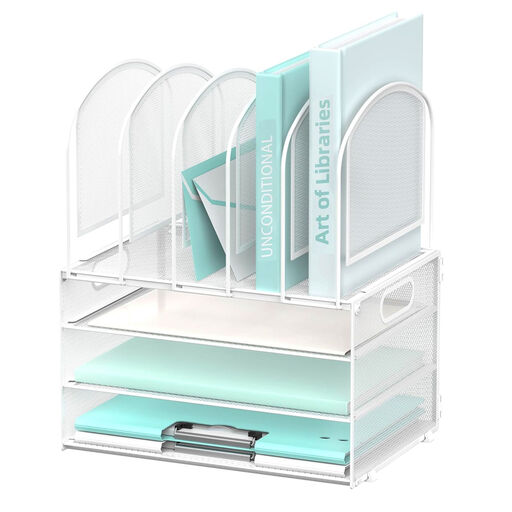
Why this product suits this profile: Three paper trays and five vertical compartments keep letters, A4 documents, magazines and ring binders together in one place. The two handles make it easier to move around your home office or study area.
The separate tiers help keep loose papers apart from vertically filed folders. Even so, distribute the weight evenly before loading it up.
Metal mesh, three tiers, five folder holders and two carry handles; according to the product description, assembly uses the supplied screws and screwdriver.
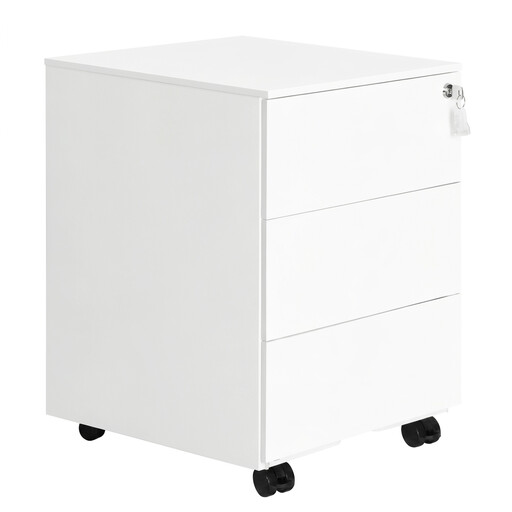
Why this product suits this profile: This mobile filing cabinet is ideal if you want to store documents and office supplies separately and move them when needed.
Three drawers keep sensitive documents out of sight and off your work surface. The lock provides an extra level of access control.
Steel frame, three drawers, full-extension runners, a lock and four castors, two of which have brakes. According to the product details, each drawer can hold up to 15 kg.
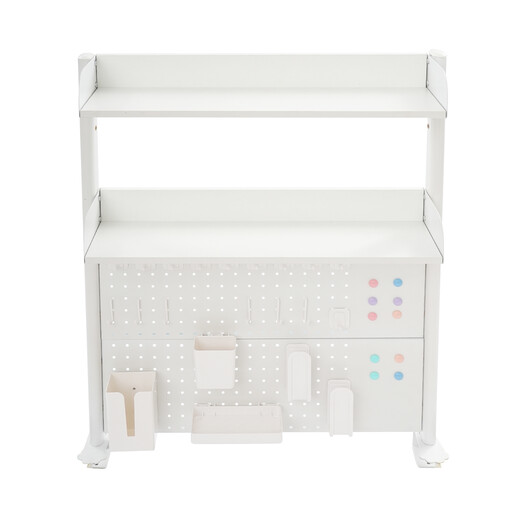
Why this product suits this profile: This clamp-on shelf makes use of vertical space without needing holes drilled in the wall or desktop. It's a good fit for workspaces where you want books, documents and notes close to hand.
The clamp is specified for desktops from 10 to 45 mm thick. Before assembly, check the desk shape and desktop thickness, and make sure there is enough clearance from the wall.
Two tiers, an adjustable divider, a perforated back panel and clamp-on assembly. The product description states a capacity of up to 44.09 lb or 20 kg per tier.
A compact desk organiser with a pen holder and drawer is enough for a few writing essentials. If you regularly deal with invoices, worksheets or post, a multi-tier document tray is a better option. In classrooms, reception areas and offices, trays with 24 or 36 compartments can be useful, provided you have enough space and take the load into account.
Businesses should also check that the dimensions, cleaning requirements, assembly and access permissions suit the intended location. For a home office, a mobile or clamp-on system is often a practical choice, as it's easier to move after work.
We've put together a complete, regularly updated list of products that meet these strict selection criteria and fully comply with the safety regulations in force in the EU.
It depends on what you need to store and how much desk space you have. Compact models are enough for pens, paper clips and sticky notes. For A4 documents, check the internal dimensions, compartment height and depth. Make sure you also leave enough room to move around your monitor, keyboard and work surface.
Load compartments evenly and don't exceed the stated capacity. Metal and PVC surfaces can usually be cleaned with a soft, slightly damp cloth. Avoid harsh cleaning products on wood, coated surfaces and drawers. A level base reduces strain on joints and castors.
Open compartments give you quick access to documents you use often. Drawers protect small items and can offer more privacy for confidential documents. For neatly storing office supplies, a combination of open trays and closed compartments is often the most practical option.