
Lieferung heute & morgen

Qualitätsgarantie

Willkommens-Angebote freischalten: KOSTENLOSE Lieferung | Bis zu 80 % RABATT | Kostenlose 30-Tage-JoyPlus-Testphase
App herunterladen
A white hallway shoe cabinet can visibly organise your entrance hall and make it look brighter. However, the choice can quickly become confusing: product images often show generously sized storage areas, while the actual shoe depth, door opening or assembly requirements only become apparent at home. For households in Germany, dimensions, internal layout and stability are therefore particularly important.
A narrow shoe cabinet takes up little floor space, but its doors or flaps require additional clearance in front of the unit. With a model that is 24 cm deep, the internal width may still be limited for larger shoe sizes or high-top trainers. Before buying, you should therefore check the cabinet’s width, depth and height, as well as the space required when the doors are open.
Figures such as “12 to 25 pairs of shoes” depend on shoe size, shoe type and the internal layout. Boots, walking shoes and high-top footwear need more height than low-profile trainers. Capacity figures should therefore be treated as a guide. Adjustable shelves or removable compartments are more practical, as they allow the interior to be adapted to different types of footwear.
A white shoe cabinet with gold accents or a shoe cabinet with a mirror can create a decorative look. However, sturdy shelves, doors that close properly and secure wall fixing remain essential. Tall furniture such as a hallway cabinet or tall shoe cabinet should stand on a level surface and be secured to the wall using the supplied anti-tip fitting – particularly in households with children.
Compact furniture is often a sensible choice for small flats. A model that is 40 cm deep can still work well if the hallway is wide enough, while an especially narrow shoe cabinet measuring around 24 cm deep projects less into the walking area. Also measure skirting boards, radiators, sockets and door openings.
A shoe cabinet with doors keeps the contents out of sight and can make the hallway feel calmer. An open compartment or top shelf is useful for everyday access. If you also want to store keys, hats and shoe-care accessories alongside your footwear, a shoe cabinet with a drawer is a practical choice.
Pay attention to:
A cabinet for 22 to 25 pairs of shoes should not automatically be assumed to hold 25 pairs of boots. Actual capacity depends on the shape and size of the footwear.
The models presented use wood-based materials such as particle board or MDF. Important details include the material thickness, load capacity and quality of the fittings. One of the models is listed as E1-rated; this refers to a defined formaldehyde emissions class for wood-based materials. The assembly instructions and supplied anti-tip fitting should be followed in full.
A shoe cabinet with a mirror also requires careful assembly and cleaning with a soft, slightly damp cloth. Before ordering, check whether the furniture will be delivered in one or more packages and whether two people are needed for assembly.
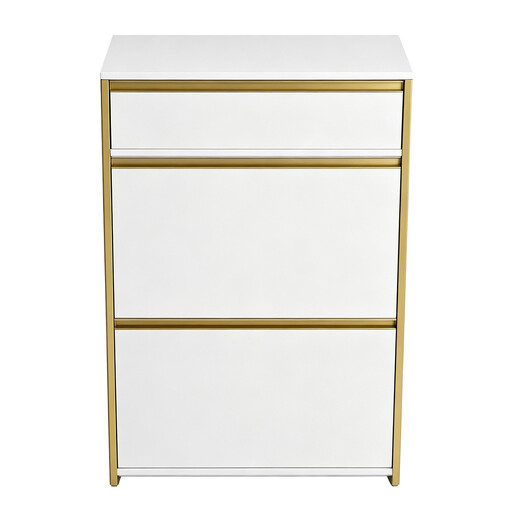
Why this product suits this profile: Measuring 60 x 24 x 104.5 cm, this unit combines a shallow depth with a drawer, doors and flexible storage compartments. This makes it suitable for smaller hallways and changing storage needs.
The adjustable and removable shelves reduce the limitations of fixed compartments. The stated capacity is up to 12 pairs of shoes and depends on the shoe model.
Slim design, drawer, two doors and adjustable internal shelves; additional anti-tip fittings are mentioned.
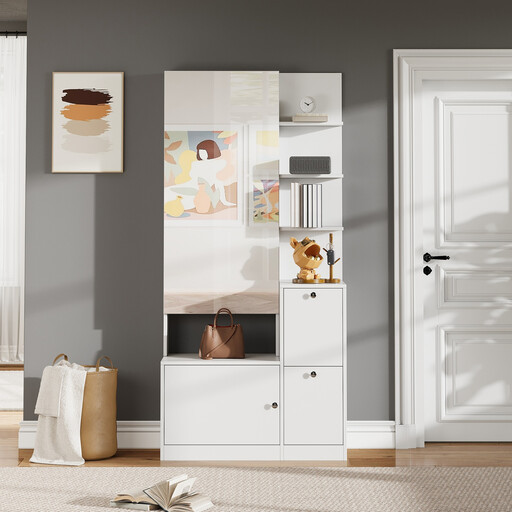
Why this product suits this profile: This combination unit makes use of the entrance hall’s vertical space, combining shoe storage, enclosed compartments, five open shelves and an integrated mirror.
The dimensions of 85 x 40 x 180 cm make the space required easy to assess. Two pull-out shoe cabinets, each with two levels, make access easier without overstating the shoe capacity as a blanket figure.
Integrated mirror, five open shelves, two doors and three separate internal sections; the stated load capacity of the top is 50 kg.
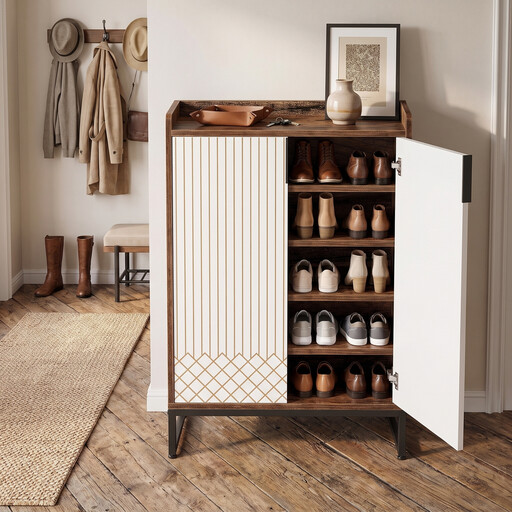
Why this product suits this profile: Measuring 73 x 35 x 105 cm, with five levels and a stated capacity of around 22 to 25 pairs, this model is aimed at families and households that regularly change their footwear.
The product details specify the dimensions, number of levels and maximum load capacity of 32.6 kg. This makes it easier to compare the unit’s suitability with the footwear you already own.
Two doors, open bottom compartment, five storage levels and adjustable feet; the design combines white surfaces with brown and gold-coloured elements.
We have put together a complete, regularly updated list of products that fully meet these strict selection criteria and the safety regulations applicable in the EU.
This depends on shoe size, the type of furniture and the available walking space. Particularly narrow models measuring around 24 cm deep save floor space, but may provide less internal room for larger shoes. Before ordering, check the internal dimensions and the position of the skirting boards.
Capacity depends on the type of footwear and the spacing between compartments. For example, one model may be designed to hold up to 12 pairs of shoes, while a five-level storage system may be listed as holding around 22 to 25 pairs. Boots and bulky sports shoes reduce the actual number.
Tall or heavy furniture should always be secured to the wall using the supplied anti-tip fitting. This is particularly important in households with children. The cabinet must also stand on a level surface so that the doors and drawers work correctly.