
Lieferung heute & morgen

Qualitätsgarantie

Willkommens-Angebote freischalten: KOSTENLOSE Lieferung | Bis zu 80 % RABATT | Kostenlose 30-Tage-JoyPlus-Testphase
App herunterladen
A white PC case with panoramic glass is more than just a container for hardware; it's a stage. The aesthetic of a clean, bright setup where every component is visible has a special appeal. However, the path to the perfect "white PC build" is paved with pitfalls. Many models that look impressive at first glance turn out to be thermal or practical disappointments. This guide will help you identify the crucial features and choose a case that not only looks great but also performs for the long haul.
Before you decide on a model, you should be aware of three common marketing traps that often lead to buyer's remorse.
The "Aquarium" Trap: Aesthetics Over Airflow Some cases marketed as a white aquarium PC case rely on large, uninterrupted glass panels on the front and side. Without sufficient air intakes through mesh grilles or strategically placed vents, the case becomes a heat-trapping hotspot. The components, especially the graphics card and CPU, cannot efficiently dissipate their heat, leading to thermal throttling and reduced performance.
The "Pre-Installed Fans" Deception A case with pre-installed ARGB fans might seem like a good deal. However, these are often basic DC (voltage-controlled) fans instead of more precise PWM (pulse-width modulated) fans. They are frequently louder and less efficient. Furthermore, the RGB implementation can be proprietary, making it difficult to synchronise with other components. What appears to be added value can quickly lead to necessary additional costs for replacements.
The Compatibility Dead End Case design is evolving rapidly. A model that seems modern today could be obsolete tomorrow. A common issue is the lack of space for modern, ever-larger graphics cards. Another point is the missing support for new motherboard standards. A PC case for Back-Connect motherboards (like MSI Project Zero or ASUS BTF) allows for extremely clean cable management, as the connectors are on the back. Those who don't plan ahead here miss a huge opportunity for a flawless aesthetic.
To avoid these traps, focus on three objective criteria. These define the quality and future-readiness of your case.
A good panoramic case balances glass and airflow. Look for the following features:
mATX gaming PC case should offer multiple options for fan installation. Crucial mounts are not just at the front and rear, but also on the top and, most importantly, the bottom to supply the graphics card directly with fresh air.Dimensions are key. Verify these three values before buying:
Micro ATX glass case that is too narrow can cause problems here.Details that simplify assembly and maintenance are the hallmark of a well-designed case.
Here are some recommendations tailored to specific user profiles that meet the criteria mentioned above.
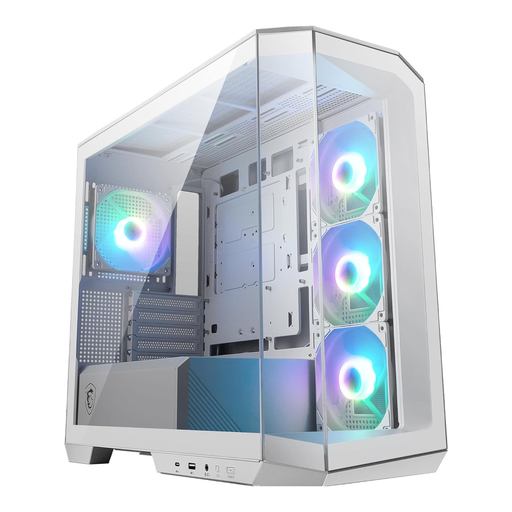
Why This Fits Their Persona: Ideal for users who want to create an aesthetically pleasing and compact white PC build without much hassle. The case offers the desired panoramic look and is ready to go out of the box thanks to the four pre-installed ARGB fans.
It bypasses the "aquarium" trap with perforated surfaces and a well-thought-out fan layout. The included fans are PWM-controlled and connected via a hub, avoiding the trap of low-quality components.
All-in-one package with four 120mm ARGB PWM fans and a hub. Offers great flexibility with 33 mm of space for cable management and support for Back-Connect motherboards.
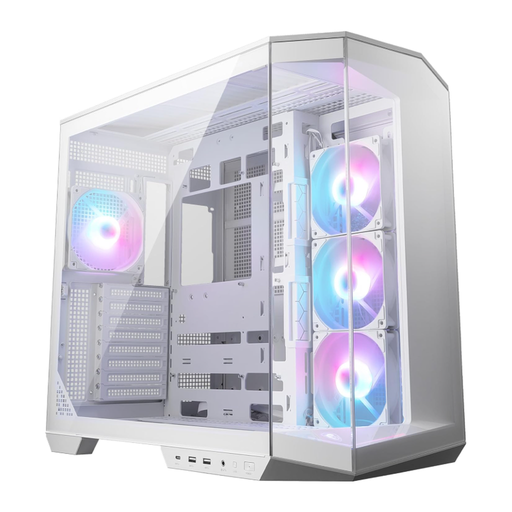
Why This Fits Their Persona: Perfect for PC builders who value an immaculate interior. As an ATX case, it offers more space and is specifically designed as a case for Back-Connect motherboards, enabling a virtually cable-free appearance in the main chamber.
It directly addresses the compatibility dead end by supporting the forward-thinking Back-Connect standard. The dual-chamber design separates the PSU and cables from the main heat-generating components, thus optimising airflow.
The dual-chamber layout and Back-Connect support enable unmatched cable management. Includes a vertical GPU bracket for showcasing the graphics card.
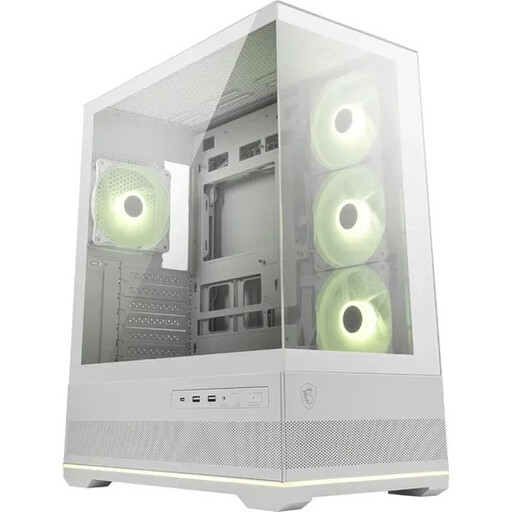
Why This Fits Their Persona: For users seeking the ultimate showcase for their high-end hardware. The seamless 270° panoramic glass offers an unobstructed view and perfectly embodies the white aquarium PC case look. Ideal for custom water cooling and elaborate RGB setups.
Despite the massive glass panel, it offers space for up to 10 fans and a 360mm radiator. The included reverse-blade fans on the side draw in air without the fan frame obstructing the view—a clever solution to the airflow trap.
Unique 270° glass view for maximum visual impact. The three pre-installed reverse-blade ARGB fans are specifically designed for show builds and are a standout feature.
We have compiled a complete, real-time list of products that fully meet these strict selection criteria and UK/EU safety regulations.
For standard gaming systems, the pre-installed PWM fans in high-quality cases like the MSI PANO M100R PZ are generally sufficient. They offer a good balance between cooling performance and noise levels. However, for overclocking or using extremely powerful components like an RTX 4090, it may be wise to install additional fans or switch to a liquid cooling solution to maintain optimal temperatures.
Support for Back-Connect is currently a feature for enthusiasts aiming for absolutely flawless cable management. Functionally, it offers no direct performance advantage. However, if an extremely clean interior aesthetic is important to you and you are willing to invest in a compatible motherboard, a compatible case is a future-proof choice that can significantly simplify assembly and maintenance.
In principle, yes. The mATX (Micro-ATX) standard defines the motherboard's dimensions and screw positions. Any case specified as an mATX case should be able to accommodate an mATX motherboard. However, pay close attention to the case manufacturer's specifications regarding the maximum CPU cooler height and graphics card length, as these can vary depending on the case design.