
Lieferung heute & morgen

Qualitätsgarantie

Willkommens-Angebote freischalten: KOSTENLOSE Lieferung | Bis zu 80 % RABATT | Kostenlose 30-Tage-JoyPlus-Testphase
App herunterladen
A white nightstand is more than just a surface next to your bed. It's a key piece of bedroom furniture that creates order and defines the room's style. However, the selection can quickly become overwhelming. Many models look appealing at first glance but only reveal their flaws in daily use. To help you make an informed decision, we'll highlight the crucial criteria and show you which pitfalls to avoid.
Before deciding on a model, it's helpful to know the typical defects that often only become apparent after the purchase.
To avoid buyer's remorse, you should check three key aspects: material, dimensions, and functionality.
The choice of material significantly influences the stability and lifespan of your nightstand. Common materials are MDF (Medium-Density Fibreboard) and particleboard. Look for the E1 classification, which stands for low formaldehyde emissions and thus a healthier indoor environment. The surface finish is just as important. A melamine resin coating offers good scratch resistance and is water-repellent, making it easier to maintain than simple paint finishes.
The dimensions of the nightstand must match your bed and the available space.
Consider which functions are relevant to your daily life. A small nightstand can offer well-designed storage.
Here are some models tailored to specific needs and room situations.
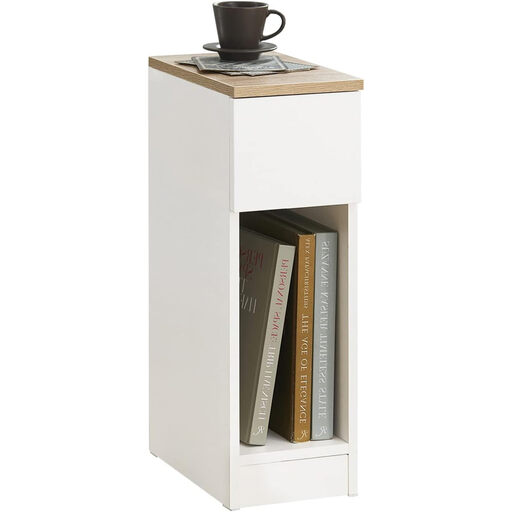
Why This Fits Their Persona: Ideal for residents of city apartments or rooms with limited space. It fits perfectly into niches between the bed and the wall where standard nightstands would be too wide.
The construction from E1-classified MDF and particleboard ensures a stable base despite its narrow width. The combination of a drawer and an open compartment offers practical storage in the smallest of spaces.
Extremely slim design: At just 20 cm wide, it's one of the most compact solutions on the market. Includes felt pads to protect the floor.

Why This Fits Their Persona: Perfect for couples or individuals who want to create a harmonious and symmetrical look in the bedroom. The Scandinavian nightstand look complements many modern interior styles.
The solid wood legs provide a stable construction, preventing the wobbling found in cheaper models. The drawer features a recessed grip, allowing for smooth operation without jamming mechanisms.
Cohesive Design in a Set: The set of 2 nightstands ensures a uniform look. Non-slip protective caps on the feet prevent scratches on the floor.

Why This Fits Their Persona: For anyone who wants to conveniently charge their tech devices overnight while enjoying a modern, multifunctional solution. This side table for the bedroom combines storage with technical convenience.
The integrated charging station is made from flame-retardant materials. An included anti-tip kit ensures stability, even when multiple devices are plugged in. The scratch-resistant and waterproof surface protects the electronics.
Integrated Charging Function: Equipped with 2 power outlets and 2 USB ports. Additional LED lighting, controllable via app or remote, creates ambiance.
We've compiled a complete, up-to-date list of products that fully meet these strict selection criteria and UK safety regulations.
What is the ideal height for a nightstand? The top of the nightstand should be level with your mattress or a maximum of 5-10 cm below it. This ensures you can comfortably reach items from your bed without having to stretch or sit up excessively.
What does the E1 classification mean for wood-based materials? The E1 standard is a European regulation that governs the maximum emission of formaldehyde from wood-based materials like MDF or particleboard. Products with E1 certification release only very low amounts of this substance into the air, making them safe for use in living spaces.
Can a floating nightstand be attached to any wall? No, the type of wall is crucial. A floating nightstand requires a load-bearing wall, ideally made of solid masonry or concrete. For drywall (e.g., plasterboard), you must use special hollow-wall anchors and carefully select the mounting points, preferably on the underlying wall studs. Always check the wall's load capacity and use the appropriate mounting hardware for your wall type.