
Lieferung heute & morgen

Qualitätsgarantie

Willkommens-Angebote freischalten: KOSTENLOSE Lieferung | Bis zu 80 % RABATT | Kostenlose 30-Tage-JoyPlus-Testphase
App herunterladen
A white shoe cabinet can create a calmer look in your entrance hall and protect shoes from dust. For the furniture to work well in everyday use, dimensions, interior layout and stability should matter more than decorative promises. Especially in German homes with narrow hallways, even a small difference in depth can determine whether doors and passageways remain convenient to use.
A tall or wide cabinet may look spacious in photos. What matters, however, is how many centimetres of usable space are available inside the compartments. Large trainers, boots and shoes with high shafts will not automatically fit into shallow drop-down compartments. Therefore, check the internal dimensions of the compartments, not just the overall height, width and depth of the furniture.
A slim shoe cabinet may still have protruding handles, wide plinths or doors that open out widely. Measure the available area, including skirting boards, radiators and the doors’ opening radius. For very narrow entrances, a flip-front shoe cabinet or furniture with pull-out compartments may be more suitable than a classic shelving unit.
“Adjustable shelves” are only practical when information is provided about the adjustment increments, number of positions or whether the shelves can be removed. Without these details, it remains unclear whether a compartment can be adapted for boots or storage boxes. Also check the permitted load for the shelves and top panel.
For a hallway, you should first measure the space available:
An open shoe rack allows quick access, but offers less protection from dust. A shoe cabinet with doors or flip fronts looks more enclosed and is better suited to keeping the hallway looking tidy.
A flip-front shoe cabinet is often suitable for everyday shoes, while a cabinet with adjustable shelves offers more flexibility. Before buying, check:
A shoe cabinet for small spaces does not necessarily need to be particularly tall. A combination of a slim cabinet, several compartments and additional storage space may make better use of the available area than a low, deep model.
For wood-based materials such as MDF or chipboard, check the product information relating to load capacity and surface care. Plastic or PP components are easy to clean and, in some cases, moisture-resistant, but may be more sensitive to high temperatures. Metal frames can provide additional stability, but do not replace correct assembly.
The following are also important:
White surfaces show dust and dark scuff marks more quickly. A smooth finish can usually be cleaned with a soft, slightly damp cloth. Abrasive products may permanently alter the surface.
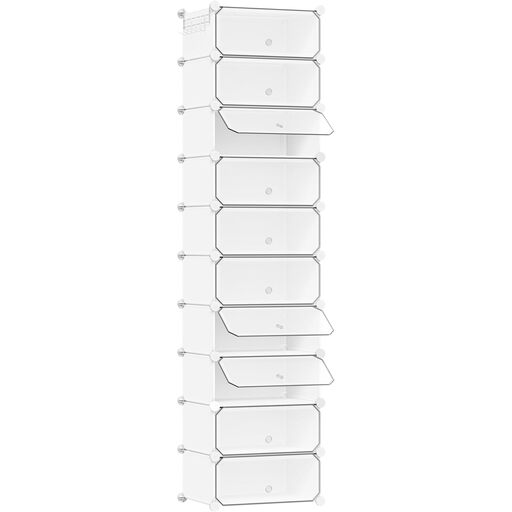
Why this product suits the profile: This modular unit with 10 compartments is suitable for households looking for flexible shoe storage in the hallway, bedroom or beneath a staircase. The stated dimensions are 40 × 30 × 170 cm.
The individual compartments and doors make the storage arrangement easy to understand. The modular construction can be configured differently to suit each room. The stated capacity depends on shoe size and shape.
PP plastic panels, a metal frame and ABS connectors; 10 doors providing dust protection, with assembly accessories included.
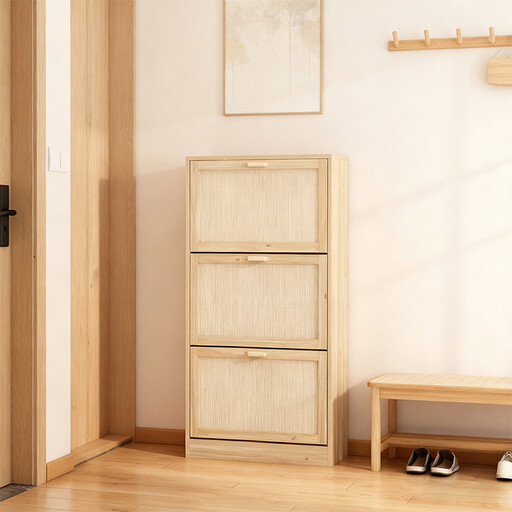
Why this product suits the profile: Measuring 60 × 118 × 24 cm, this slim shoe cabinet combines enclosed compartments with a compact depth, making it suitable for smaller entrance areas.
The removable shelves allow the cabinet to be adapted to different shoe heights. Anti-tip protection is provided; wall mounting should be carried out according to the instructions.
Three flip fronts, adjustable shelves, stated capacity for up to 12 pairs of shoes and a top-panel load capacity of up to 10 kg.
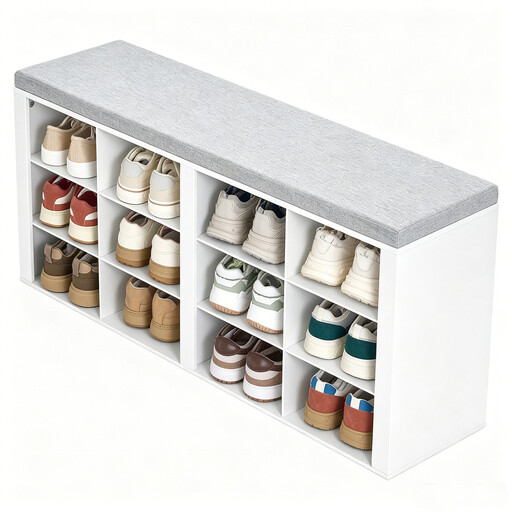
Why this product suits the profile: A shoe cabinet with a bench can be ideal for families and anyone who prefers to change shoes while seated. The unit measures 104.5 × 30.5 × 49.5 cm.
The seat has removable covers. Adjustable shelves accommodate different types of shoes; however, the stated load capacity of 150 kg should not be interpreted as an arbitrary point load.
A combination of seating and shoe storage, height-adjustable shelves and removable seat covers for cleaning.
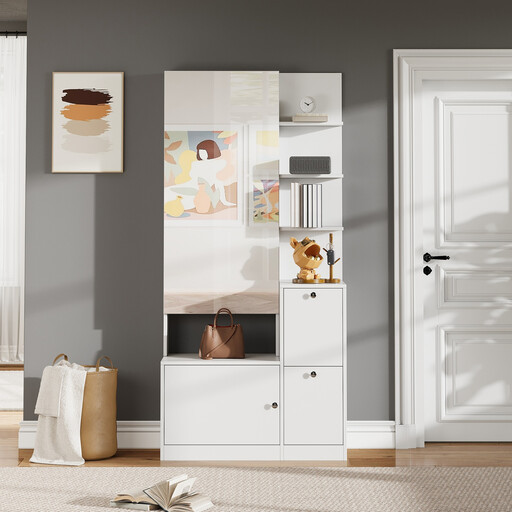
Why this product suits the profile: Measuring 85 × 40 × 180 cm, this storage cabinet makes use of vertical space and combines shoe compartments, open shelves and an integrated mirror.
The division into several areas prevents shoes, bags and household items from filling a single shared compartment. Before assembly, check that both packages contain all the required parts.
Two pull-out shoe cabinets, each with two levels, five open shelves and an integrated mirror; the stated top-panel load capacity is up to 50 kg.
We have put together a complete, regularly updated list of products that fully meet these strict selection criteria and the safety regulations applicable in the EU.
Before assembling the furniture, read the instructions and check that all packages have arrived. For tall furniture, anti-tip protection should be used, particularly in households with children. Do not place a white cabinet directly in front of a radiator or in an area that is permanently damp.
A soft, slightly damp cloth is usually all you need for cleaning. Liquids should not be allowed to penetrate and cause swelling, particularly with chipboard and MDF. Before storing shoes, remove any coarse dirt and allow them to dry first if they are damp.
This depends on shoe size and construction. Models around 23 to 30 cm deep often leave more space in the passageway. Also check the internal compartment width and whether the doors or flip fronts protrude into the walkway.
A flip-front shoe cabinet or a shoe cabinet with doors offers greater protection from visible dust and gives the hallway a more enclosed appearance. An open shoe rack, on the other hand, provides quicker access and can be practical for everyday shoes that need good ventilation. The right choice depends on the available space, cleaning requirements and the look you want to achieve.
There is no reliable one-size-fits-all answer. Its lifespan depends on the material, load, assembly, moisture and daily use. Observing the load limits, checking screw connections and protecting the furniture from moisture and heat will help reduce common causes of wear.