
Lieferung heute & morgen

Qualitätsgarantie

Willkommens-Angebote freischalten: KOSTENLOSE Lieferung | Bis zu 80 % RABATT | Kostenlose 30-Tage-JoyPlus-Testphase
App herunterladen
A radiant smile is often associated with health and good hygiene. The desire for whiter teeth leads many consumers to products like whitening toothpaste. However, the market is crowded and full of promises that aren't always kept. Many products advertise fast results but can do more harm than good if chosen incorrectly.
As your Joybuy Product Recommendation Officer, I'm here to help you see through the marketing hype. This guide explains what you need to look for to make an informed decision for at-home teeth whitening and avoid common pitfalls.
Before you choose a product, you should be aware of the most common issues that can lead to disappointment or even tooth damage.
To find the right toothpaste for stains, you should look beyond the advertising and focus on objective criteria. These three factors are crucial for effectiveness and safety.
Whitening methods can be divided into two main categories:
The RDA (Relative Dentin Abrasion) value indicates how much a toothpaste abrades the enamel and the underlying dentin. Although this value is rarely declared on the packaging, it is an important indicator for daily use:
Adequate protection of the tooth enamel is essential, especially when using whitening toothpastes. Fluoride is the most important active ingredient for this. It helps to remineralise the enamel, make it more resistant to acid attacks, and prevent cavities. Look for a concentration of around 1,450 ppm fluoride (usually listed as sodium fluoride or sodium monofluorophosphate), which corresponds to the standard recommended by dentists for adults.
Not every whitening toothpaste is suitable for everyone. We have matched products based on different needs and user profiles.
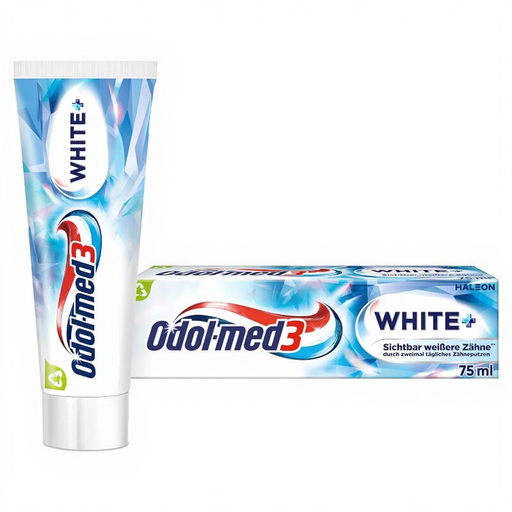
Why it's a good fit: Ideal for users seeking a reliable and affordable solution for daily care. It combines gentle whitening with the proven 3-in-1 protection of an established brand.
The product promises to restore the natural whiteness of teeth rather than suggesting an unrealistic whitening of several shades. The focus is on solid cleaning performance.
Offers clinically tested 3-in-1 protection against cavities, gum problems, and tartar formation in addition to its whitening effect.
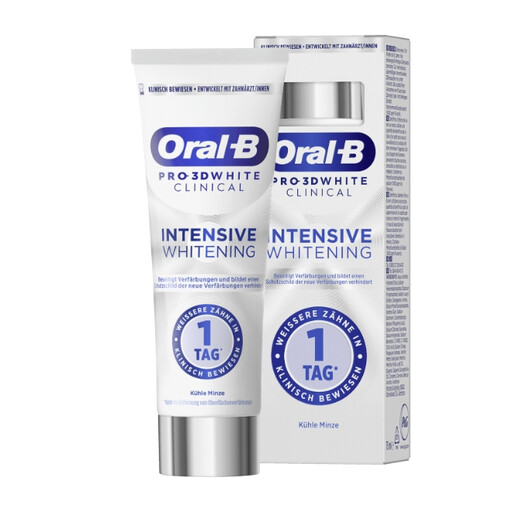
Why it's a good fit: For individuals who want effective whitening but are concerned about sensitivity. The formula is explicitly designed for sensitive teeth.
Directly addresses the concern of enamel abrasion. According to Oral-B, its ionic technology removes stains without scrubbing, making it gentler on the enamel.
Combines whitening with suitability for sensitive teeth. The formula also protects against the formation of new stains.
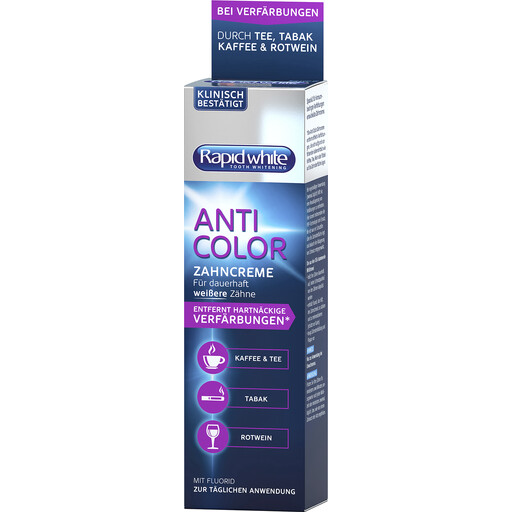
Why it's a good fit: Specially developed to remove stubborn stains caused by consumables like coffee, tea, wine, or tobacco. Ideal for users who want to specifically target this type of discolouration.
Instead of vague promises, the product offers a clear mechanism: its PVP technology forms a protective film on the tooth surface that counteracts the re-adhesion of stains—a practical, preventative approach.
Targeted action against consumption-related stains and active protection against new deposits. Contains fluoride to strengthen tooth enamel.
We have compiled a complete, up-to-date list of products that fully meet these strict selection criteria and UK/EU safety regulations.
The effect of a whitening toothpaste is gradual. It removes superficial stains over days and weeks with regular use (twice daily). An immediate, drastic whitening effect, like that achieved with professional bleaching, is not to be expected. The first visible results in removing stains can appear after about a week, depending on the product and your starting point.
Yes, with improper use or with products that have a very high degree of abrasion (high RDA value), there is a risk of wearing down the enamel. This can lead to increased sensitivity. It is advisable to look for formulas labelled as "gentle" or "for sensitive teeth" and to follow the manufacturer's instructions. A fluoride-containing toothpaste is also important to strengthen the enamel.
Whitening strips and toothpastes serve different purposes. A whitening toothpaste is designed for daily cleaning and the gradual removal of superficial stains. Whitening strips, like those from PERLWEISS, are a more intensive treatment for at-home teeth whitening. They often contain active ingredients like PAP or low-dose peroxide, which can also lighten deeper-set stains. They are not an alternative to daily dental care but a supplementary treatment for faster and more noticeable results.