Families who prioritise wholegrains
If you regularly buy wholegrain cereals or muesli, check the ingredients list and fibre per 100 g rather than relying on a dark colour or a multigrain label.


For a large household, choosing a wholegrain cereal makes sense when its ingredients, taste and pack size suit how much you actually get through. Sweeter cereals that state their wholegrain content may be an option if you prefer that taste, but a wholegrain claim alone doesn’t mean a product is low in sugar. So compare the ingredients, sugar and fibre per 100 g, and check the allergen information if needed.
If you regularly buy wholegrain cereals or muesli, check the ingredients list and fibre per 100 g rather than relying on a dark colour or a multigrain label.
Even with products that contain wholegrains, it’s worth checking the ‘of which sugars’ figure per 100 g. The consumer advice centre points out that sweetening ingredients can appear under various names in the ingredients list.
When buying larger quantities, consider more than just pack size: check the ingredients, any allergens, the best-before date and how much your household is likely to get through.
For a large household, start by deciding what matters most at breakfast: a clearly identifiable wholegrain base, less sugar, a manageable supply or a recipe that suits everyone eating it.
| Criteria | What to check when buying | Who it matters most to |
|---|---|---|
| Wholegrains and fibre | Wholegrain ingredients and, where stated, their proportion; fibre per 100 g. | If you’re looking for a clear wholegrain base for your family, you’ll want to be able to identify the ingredients rather than judge by the colour of the pack. Around 33% of consumers put this first. |
| Sugar | ‘Of which sugars’ per 100 g and sweetening ingredients in the ingredients list. | If you’re serving sweet cereals, you may want to compare their sugar content with other recipes before choosing. Around 27% of consumers prioritise this comparison. |
| Pack size | Pack contents, best-before date and storage instructions. | If you’re shopping for several people, you’ll need a quantity that can be used in time and stored properly. This is the top priority for around 20% of consumers. |
| Taste and suitability of ingredients | Choose between muesli, flakes or crunchy cereals; check the current allergen information if needed. | If several people will be eating it, the recipe you choose needs to suit their preferences. If anyone has an allergy, you’ll also need to check for allergens. Around 20% of consumers put this first. |
A stated wholegrain content doesn’t automatically make a recipe low in sugar: Nestlé lists CINI MINIS as containing 36.6% wholemeal wheat flour and 24 g of sugar per 100 g.
Read the wholegrain content alongside the nutritional information. If sugar is a key factor in your choice, compare the figures per 100 g.
Colour and a multigrain label don’t prove that a product contains wholegrains. Check whether the grains used are actually labelled as wholegrain.
Check the product name and ingredients list. If the wholegrain content is highlighted, its percentage can also help you compare products.
A larger pack doesn’t change the recipe or your family’s needs. If it stays open for too long or its contents don’t suit everyone, the extra quantity may go to waste.
Before stocking up, compare the pack contents, best-before date, storage instructions and ingredients with how much your household is likely to use.
Muesli and cereals can have different ingredients, even within the same brand. If someone in your household has an allergy, it’s essential to check the information for the specific product.
Read the ingredients and allergen information on the current pack, particularly for cereals containing gluten, milk and nuts, if these are relevant to your household.
The muesli range includes a variety of wholegrain recipes and pack sizes.
CINI MINIS are ready-to-eat cinnamon-flavoured cereals with stated wholemeal wheat flour content.
Kellogg's lists ready-to-eat wholegrain cereals in its range.
familia offers a range of muesli recipes, including organic and crunchy options.
This selection from Joybuy includes crunchy muesli and oats as breakfast staples. Choose according to the recipe and pack size you’re looking for; use the information on each product’s pack for nutritional comparisons.
 Image unavailable
A crunchy muesli for households looking for a 750 g pack. Compare the ingredients and sugar content on the pack when making your choice.
 Image unavailable
A 600 g option if you fancy a crunchy muesli. Check the current pack for sugar, wholegrain ingredients and, if needed, allergen information.
 Image unavailable
Fine oat flakes for families who like to make their own muesli. The pack contains 500 g; check the current ingredients and allergen information if needed.
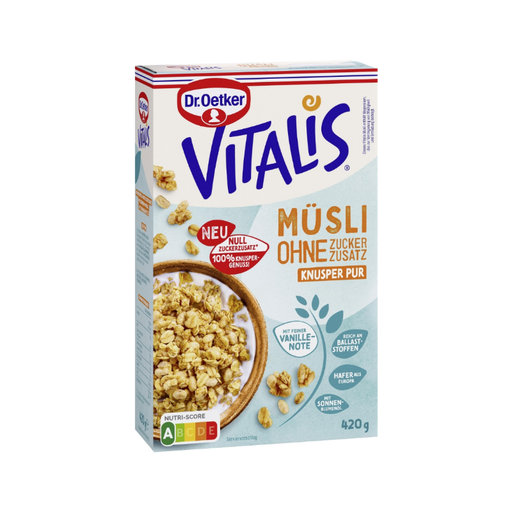 Image unavailable
A crunchy muesli in a 420 g pack. The product name doesn’t replace the ‘of which sugars’ figure per 100 g, so check the nutritional information on the pack.
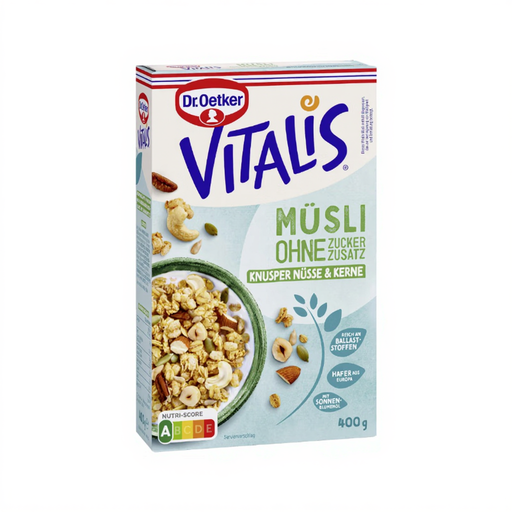 Image unavailable
A 400 g nutty option for households where these ingredients are suitable. Before choosing, check the current allergen information and the sugar and fibre content per 100 g.
Look for clearly named wholegrain ingredients in the product name or ingredients list. A dark colour or the word ‘multigrain’ doesn’t by itself prove that a product contains wholegrains; the German Nutrition Society makes this point too.
No, the two terms don’t mean the same thing. The consumer advice centre explains that ‘low in sugar’ means no more than 5 g of sugar per 100 g in solid foods. Products labelled ‘no added sugar’ may still contain sugar, as shown in the nutritional information. So always compare the ‘of which sugars’ figure.
Compare sugar and fibre per 100 g rather than looking only at the figures per serving. If you’re stocking up, also check the pack contents, best-before date and storage instructions to make sure the quantity suits how much your household uses.
If anyone in your household has an allergy, check the ingredients and allergen information on the current pack of the specific product. The German Food Association explains that relevant allergens must be identified in the ingredients list on packaged foods; another product from the same brand may have different ingredients.