Households looking for wholegrains
You want to know which wholegrain cereals are in a chocolate product when doing your weekly shop. The ingredients list, any stated wholegrain content and the fibre per 100 g will help you compare products.


Choose chocolate cereals for your weekly shop based on the type of grain you prefer. When comparing similar products, check the wholegrain ingredients, sugar and fibre per 100 g. Crunchy cereals and chocolate oat muesli differ in shape and ingredients. A wholegrain claim or ‘less sugar’ label is no substitute for checking the nutrition information, allergens and how much you’ll actually get through in a week.
You want to know which wholegrain cereals are in a chocolate product when doing your weekly shop. The ingredients list, any stated wholegrain content and the fibre per 100 g will help you compare products.
You want to compare different chocolate cereals by their sugar content per 100 g, rather than relying solely on serving sizes that vary or claims such as ‘less sugar’.
What matters is the labelling on the pack you actually put in your trolley. Ingredients, highlighted allergens and possible ‘may contain’ warnings can differ from information on older product packaging if the recipe has changed.
First, decide whether your household would prefer crunchy chocolate cereals or chocolate oat muesli. Then compare like with like using the information on the pack. Before buying, check that the pack size, storage instructions and ingredients suit everyone in your household.
| Criteria | What to check | Who it matters to |
|---|---|---|
| Wholegrains and fibre | Look for a named wholegrain cereal and, where stated, its proportion in the ingredients list. Compare fibre per 100 g. | If you’re buying wholegrains for several breakfasts, you’ll want to know exactly which cereals are in the product. Around 40% of consumers would put this first when doing their weekly shop. |
| Sugar | Compare sugar per 100 g in similar products. For ‘less sugar’ claims, check which products are being used as a comparison. | If you’re considering several chocolate products, you won’t want to choose based only on a claim on the front of the pack. For around 30% of consumers, comparing sugar would be the main priority. |
| Shape and weekly supply | Choose the type and pack size to suit how much you use. Check the storage instructions and how to reseal the pack after opening. | You’ll want a pack that suits your household’s breakfast habits and can be stored properly throughout the week. Around 20% of consumers would focus mainly on this. |
| Allergens and recipe | Check the ingredients list, highlighted allergens and any ‘may contain’ warnings on the current pack. | If someone in your household needs to avoid certain ingredients, the labelling on the pack you buy is essential. For around 10% of consumers, this would be their first check. |
Information from Nestlé Cereals Deutschland for NESQUIK Crunchy Breakfast and from Kellogg's Deutschland for Oaties Cocoa Crunch shows that both products contain a stated proportion of wholegrains, but also 22.1 g and 21 g of sugar per 100 g respectively.
For similar products, consider the wholegrain ingredients, sugar and fibre together rather than assuming that a single figure tells you everything about the nutritional profile.
Kölln’s ‘30% less sugar’ claim for one chocolate muesli variety is based on traditional chocolate mueslis, not every other pack on the shelf.
Check which products are being compared, then compare the sugar per 100 g in the products you’re choosing between.
Recipes can change, so an old ingredients list isn’t a reliable basis for choosing a new pack.
Check the highlighted allergens and any ‘may contain’ warnings on the pack every time you buy.
For your weekly shop, it’s not just the pack size that matters. Consider whether your household will use it all and can store it as instructed once opened.
Choose a size that suits your usual consumption and follow the storage and resealing instructions on the pack.
The information below applies to the specific products named, not to each brand’s entire range. When shopping, always check the details on the current pack.
For NESQUIK Crunchy Breakfast, Nestlé Cereals Deutschland lists 52.7% wholemeal wheat flour, 8.7 g of fibre and 22.1 g of sugar per 100 g.
For Oaties Cocoa Crunch, Kellogg's Deutschland lists 55% wholegrain oats, as well as wheat and maize as other cereal ingredients.
Kölln states that its Crunchy Oat Fleks Chocolate contains 65% wholegrain oats. The ingredients list for one chocolate oat muesli contains 66% wholegrain rolled oats.
These are chocolate oat-based mueslis for households looking to choose muesli instead of crunchy chocolate flakes for their weekly shop. Compare the varieties using the latest ingredients and nutritional information, as well as the pack size.
 No image available
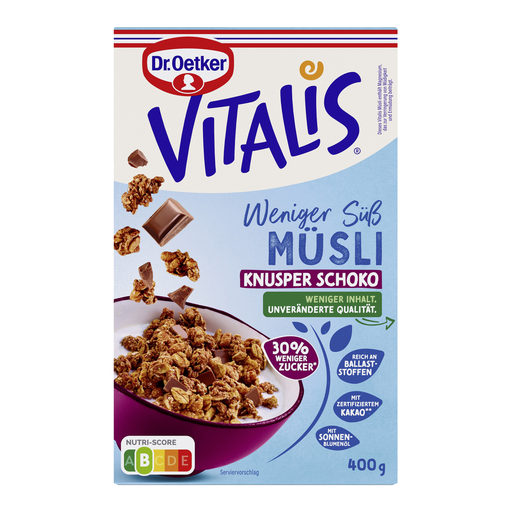
A crunchy chocolate muesli option for households looking for a crisp texture. The pack contains 400 g. To compare it with other mueslis, check the sugar and fibre per 100 g.
 No image available
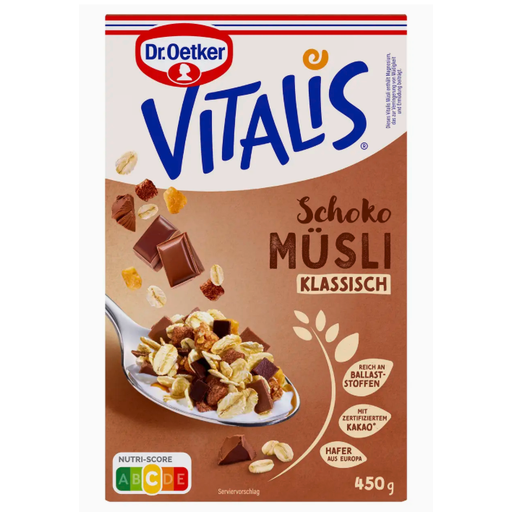
A chocolate muesli option for households looking for the Classic variety. The pack contains 450 g. Compare its ingredients and nutritional information per 100 g with those of the other varieties.
 No image available
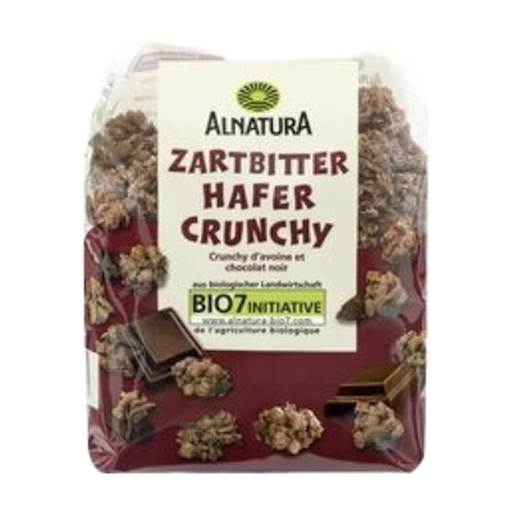
An option for households looking for crunchy oat muesli with dark chocolate. The pack contains 375 g. Check the nutritional information on the pack and, if needed, the allergen information.
 No image available
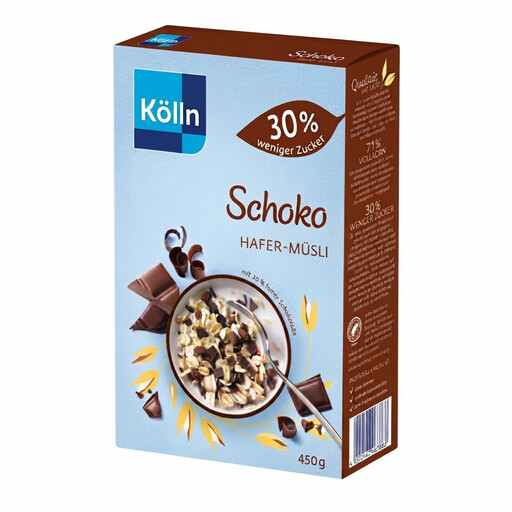
This 450 g variety is worth considering if you want to compare chocolate oat muesli by sugar content. Kölln bases its ‘30% less sugar’ claim on traditional chocolate mueslis. To compare individual packs, use the nutritional information per 100 g.
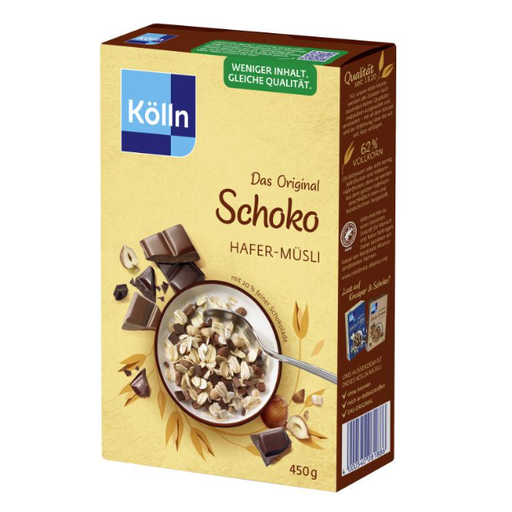 No image available
A 450 g option for households looking for traditional chocolate oat muesli. When comparing it with the other Kölln variety, check the ingredients and nutritional information on each pack rather than assuming the variety name tells you about specific nutritional values.
Look for a specifically named wholegrain cereal in the ingredients list, then compare any stated proportion and the fibre per 100 g. Ingredients are listed in order of weight. A wholegrain claim on the front of the pack alone doesn’t tell you everything about the nutritional profile.
No. The claim only applies in relation to the stated comparison group. For one Kölln variety, the manufacturer says this is traditional chocolate mueslis. For a specific purchase, also compare the sugar per 100 g in similar products.
If a Nutri-Score is shown, it can be a useful way to compare similar products, but it doesn’t replace the ingredients list or nutritional information. The consumer advice centre recommends comparing products within the same category or with the same intended use, such as similar mueslis rather than unrelated foods.
Check the highlighted allergens in the ingredients list and any ‘may contain’ warnings on every new pack you buy. Recipes can change, so if you have an allergy, an old online listing or the brand name alone isn’t enough.
Follow the storage instructions on the specific pack and reseal the bag as directed after opening. For Kölln Crunchy Oat Fleks Chocolate, EDEKA24 recommends storing the product in a dry place and resealing the bag. Choose a pack size that suits your household’s consumption.