Families looking for fibre
If you’re looking for an afternoon snack and want to compare wholegrain and fibre content, check the ingredients list and the figures per 100 g. The product name alone won’t tell you how two varieties compare.


Wholegrain crispbread can make a good base for an after-school snack, provided the ingredients, fibre content and taste suit your child. Check the wholegrain content and nutritional information on the specific pack rather than judging by its colour or seeds on the surface. You can round out the snack with fruit or vegetables and a topping your child enjoys. If your child has a gluten intolerance or allergies, checking the label comes first.
If you’re looking for an afternoon snack and want to compare wholegrain and fibre content, check the ingredients list and the figures per 100 g. The product name alone won’t tell you how two varieties compare.
If your child leaves a variety uneaten because of its taste or texture, nutritional information can only help so much. You can factor in a familiar topping, along with fruit or vegetables, when putting the snack together, as recommended by the Verbraucherzentrale Hessen for children’s snacks between meals.
The label on the specific pack is what matters: the ingredients, highlighted allergens and precautionary ‘may contain’ statements all need to meet your requirements. Rye or wheat crispbread isn’t gluten-free simply because it’s sold as a wholegrain product.
Start with the ingredients and labelling, then compare the nutritional information and consider which variety your child would actually enjoy with a suitable topping. Here’s how to weigh up the main considerations when choosing an afternoon snack:
| What matters | What to check | Who it matters to |
|---|---|---|
| Wholegrain and fibre | Check for wholegrain ingredients and a stated percentage, if provided. Compare fibre figures per 100 g. | If a clear wholegrain percentage matters more to me than how the slices look, I need specific information on the pack. This is a key consideration for around 36% of consumers when buying. |
| Taste and snack combinations | Check the type of grain and other ingredients, and plan a suitable topping along with fruit or vegetables. | A strong-tasting rye crispbread is no use to me if my child doesn’t like it. I’m looking for a variety that fits easily into their afternoon. Around 29% of consumers put this practicality first. |
| Allergens and gluten | Check the ingredients, highlighted allergens and precautionary ‘may contain’ statements on every pack. If a gluten-free diet is required, look for an explicit gluten-free label. | If there’s an allergy or a need to follow a gluten-free diet, I first need to establish whether the specific pack is suitable. Checking the labelling is the top priority for around 21% of consumers. |
| Everyday shopping and pack information | Compare pack sizes and information directly on the product, and bear in mind that recipes may vary between suppliers. | I want to be able to buy a variety whose ingredients and nutritional information I can check reliably during my usual shop. Around 14% of consumers put this consideration ahead of the others. |
Appearance doesn’t tell you how much wholegrain a crispbread contains. The grain ingredients and any stated wholegrain percentage give you a more reliable basis for comparison.
Look for wholegrain ingredients in the ingredients list and check whether the percentage is given for the specific variety.
Rye contains gluten. A wholegrain or organic label is no substitute for an explicit gluten-free label.
If a gluten-free diet is required, check the relevant label as well as the ingredients and precautionary ‘may contain’ statements on every specific pack.
ALDI SÜD notes that GOLDÄHREN Wholegrain Crispbread may come from different suppliers and have different nutritional values. EDEKA also points out that online information may differ from the product in store.
Check the ingredients and nutritional information on the pack you’re actually buying.
Crispbread provides the grain base for a snack. The Verbraucherzentrale Hessen’s advice on snacks between meals for children also includes fruit or vegetables. How much your child wants in the afternoon will depend, among other things, on how their day has gone so far.
Pair a suitable variety with a topping and fruit or vegetables rather than assuming every child needs the same-sized snack.
The features listed refer to the specific products, not to a brand’s entire range. When you buy, always check the ingredients and allergens on the specific pack.
Wasa Whole Grain Rye is clearly labelled as a wholegrain rye variety. Wasa states that the product is 100% wholegrain and contains 20 g of fibre per 100 g.
EDEKA sells an organic wholegrain rye crispbread containing 94% wholegrain rye flour, in a 250 g pack.
The ALDI SÜD listing for GOLDÄHREN Wholegrain Crispbread gives a pack size of 250 g and 15.3 g of fibre per 100 g.
Ryvita Dark Rye is an alternative rye crispbread. The UK manufacturer’s website states that it contains 92 g of wholegrain rye flour per 100 g of product.
According to REWE, Leicht & Cross Wholegrain Crispbread is made with a mixture of wholegrain rye and wheat flour.
This selection includes Wasa crispbread in several grain and flavour varieties that could work as a base for an after-school snack. Check the wholegrain content, ingredients and nutritional information for each variety separately, as they aren’t interchangeable.
 No image available
A wholegrain rye variety to consider if you want to compare wholegrain and fibre content before choosing a topping. Wasa states that Whole Grain Rye is 100% wholegrain and contains 20 g of fibre per 100 g; the REWE listing gives wholegrain rye flour, salt and yeast as ingredients. The product contains rye and, according to REWE, may contain traces of sesame.
 No image available
This variety may suit you if you’re looking for crispbread with sesame and flaxseed. The pack contains 210 g. Check the labelling for the wholegrain content, fibre per 100 g and any relevant allergens.
 No image available
A rye sourdough variety for households looking to include this flavour in a snack. The pack contains 235 g. Rye contains gluten, so also check the full ingredients list and nutritional information for this variety.
 No image available
This oat and sesame variety offers a different ingredient profile from plain rye crispbread. The pack contains 230 g. Compare the stated wholegrain content and nutritional information on the pack, and bear sesame in mind when checking for allergens.
 No image available
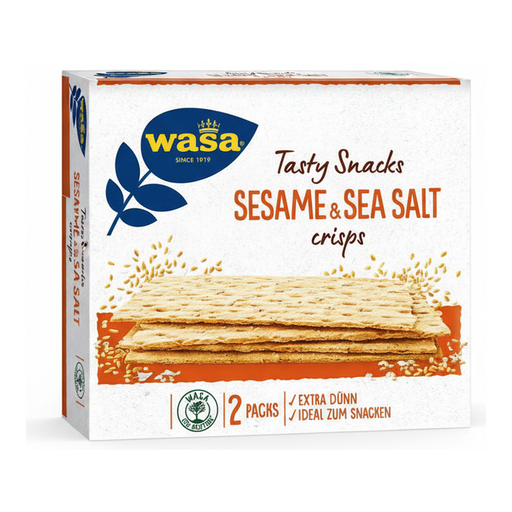
This round sesame and sea salt variety could be a good choice if the shape and seasoning matter for your snack. The pack contains 190 g. Check the actual wholegrain content, ingredients and allergens for this variety rather than assuming it’s the same as wholegrain rye crispbread.
No. A wholegrain product doesn’t have to be made entirely from wholegrains. Lebensmittelklarheit explains the guidelines on the expected composition of crackers and similar products, though these aren’t legally binding. To compare two varieties, check the grain ingredients and look for a stated wholegrain percentage.
Crispbread can provide the grain base for an afternoon snack. The Verbraucherzentrale Hessen includes fruit or vegetables in its advice on snacks between meals for children. You can add a topping your child likes, too. How much they need will depend, among other things, on how hungry they are and what they’ve eaten earlier.
Rye contains gluten, so ‘wholegrain rye’ doesn’t mean gluten-free. The Bayerisches Landesamt für Gesundheit und Lebensmittelsicherheit explains that food can only be labelled ‘gluten-free’ if it contains no more than 20 ppm of gluten. If a gluten-free diet is required, check for an explicit gluten-free label and read the information on the specific pack.
Follow the storage instructions on the pack and keep crispbread away from moisture. Wasa recommends storing its product in a dry place away from light. The REWE listing for Leicht & Cross also recommends eating it within a few days of opening.
If a product has different suppliers over time, its nutritional information may vary too. ALDI SÜD explicitly notes this possibility for GOLDÄHREN Wholegrain Crispbread. That’s why you should rely on the ingredients and nutritional information on the pack you buy.