Those focusing on fibre
If you want crispbread as an office snack, compare the fibre content per 100 g and check which wholegrain cereal is listed in the ingredients.


Plain wholegrain rye crispbread is an obvious choice for an office tin if you value a short ingredients list and comparable fibre figures. If you prefer seeds and a more robust flavour, check the ingredients, nutritional information and allergens for the specific variety. Whichever you choose, store crispbread in a dry place, away from fresh bread.
If you want crispbread as an office snack, compare the fibre content per 100 g and check which wholegrain cereal is listed in the ingredients.
You want to store an opened pack in portions. The key is to keep the tin clean and dry, and not to store the crispbread next to fresh bread.
You can tell plain rye crispbread apart from varieties with seeds, and look out for rye, wheat, sesame and any may-contain warnings on the pack.
First decide whether the cereal base and fibre content, or a particular seed mix, matters most to you. Whichever variety you choose, it must be stored in a dry office tin.
| What to consider | What to check when buying | Who it matters to |
|---|---|---|
| Fibre and wholegrain base | Compare fibre per 100 g and check the cereal base in the ingredients list. | If I want a clearly identifiable wholegrain base and easy-to-compare fibre information for my office tin, these details matter more than the variety’s name. Around 36% of consumers put this first. |
| Storing in a tin | Check the pack size and storage instructions; use a clean, dry tin and keep it away from fresh bread. | I transfer crispbread into a tin for several working days and want to keep moisture from affecting its crunch. Storage is the main consideration for around 29% of consumers. |
| Ingredients and allergens | Check the current pack for cereals, sesame and any may-contain warnings. | If I share the tin or need to avoid certain ingredients, the exact labelling is what determines my choice. This is the most important buying consideration for around 21% of consumers. |
| Seeds and flavour | Check the ingredients list for seeds, and the fat and salt content per 100 g. | I’m specifically looking for a seeded or more savoury variety, and want to compare its nutritional information with a plain option. Around 14% of consumers prioritise this profile. |
The declared figures vary by variety: REWE lists 19 g of fibre per 100 g for Leksands Bio Swedish Wholegrain Crispbread and 11 g for Dr. Karg's Classic 3-Saat.
Compare nutritional information using the same serving basis, and read the ingredients list on the specific pack.
Verbraucherzentrale recommends protecting crispbread from moisture and not storing it with other bread. This also matters when transferring it to an office tin.
Use a clean, completely dry tin with a lid, and only transfer a manageable amount.
Ingredients and nutritional values can differ considerably: REWE lists sesame and 22 g of fat per 100 g for Dr. Karg's Classic 3-Saat. Wasa Sesam & Vollkorn also contains sesame.
Choose a seeded variety for its specific ingredients, and check the allergen information on the relevant pack if needed.
EDEKA warns that online information may differ from the packaging. ALDI SÜD lists several possible suppliers for its GOLDÄHREN wholegrain crispbread.
For an accurate nutritional comparison and to check allergens, read the labelling on the pack you actually buy.
The details below apply to the specific variety named, not to a brand’s entire range.
REWE lists wholegrain rye flour as an ingredient in Leksands Bio Swedish Wholegrain Crispbread, with 19 g of fibre per 100 g.
The Bio Vollkorn-Knäckebrot Delikatess listed by REWE contains wholegrain rye flour and sea salt, with 16 g of fibre per 100 g.
ALDI SÜD lists 15.3 g of fibre per 100 g for GOLDÄHREN wholegrain crispbread in the 250-g pack.
EDEKA lists 95% wholegrain rye flour, along with water and salt, as ingredients in its wholegrain crispbread.
The Sesam & Vollkorn variety listed by REWE contains wholemeal wheat flour, wheat flour and sesame.
According to REWE, Classic 3-Saat is a wholegrain wheat crispbread with sunflower seeds, sesame and linseed.
Ryvita describes Original Crispbread in its UK range as a rye variety made with wholegrain rye flour, rye flour and salt.
This selection includes Wasa crispbread made with wholegrain rye, as well as varieties with seeds or added seasoning. For your office tin, the ingredients of the specific variety and dry storage remain key.
 No image available
An option if you’re looking for wholegrain rye for your office tin rather than a variety specifically labelled as seeded. Compare the fibre content per 100 g and, if you have allergies, check the current pack labelling.
 No image available
For anyone considering a variety with oats and sesame. Before sharing your office tin, check the ingredients and allergen information on the current pack.
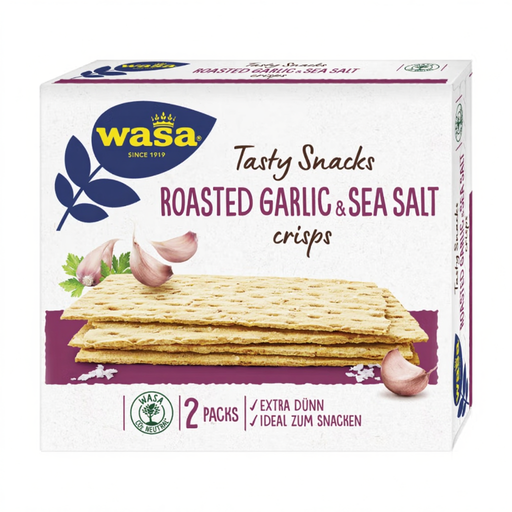 No image available
A savoury option for your office tin if you’re specifically after roasted garlic and sea salt. Compare the salt content per 100 g and the ingredients with plainer varieties.
 No image available
If you’re choosing a variety with sesame and linseed, check the fibre content per 100 g and the allergen information on the pack if fibre is a priority for you.
 No image available
A rye option if you prefer sourdough crispbread. To compare fibre content, check the nutritional information per 100 g, and use the current pack to confirm the ingredients and allergens.
Keep it in a clean, dry tin with a lid, and store it separately from fresh bread. Verbraucherzentrale recommends protecting crispbread from moisture, so only transfer an amount you’ll use up soon at work.
No. Compare the stated grams of fibre per 100 g on the specific packs. The word “wholegrain” alone doesn’t tell you whether two varieties have the same fibre content.
Check the types of cereal and, for seeded varieties, pay particular attention to sesame and any may-contain warnings on the specific pack. The varieties covered here have different ingredients; a short ingredients list is no substitute for checking allergens.