Households comparing fibre content
If you’re looking for wholegrain rye crispbread, you can compare the fibre and salt content per 100 g. The varieties listed by REWE show that wholegrain crispbreads can have different nutritional values.


Don’t choose wholegrain crispbread by its colour. Compare the fibre and salt per 100 g, and check the ingredients and allergens on the pack. If hard crispbread is difficult to chew, ease of chewing matters more than a high fibre value. A softer wholegrain alternative may be a better choice.
If you’re looking for wholegrain rye crispbread, you can compare the fibre and salt content per 100 g. The varieties listed by REWE show that wholegrain crispbreads can have different nutritional values.
If you need to avoid certain ingredients, check the labelling on the pack you buy. The rye and seed varieties listed have different ingredients and precautionary allergen statements.
The Federal Centre for Nutrition notes that chewing ability and the sensation of thirst can decline with age. For these households, it’s important to consider whether crispbread is comfortable to chew and to remember to drink enough throughout the day.
First, check whether the variety meets your requirements for wholegrain ingredients, ingredients and ease of chewing. Then compare the nutritional information on the specific packs.
| Criteria | What to check when buying | Who it matters most to |
|---|---|---|
| Wholegrain ingredients and fibre | Look for the wholegrain claim and compare fibre per 100 g. The German Nutrition Society advises against judging whether a product is wholegrain by its dark colour alone. | If fibre is a priority when I choose bread, I want to compare the values for each variety. This is likely to be the main reason for buying for around 40% of consumers. |
| Ingredients and allergens | Check the ingredients, highlighted allergens and precautionary allergen statements on the pack you buy; don’t assume rye and seed recipes are the same. | If I need to avoid certain ingredients, clear labelling that I can check matters more to me than how the variety looks. This is likely to be a priority for around 30% of consumers. |
| Ease of chewing and everyday use | If you find hard bread difficult to chew, consider what works for you and choose a softer wholegrain alternative if necessary. Also check the pack size and storage instructions. | If I find chewing difficult, a high nutritional value on the label alone doesn’t help me. For around 30% of consumers, practicality is likely to come first. |
The wholegrain crispbreads listed by REWE differ in their fibre content per 100 g. So the wholegrain claim alone isn’t a substitute for comparing the nutritional information.
Check the fibre and salt per 100 g on the specific pack instead of judging the nutritional values by the colour or visible seeds.
Depending on the recipe, ingredients such as sesame and precautionary allergen statements may be relevant, as well as cereals containing gluten.
If you have allergies, check the ingredients and allergen information on every pack, even if two product names look similar.
If you haven’t been eating much fibre, don’t base a change in your diet solely on the highest value on the pack. The Federal Centre for Nutrition recommends increasing your fibre intake gradually.
Start with an amount that works for you and remember to drink enough.
ALDI SÜD notes that GOLDÄHREN wholegrain crispbread may come from different suppliers, so nutritional information may vary. EDEKA also recommends checking the labelling on the pack in question.
When shopping, compare the ingredients and nutritional information on the pack actually on offer.
Wasa Whole Grain Rye 260 g, listed by REWE, is an example of wholegrain rye crispbread with a short ingredients list.
Naturata Organic Wholegrain Crispbread Delicatess is aimed at households looking for a wholegrain rye recipe with just a few ingredients.
REWE Bio Naturland Wholegrain Crunch Crispbread is a seed and multigrain variety, rather than the same recipe as plain rye crispbread.
The GOLDÄHREN wholegrain crispbread listed by ALDI SÜD is another variety to consider when comparing nutritional information.
The wholegrain crispbread described by EDEKA is an own-brand variety with a high rye content.
This selection includes wholegrain rye varieties, crispbread with oats or seeds, and a seasoned wheat variety. If you’re specifically looking for wholegrain crispbread, check the ingredients and fibre content on the pack for each variety.
 No image available
A good option for households looking to compare wholegrain rye and a stated fibre value. REWE lists 20 g of fibre and 1.2 g of salt per 100 g for this variety. If you have allergies, check the labelling on the pack you buy.
 No image available
An option for households considering crispbread with oats and sesame. As it contains cereals and sesame, it’s especially important to check the allergen information on the pack you buy.
 No image available
This variety may suit you if you’re looking for rye-based crispbread with flaxseed. If fibre is a priority, compare the value per 100 g on the pack and check the allergen information.
 No image available
A rye variety made with sourdough, for households who prefer this recipe. Before buying, check the fibre per 100 g and, if you have allergies, compare the ingredients and allergen information on the pack.
 No image available
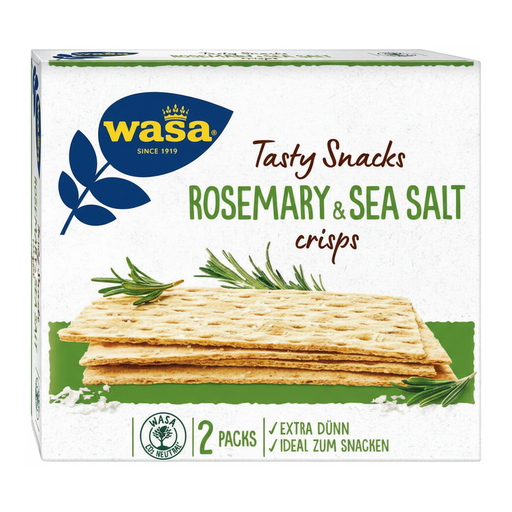
A seasoned wheat variety for households who aren’t looking exclusively for rye crispbread. If wholegrain is your key consideration, check the proportion of wholegrain ingredients, as well as the salt and fibre, on the pack.
Compare the values per 100 g on the packs, rather than relying on the wholegrain claim alone. For example, the Wasa Whole Grain Rye and Naturata Delicatess varieties listed by REWE contain 20 g and 16 g of fibre per 100 g respectively.
If you haven’t been eating much fibre, it’s best to make the change gradually. The Federal Centre for Nutrition recommends increasing your fibre intake slowly; remember to drink enough, too.
You need to be able to chew hard crispbread comfortably, even if its nutritional values meet your selection criteria. The Federal Centre for Nutrition notes that chewing ability may decline with age; if needed, consider a softer wholegrain alternative.
It depends on the specific recipe: rye and wheat varieties contain cereals with gluten, while sesame may be relevant in seed varieties, among other allergens. Always check the ingredients, highlighted allergens and precautionary allergen statements on the pack you buy.