Self-caterers with limited kitchen facilities
You want a no-cook breakfast, pairing muesli or granola with milk, yoghurt or a plant-based drink. What’s already available in your holiday let will influence your choice.


For breakfast in a holiday let, a simple wholegrain muesli makes a versatile base to pair with whatever fruit, yoghurt or plant-based drink is available. If you’d prefer a baked, crunchy mix, compare the ingredients of each granola or crunchy muesli: wholegrain content, sugar per 100 g and allergens vary from one variety to another.
You want a no-cook breakfast, pairing muesli or granola with milk, yoghurt or a plant-based drink. What’s already available in your holiday let will influence your choice.
You want to know what grains are in the mix and compare the sugar content of different varieties, rather than relying solely on wording on the front of the pack.
Check the ingredients and allergens on the specific pack, such as cereals containing gluten, nuts, sesame or milk. A vegan recipe doesn’t tell you whether it contains nuts or cereals containing gluten.
First, decide whether you want a base to customise or a ready-made crunchy mix. Then compare the nutrition information and ingredients for the specific variety. If you have dietary restrictions, check the allergens before you travel.
| What to look for | What to check when buying | Who it matters to |
|---|---|---|
| Wholegrain base | Look for wholegrain ingredients listed by name and, where available, the wholegrain percentage. The product name alone doesn’t give you enough detail about the grains. | If a clearly identifiable wholegrain base matters to me, I want to be able to compare the grains it contains. Around 27% of consumers would put this need first. |
| How you’ll use it | Choose between a base muesli to customise and baked granola or crunchy muesli as a ready-made topping. Check the pack size too. | With only a few ingredients in my holiday let, I want to be able to have breakfast without cooking. For around 27% of consumers, ease of use is the main consideration. |
| Sugar and sweetness | Compare the sugar content in g per 100 g and check the ingredients list for sweeteners such as sugar or syrup. | Even with a wholegrain mix, I want to decide for myself how sweet my breakfast is. Around 20% of consumers would make this a priority. |
| Allergens and dietary requirements | Check the ingredients, highlighted allergens and any ‘may contain’ warnings on the specific pack. | If certain ingredients aren’t suitable for me, the variety I choose needs to meet my requirements. For around 26% of consumers, suitability would come first. |
These terms describe different things. Kölln’s Knusper Klassik contains 65% wholegrain and 18 g of sugar per 100 g.
For the variety you’re considering, compare the sugar content per 100 g and the ingredients list. If you want to control the sweetness yourself, consider a simple base muesli too.
As well as grains, nut and seed mixes may contain other ingredients that matter to you. EDEKA lists sesame among the ingredients in its Kerne & Saaten granola and warns that it may contain traces of other allergens.
Check the ingredients and warnings on the specific pack before choosing a variety for your trip. Terms such as ‘organic’ or ‘vegan’ don’t replace this check.
Recipes can vary considerably within the same brand: Kölln states that its Vollkorn Basis Müsli contains 88% wholegrain, compared with 65% for Knusper Klassik.
Compare the specific variety’s ingredients, nutrition information and allergens, particularly if you’re switching from a base muesli to a baked crunchy mix.
Seitenbacher offers a range of wholegrain mueslis. When comparing them with granola, it’s the individual recipe that matters.
Alnatura offers crunchy muesli made with wholegrain flakes, among other products.
Kölln’s wholegrain base muesli and baked crunchy mueslis offer different breakfast options to compare.
Brüggen makes muesli and cereals, including traditional and crunchy mixes.
REWE’s muesli and granola range includes its own-label products and other brands.
EDEKA offers both granola with nuts and seeds, and base muesli made with a range of wholegrain cereals.
This selection includes crunchy wholegrain mueslis and a fruit muesli as an alternative to baked granola. When choosing, consider whether you want a ready-made crunchy mix or a fruit muesli to pair with other breakfast ingredients.
 No image available
An option if you’re looking for a crunchy mix for breakfast in your holiday let. Despite the ‘Less Sweet’ name, compare the sugar content per 100 g. If soya is relevant to you, check the allergen information on the specific pack.
 No image available
This crunchy mix is an option for breakfast with milk, yoghurt or fruit. Check the sugar content and ingredients list. If you need to avoid cereals containing gluten or traces of milk, nuts and sesame, the pack labelling is important.
 No image available
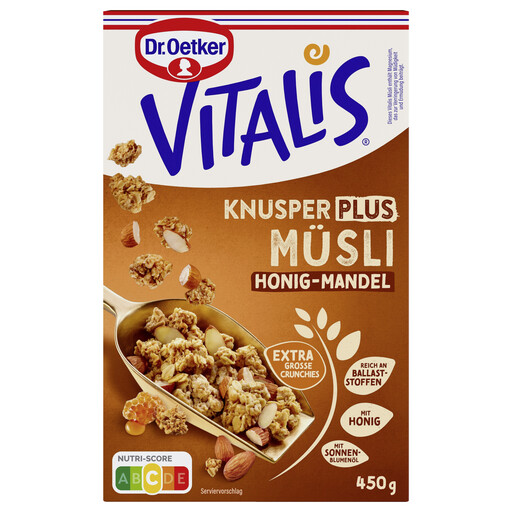
This variety is for you if you’re looking for a crunchy mix with honey and almonds. Before buying, compare the sugar content per 100 g and the allergen information, rather than assuming the wholegrain description applies to the entire recipe.
 No image available
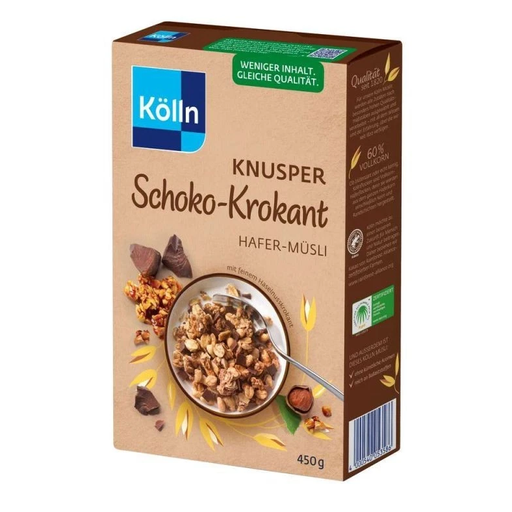
If you’re after a chocolatey crunchy mix, check the sugar content and allergens for this variety. Cereals containing gluten, hazelnuts and milk may be particularly important when choosing. If you’re specifically looking for the caramel variety, check the product title against the ingredients list on the pack.
 No image available
This fruit muesli is an alternative if you’d prefer a fruity option to a baked crunchy mix. Even with ‘No Added Sugar’, compare the total sugar content per 100 g and check the ingredients, allergens and serving suggestions on the pack.
No. Wholegrain content and sugar content are separate measures. Kölln states that its Knusper Klassik contains 65% wholegrain and 18 g of sugar per 100 g. So compare the sugar content and ingredients of the variety you want to buy.
Seal the pack well after opening and keep the granola somewhere dry. If the packaging can’t be resealed, you can use a clean, dry container. Also follow the storage instructions on the pack.
No. These terms don’t replace checking the specific ingredients and allergen information. Pay particular attention to the grains, nuts and sesame that matter to you, as well as any ‘may contain’ warnings on the pack.