If you’d like to choose your own ingredients for a weekday breakfast, a simple blend of wholegrain flakes and seeds is a good place to start. Fruit, Bircher or crunchy muesli may suit you better if you want a ready-made mix that needs less preparation in the morning, or if flavour is your priority. If so, compare the wholegrain ingredients, sugar per 100 g and allergen information for the specific variety.
Which blends are right for you?
For anyone comparing sugar and ingredients
If you’re looking for a straightforward blend for weekdays, check the order of the ingredients and the sugar per 100 g. The claim ‘no added sugar’ doesn’t replace this comparison: the consumer advice centre points out that a product can still contain sugar even when ‘sugar’ isn’t listed as an ingredient.
For anyone looking for a wholegrain base
If you’d like to start the morning with wholegrain flakes and add your own ingredients, compare the stated wholegrain content and fibre per 100 g. You can combine a simple base with other ingredients to suit your taste; remember to include their nutritional values in your breakfast too.
For anyone who likes to vary flavours and textures
Fruit, Bircher and crunchy muesli already contain different ingredients. If you switch between these blends, check the wholegrain ingredients, sugar and allergens for each variety individually rather than assuming they’re the same.
What should you look for when buying?
First decide whether you’d prefer a base you can customise or a ready-made blend. Then compare varieties using the same per-100 g figures and their ingredient lists.
Simple wholegrain base
A good choice if: you’d rather add your own fruit or other ingredients.
The trade-off: putting your own blend together takes extra ingredients and a little time.
Fruit muesli
A good choice if: you’d like fruit already included in the blend.
The trade-off: dried fruit contributes to the sugar content, even in varieties labelled ‘no added sugar’.
Bircher muesli
A good choice if: you prefer a ready-made combination of grains and fruit; some varieties also contain nuts.
The trade-off: check the ingredients in each variety to make sure they’re right for you.
Crunchy muesli
A good choice if: you want a ready-made blend with a crunchy texture.
The trade-off: wholegrain flakes may be processed with other ingredients, such as sugar or vegetable oil; the exact recipe is what matters.
| Criteria |
What to check |
Who it matters to |
| Wholegrain and fibre |
Compare named wholegrain flakes or the wholegrain content, as well as fibre per 100 g. |
I want to choose a wholegrain base in the morning and add other ingredients myself. This wholegrain preference is the main priority for around 37% of consumers. |
| Sugar and ingredients |
Check the sugar per 100 g and read the ingredients list; don’t assume ‘no added sugar’ means sugar-free. |
When choosing a fruity or crunchy variety, I want to know what it contains and how much sugar is listed overall. This is the main priority for around 36% of consumers. |
| Preparation |
Check whether fruit or nuts are already included or need to be added in the morning. |
I want to keep the amount of preparation before work to a minimum. That’s why around 18% of consumers would mainly look for a ready-made blend. |
| Allergens and dietary requirements |
Check the ingredients, highlighted allergens and any ‘may contain’ information for the specific variety. |
I need to make sure the blend meets my personal requirements for ingredients and allergens. This is the main selection criterion for around 9% of consumers. |
Common mistakes when choosing
-
Assuming ‘wholegrain’ means low in sugar
Fruit or crunchy muesli can contain wholegrain flakes as well as dried fruit or added sugar. The consumer advice centre points out that looking at individual ingredient names won’t tell you the product’s total sugar content.
Compare the sugar per 100 g and read the full ingredients list for the variety you’ve chosen.
-
Judging allergens by the front of the pack alone
Similar mueslis can contain different grains, nuts and other ingredients that may cause allergies. Information about possible traces can also vary between varieties.
Check the ingredients and allergen information for every variety. If you have a diagnosed allergy or coeliac disease, the labelling on the specific pack is what matters.
-
Assuming every variety is the same based on the brand
Kölln sells both a wholegrain base muesli and crunchy muesli. Brüggen also says it makes muesli for retailers’ own brands, so a manufacturer’s name doesn’t tell you that every recipe is the same.
Use brands to narrow down your options, then compare the ingredients, nutritional information and allergens on each pack.
Brands to help you choose
The following brands offer a range of mueslis and breakfast cereals. When deciding what to buy, check the information for the specific variety rather than relying on the brand name alone.
Kölln
Kölln sells simple oat mueslis, fruit mueslis and crunchy varieties.
- Kölln states that its Mühlenklassiker Vollkorn Basis Müsli contains 88% wholegrain and is ‘no added sugar’.
- Recipes vary: Kölln also lists sugar and vegetable oil as ingredients in one of its crunchy varieties.
Brüggen
Brüggen says it makes traditional, crunchy and organic muesli, as well as products for retailers’ own brands.
- The manufacturer’s information helps you understand that Brüggen produces different types of muesli.
- It doesn’t tell you the wholegrain content, nutritional values or allergens in an individual own-brand product.
Familia
Familia offers Bircher Müesli made with grains, fruit and nuts, among other products.
- For its Bio Birchermüesli Original, bio-familia states that 78% of the product is grain, 90% of which is wholegrain.
- This variety contains hazelnuts and almonds. Check the ingredients for the specific variety if nuts are relevant to your choice.
Seitenbacher
Seitenbacher sells muesli and highlights wholegrain as a feature of its range.
- The brand is worth considering when you’re looking for a shortlist of hearty mueslis.
- Only the product labelling can tell you whether a specific variety meets your requirements for wholegrain, sugar and allergens.
Alnatura
Alnatura sells organic mueslis with wholegrain flakes, as well as fruity and nutty varieties.
- Alnatura states that its Früchtemüsli contains 40% dried fruit; the brand describes its Maxi-Müsli as containing sultanas and roasted hazelnuts.
- Remember to take fruit into account when checking the sugar content; hazelnuts are part of the Maxi-Müsli recipe.
REWE Bio
REWE Bio Naturland 5 Korn Müsli is one example of a blend made with wholegrain flakes and seeds.
- REWE states that this product contains 13 g of fibre and 1 g of sugar per 100 g.
- The blend contains gluten-containing cereals; REWE also lists possible traces of other allergens.
Muesli and breakfast cereals at Joybuy
Here you’ll find fruit and crunchy mueslis, as well as rolled oats that you can use as a breakfast base and customise yourself. Rolled oats aren’t a ready-made muesli blend, so compare products according to how you’d like to prepare breakfast in the morning.
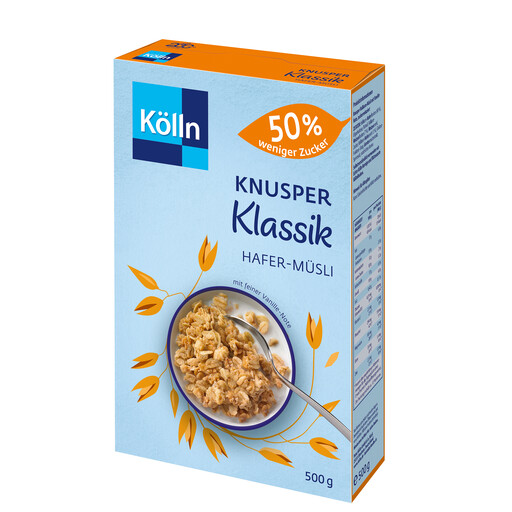 Image unavailable
Kölln crunchy muesli, ‘50% less sugar’ variety, 375 g
For anyone who wants a crunchy muesli blend in the morning rather than a base of flakes to customise themselves.
‘50% less sugar’ is the name of the variety, not a claim that the muesli is sugar-free. Check the pack size before buying.
View at Joybuy
 Image unavailable
Kölln fruit muesli with 50% fruit, No Added Sugar variety, 500 g
For anyone who wants fruit in their muesli already, rather than adding it themselves in the morning.
The No Added Sugar variety name doesn’t mean the muesli is sugar-free. Check the total sugar per 100 g and the allergen information on the pack when making your choice.
View at Joybuy
 Image unavailable
Jeden Tag Less Sweet crunchy muesli, 750 g
For anyone looking for a ready-made blend with a crunchy texture.
Less Sweet is part of the variety name. When comparing it with other mueslis, the sugar per 100 g and the ingredients list are more useful than the name alone.
View at Joybuy
 Image unavailable
Jeden Tag hearty rolled oats, 500 g
For anyone who wants to make their own breakfast blend with their choice of ingredients.
These are rolled oats, not ready-made muesli. Remember to add any fruit or other ingredients you’d like yourself.
View at Joybuy
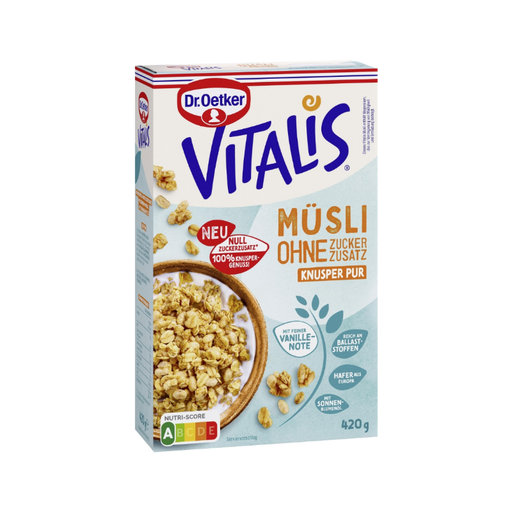 Image unavailable
Dr. Oetker Vitalis No Added Sugar crunchy muesli, 420 g
For anyone who prefers a crunchy muesli blend.
Even with a variety called No Added Sugar, check the total sugar per 100 g, ingredients and allergens on the specific pack.
View at Joybuy
Frequently asked questions
How can I identify wholegrain muesli for everyday breakfasts?
Look for named wholegrain flakes or a stated wholegrain content. Then compare the ingredients and nutritional information for the same variety, as the word ‘wholegrain’ alone doesn’t tell you how much sugar it contains or whether it includes other ingredients such as fruit or nuts.
Is fruit muesli labelled ‘no added sugar’ also sugar-free?
No. Dried fruit can contain naturally occurring sugar. As well as checking the claim on the pack, look at the sugar per 100 g and the ingredients list.
What portion size should I use to compare muesli?
Start by comparing products using the nutritional information per 100 g, then take into account how much you actually eat. The consumer advice centre uses 50 g of cereal flakes as a comparison with one slice of bread; this isn’t a personal portion recommendation.
What should I look for in muesli allergen information?
Check the listed ingredients and any ‘may contain’ information for the specific variety, especially if cereals or nuts are relevant to you. The German Government says that the most common allergy-causing ingredients and substances must be labelled on prepacked foods; Lebensmittelklarheit explains that allergen information must also be available when buying food online.
How should I store muesli after opening?
Follow the storage instructions on the pack and seal it securely after opening. For one Seitenbacher Vollkorn-Früchte-Müsli, the retailer Combi specifically recommends storing it in a cool place and keeping the pack tightly closed; instructions may differ for other varieties.


