Families looking for wholegrain ingredients
If wholegrain is a priority for your tea party, a named wholegrain ingredient and a stated percentage are more helpful when choosing than the colour of the pretzel.


For a children’s tea party with a focus on wholegrain, a pretzel with a clearly identified wholegrain ingredient is an obvious choice. But you can only make a meaningful comparison by looking at the ingredients list, salt per 100 g and allergen information together. No salt sprinkled on top doesn’t mean the overall salt content is low, and spelt is not a wheat-free alternative.
If wholegrain is a priority for your tea party, a named wholegrain ingredient and a stated percentage are more helpful when choosing than the colour of the pretzel.
If you want to assess salty snacks for children, compare the salt per 100 g – even for pretzels without visible salt sprinkled on top.
Here, the ingredients and allergen information are the main things to check. Spelt is a type of wheat, while sesame may be an ingredient or appear in a ‘may contain traces’ warning, depending on the pretzel.
First, check whether the pretzel suits your wholegrain preferences. Then compare the salt content and allergens. Finally, consider the shape and how you’d like to serve it at your tea party.
| Criteria | What to check | Who it matters most to |
|---|---|---|
| Wholegrain base | Check for a specific wholegrain ingredient and, if stated, its percentage. Compare fibre using the nutritional information per 100 g. | If wholegrain is the reason for my choice, I want to be able to check the percentage rather than rely on appearances. For around 36% of consumers, this information comes first. |
| Salt | Compare salt per 100 g; don’t assume that ‘no salt sprinkled on top’ means a low overall salt content. | When choosing salty snacks for children, I want to know the stated amount of salt, even if there are no salt crystals on top. Around 29% of consumers give this comparison the most weight. |
| Allergens | Check the types of grain and sesame in the ingredients list and allergen information; don’t assume spelt is wheat-free. | If a grain or sesame allergy is a concern, I need to check the specific labelling on the pretzel. For around 21% of consumers, checking the ingredients comes first. |
| How it’s served | Check the size of each pretzel and whether it needs preparing for your planned tea party. | If I want to serve the pretzels without any preparation, a suitable small shape matters more to me than a pretzel that needs warming. Around 14% of consumers prioritise convenience. |
Wholegrain ingredients and salt content are separate considerations. REWE states that its Freche Freunde pretzels with no salt sprinkled on top contain 2.1 g of salt per 100 g; Bio und Vollwert-Bäckerei Schubert states that its wholegrain spelt pretzel contains 1.4 g per 100 g. The products also differ in shape and ingredients.
Compare the salt per 100 g, then check which ingredients and shape suit your tea party.
Spelt is a type of wheat. So the term ‘wholegrain spelt’ doesn’t make a pretzel a suitable alternative for someone with a wheat allergy.
If an allergy is a concern, check the ingredients and allergen information for the specific product, and follow the individual medical advice you’ve been given.
For the pretzels considered here, sesame appears as an ingredient in some cases and as a possible trace warning in others. This distinction matters if sesame needs to be avoided.
Check the labelling again each time you buy, and if you have a sesame allergy, use your individual medical advice to determine which warnings are relevant.
The wholegrain pretzels in the 125-g pack are an option if you want the wholegrain percentage to be stated explicitly.
The organic chickpea pretzels are small pretzel snacks that can be served without preparation and have no salt sprinkled on top.
The wholegrain spelt pretzel is a larger option for a tea party where you don’t need small pretzel snacks.
The classic pretzel is only an option if wholegrain isn’t a must for your tea party.
This selection includes two packaged Alnatura pretzels for a tea party: one variety with a stated wholemeal wheat percentage and one spelt variety with sesame. Compare their labelling if wholegrain, salt or allergens are important to your choice.
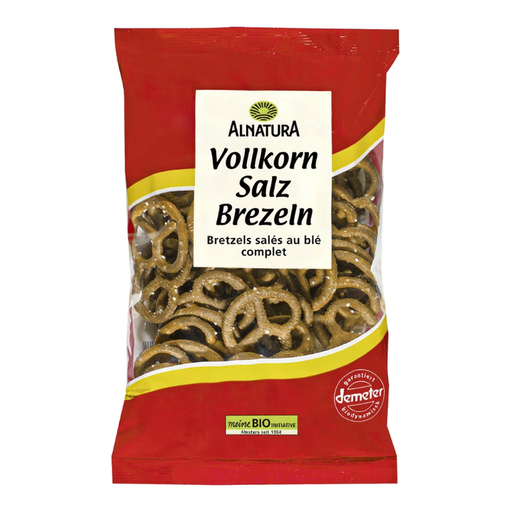 Image unavailable
For a tea party where a stated wholegrain percentage matters.
Alnatura states that this variety contains 81% wholemeal wheat flour. It contains wheat and barley malt extract; if you have a sesame allergy, pay particular attention to the labelling on the current pack. Compare the salt content per 100 g stated on the pack.
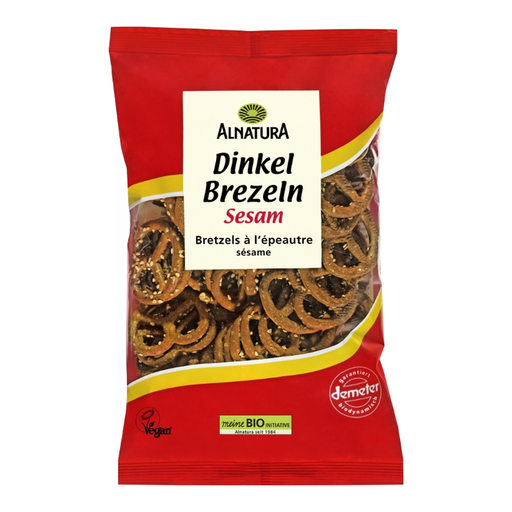 Image unavailable
For a tea party where spelt pretzels with sesame are an option.
The pack contains 125 g. Spelt is a type of wheat, not a wheat-free alternative. Before buying, check the full ingredients list, allergen information and nutritional details on the specific pack.
No. The wholegrain content doesn’t determine the salt content. Compare the figures per 100 g on the specific products: REWE states that its Freche Freunde pretzels with wholegrain spelt flour contain 2.1 g of salt, while Ditsch states that its classic pretzel contains 2.02 g.
Spelt is a type of wheat, so you shouldn’t choose it as an alternative for someone with a wheat allergy just because it has a different name. The labelling on the specific product and individual medical advice are what matter.
It means there’s no salt sprinkled on the surface; it doesn’t describe the overall salt content. REWE states that its Freche Freunde pretzels with no salt sprinkled on top contain 2.1 g of salt per 100 g.
Before buying, ask for the allergen information for the exact pretzel on offer. For packaged products, check the ingredients list and information on the current pack. This is particularly important if certain grains or sesame are a concern for you.