Families with fussy bread eaters
You want to find a loaf your family will eat, while also being sure you’re actually buying wholemeal bread. Colour alone won’t tell you the difference.


If a clearly stated wholemeal content is important when shopping for your family, look for the description ‘wholemeal bread’ and check the ingredients and nutritional information. A milder wheat-mix bread may be a better starting point for fussy eaters, but the description ‘mixed bread’ does not guarantee any wholemeal content. A wholemeal bread mix may be worth considering if the quantity, preparation time and ingredients suit your household.
You want to find a loaf your family will eat, while also being sure you’re actually buying wholemeal bread. Colour alone won’t tell you the difference.
For these households, the bread description, ingredients and nutritional information all matter. When buying larger quantities, it’s also worth considering how much bread your household can use in time and store.
You’re planning to make bread from a mix and comparing the pack size, ingredients, allergen information and preparation steps with your family’s routine.
First, decide whether a wholemeal description or choosing a milder loaf that your family will enjoy is the priority. Then you can work out how much to buy and, if relevant, how much time you can spend baking at home.
| What to consider | What to check | Who it matters to |
|---|---|---|
| Wholemeal content and nutrition | Look for the description ‘wholemeal bread’ and check the ingredients; for packaged bread, compare the nutritional information per 100 g. | If I specifically want wholemeal bread for my family, the description and ingredients should match that goal. Around 27% of consumers put this clarity first. |
| Taste and acceptance | Try a milder variety in a smaller quantity to begin with; don’t assume mixed bread is wholemeal bread. | If a family member dislikes stronger-tasting bread, I first want to find a loaf they’ll actually eat. Around 33% of consumers prioritise this. |
| Quantity and freshness | Compare the pack weight or stated yield with how much you use, and make room to store or freeze the bread. | When shopping for the family, I need enough bread without buying so much that it goes to waste. That’s why around 27% of consumers prioritise getting the quantity right. |
| Baking at home and ingredients | For bread mixes, check the preparation steps, equipment needed, ingredients and allergen information on the specific pack. | If I bake my own bread, the preparation needs to fit my routine and the recipe needs to suit my household. Around 13% of consumers prioritise the time involved and control over ingredients. |
Dark or grainy bread isn’t necessarily wholemeal. According to NDR, bread described as wholemeal must contain at least 90% wholemeal flour or meal.
Check the description and ingredients list rather than judging by appearance alone.
A milder wheat-mix bread may suit your family’s taste, but its description doesn’t mean it has the wholemeal content of wholemeal bread.
Choose mixed bread because it’s the variety you want. If wholemeal is your main priority, look for a description that confirms it.
Bread can go stale or spoil even in a large family if the pack size doesn’t match how much you use. The Verbraucherzentrale notes that different types of bread stay fresh for different lengths of time.
Buy according to how much you actually use, and freeze any bread you won’t need straight away in individual portions.
Bread mixes vary in their ingredients and may contain allergens that matter to individual family members.
Check the ingredients list, highlighted allergens and any ‘may contain’ warnings on the specific product.
The wholemeal bread mix with sea salt and baker’s yeast comes in an 885 g pack, enough for one or two loaves.
The documented wholemeal bread mix comes in a 500 g pack for baking one loaf at home.
EDEKA lists the documented wholemeal wheat bread as weighing 500 g.
Under ‘Unser Brot’, Lidl describes several types of bread from its bakery, including multigrain, spelt and sourdough varieties.
This selection includes two bread mixes for baking at home and one ready-made pumpernickel loaf. Compare each pack size with how much you use; the product description alone can’t tell you whether fussy family members will enjoy the taste and texture.
 Image unavailable
For households that want to bake their own spelt bread and plan to use a 1 kg pack. Check the pack for preparation instructions, yield and allergen information.
 Image unavailable
For households that would rather buy ready-made pumpernickel than use a bread mix. The pack contains 500 g; check the current product description, ingredients list and storage instructions.
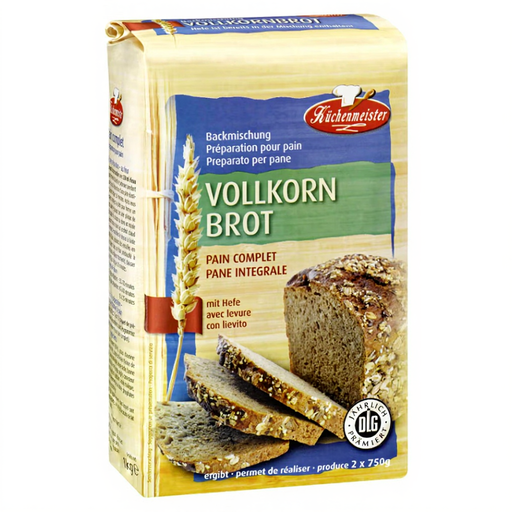 Image unavailable
For households that prefer a 500 g pack for baking at home. Before buying, check that the ingredient labelling and stated yield meet your needs.
No. Neither the colour nor visible grains prove that bread is wholemeal. According to NDR, bread described as wholemeal must contain at least 90% wholemeal flour or meal. When shopping, check the description and ingredients list.
Yes, if you’re looking for a milder type of bread to begin with and your family will actually eat it. But wheat-mix bread isn’t the same as wholemeal bread: according to NDR, the description means that 51 to 89% of the flour is wheat flour, not that the bread has a guaranteed wholemeal content.
Compare the product description, ingredients and nutritional information per 100 g, as well as the pack weight. If allergens matter to your family, read the labelling on the specific pack, including any ‘may contain’ warnings.
Buy an amount that matches how much you use, and freeze any surplus in individual portions if needed. The Verbraucherzentrale recommends keeping bread at room temperature in a dry, dark place, such as a bread bin or bread crock. Any bread with visible mould should be thrown away in its entirety.