Families with strict allergen requirements
If certain ingredients are off limits for your child, the information for the specific bread variety must match the arrangements agreed with the nursery.


For a nursery lunchbox, what matters isn’t whether a loaf is labelled ‘premium’, but whether its ingredients and allergens meet your child’s requirements and whether it’s easy to prepare and eat. Pre-sliced packaged bread makes it easier to compare the information on the pack; fresh bakery bread means checking the details for the specific variety, while a bread mix needs time to bake and cool. Standard wholemeal bread made with wheat, spelt or rye isn’t suitable for a gluten-free diet.
If certain ingredients are off limits for your child, the information for the specific bread variety must match the arrangements agreed with the nursery.
Pre-sliced wholemeal bread can go straight into a lunchbox without any baking beforehand. With packaged bread, you can compare the ingredients and nutritional information directly on the pack.
If you’re particularly interested in the ingredients, sourdough or freshly baked bread, also check whether your child likes the texture and graininess, and whether you have enough time to prepare it.
There are four options for a nursery lunch: pre-sliced packaged bread, rye wholemeal bread with a short ingredients list, fresh bakery bread and homemade bread made from a bread mix. Whichever you choose, you’ll still need to check the allergens.
A good fit if: You’re short on time in the morning and want to compare the information on the pack before buying.
Bear in mind: Wholemeal spelt bread also contains gluten. The product name is no substitute for checking the ingredients list.
A good fit if: You’re looking for a straightforward recipe and a more robust loaf.
Bear in mind: Rye contains gluten. An organic label doesn’t tell you whether your child will like the taste and texture.
A good fit if: You want to buy fresh bread and use it in the lunchbox soon afterwards.
Bear in mind: General information about a range is no substitute for checking the ingredients and allergen information for the specific variety.
A good fit if: You can bake the bread at home before the nursery day.
Bear in mind: A bread mix isn’t ready to eat. Allow time for baking and for the loaf to cool completely.
| What matters | What to check | Who it matters to |
|---|---|---|
| Allergen suitability | Check the latest ingredients and allergen information, including any may-contain warnings, against your child’s individual nursery arrangements. | If certain ingredients are off limits for my child, I need to check the specific variety before packing it. Around 36% of consumers put allergen suitability first. |
| Easy to eat from a lunchbox | Choose a slice shape, texture and graininess that suit your child and the filling you have planned. | Bread isn’t much help in my nursery routine if my child struggles with the slices or their texture. For around 29% of consumers, ease of use is the main consideration. |
| Ingredients and wholemeal content | Read the types of grain and the ingredients list; compare nutritional information using the same basis. | If the exact recipe matters to me, I want to know which grains are in the bread. About 21% of consumers give this consideration the most weight. |
| Freshness and preparation | Choose between bakery bread to be eaten soon, packaged bread that can be stored, and a mix that needs time to bake and cool. | For a freshly prepared lunchbox, the bread needs to fit into my routine. Preparation is the priority for around 14% of consumers. |
Spelt is a type of wheat and contains gluten. Calling it wholemeal or organic doesn’t change that.
If a gluten-free diet is required, check that the specific product is labelled accordingly and follow the arrangements agreed with the nursery.
REWE lists other ingredients in its wholemeal spelt bread, including sugar, syrup, oil and wheat gluten. The organic rye wholemeal bread described by EDEKA has a different, shorter ingredients list. The name alone doesn’t tell you everything about the recipe.
Read the ingredients for the specific variety and, if needed, compare the nutritional information per 100 g.
EDEKA notes that information on its product pages may differ from the actual packaging. If your child has specific allergen requirements, the current information for the product you’re given is what matters.
Before packing it, check the pack you have or, for unpackaged bread, ask the retailer for the latest allergen information.
Seitenbacher’s wholemeal bread mix needs to be prepared first, so it isn’t an instant alternative to shop-bought bread.
Allow time to bake the bread, let it cool completely and store it before the nursery day.
This packaged wholemeal spelt bread gives you a basis for comparing ingredients and nutritional information for a lunchbox.
This rye wholemeal bread is an option for families looking for a sourdough loaf with a clearly stated, short ingredients list.
The wholemeal spelt and wholemeal sandwich options described by EDEKA differ in shape and recipe.
This wholemeal bread mix is for households that want to bake their own bread before the nursery day.
Lidl describes its in-store bakery range as a way to buy fresh bread to eat soon afterwards.
These two bread mixes are worth considering if you want to bake bread at home ahead of time for a nursery lunchbox. They aren’t a substitute for ready-to-eat sliced or bakery bread when you don’t have time to prepare anything in the morning.
 No image available
An option for families who want to bake their own wholemeal spelt bread before the nursery day.
Pack size: 1 kg. As this is a bread mix, it needs to be prepared and allowed to cool completely before packing. If your child has specific allergen requirements, check the labelling on the pack.
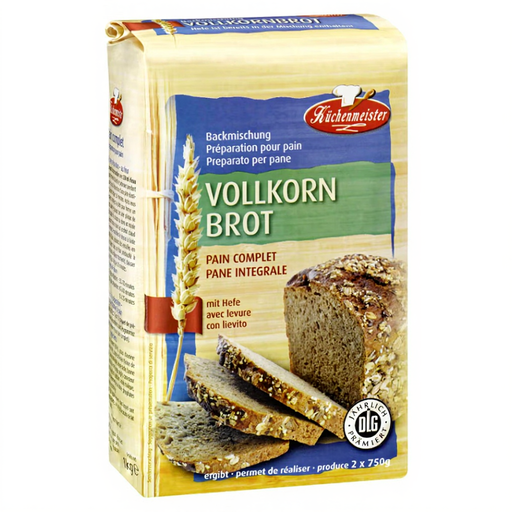 No image available
Another bread mix for families who can prepare their lunchbox bread in advance.
Pack size: 500 g. Before buying, check the ingredients list and, if your child has specific requirements, the allergen labelling. Allow time for baking and cooling before use.
No. The DGE Catering Check for vegetarian nursery meals applies to the menu as a whole: it recommends including a wholemeal product at least once a week. This doesn’t mean every individual packed lunch has to include wholemeal bread.
No. Spelt and rye are grains that contain gluten. If a child needs to follow a gluten-free diet, check the labelling on the specific product and follow the arrangements agreed with the nursery.
A may-contain warning alone isn’t enough to assess whether a product is suitable for a child with specific allergen requirements. Lebensmittelklarheit distinguishes between the labelling of allergenic ingredients that have been added and voluntary warnings about possible traces. So you should take account of the full information for the specific product and the arrangements agreed with the nursery.