Families focused on wholegrains
For these families, a clear wholegrain content matters more than an especially mild flavour. The German Nutrition Society describes wholegrain products as higher in fibre than their white-flour equivalents.


If your child enjoys bread with a stronger flavour, a product labelled as wholemeal bread is an obvious choice: according to Lebensmittelklarheit, at least 90% of the grain content in wholemeal bread is wholegrain. If your child turns down this type of bread, a milder bread with a declared wholegrain content could be a stepping stone – but that doesn’t automatically make it wholemeal bread. For a school-holiday lunch, you’ll also need to consider the ingredients, any potential allergens and whether the bread is ready to eat.
For these families, a clear wholegrain content matters more than an especially mild flavour. The German Nutrition Society describes wholegrain products as higher in fibre than their white-flour equivalents.
If stronger-flavoured bread is left uneaten, they look for a more familiar bread base with a clear wholegrain content. A dark colour or visible seeds don’t prove that a bread is wholemeal, as the NDR also explains in its guide to different types of bread.
The grains, allergens and any ‘may contain’ warnings need to suit the specific pack. Whether the bread is ready to eat or needs baking also affects how you plan a school-holiday lunch.
First decide whether your child will eat a product specifically labelled as wholemeal bread, or whether bread with some wholegrain content is more likely to go down well. Then check the ingredients and how much preparation the particular product needs.
| Criterion | What to check | Who it matters to |
|---|---|---|
| Wholegrain content | Look for the terms ‘wholemeal bread’ or ‘wholemeal rolls’, and check the grain ingredients. According to Lebensmittelklarheit, at least 90% of the grain content in bread and rolls labelled this way is wholegrain. | When bread is the basis of lunch, I want to be able to identify its wholegrain content. Around 36% of consumers are expected to put this first. |
| Whether your child will eat it | For bread with some wholegrain content, check the ingredients list rather than assuming it’s wholemeal because of its colour or visible seeds. | If my child won’t eat stronger-flavoured bread, a more familiar bread base with a clear wholegrain content matters more to me. Around 36% of consumers are likely to prioritise whether their child will eat it. |
| Ingredients and practicality | Read the allergen and ‘may contain’ information for the specific product. For bread mixes, also check the instructions and baking time. | If there are allergies or lunch is being planned at short notice, I need to check the ingredients and preparation in advance. Around 28% of consumers are likely to see this as their top purchasing priority. |
Visible seeds don’t guarantee that the dough is made with wholemeal flour, according to the NDR. So if you’re specifically looking for wholemeal bread, appearance alone isn’t enough.
Check the bread’s description and, for packaged products, the ingredients list.
Choosing a bread base doesn’t tell you what the rest of the school-holiday lunch will be. The German Nutrition Society also recommends serving a topping, fruit or vegetables and a drink with bread.
As you choose the bread, think about what you can serve with it easily.
Ingredients and ‘may contain’ information vary between products. For example, EDEKA24 lists possible traces of nuts, sesame and soya for its EDEKA Bio Rye Wholemeal Bread.
Read the information on the specific pack. If you’re buying loose bread, ask about allergen information before you buy.
A bread mix isn’t ready to serve for lunch. The wholemeal bread mix described by Seitenbacher is specifically intended for home baking.
Plan to use a bread mix on a day when you have enough time to prepare it. If lunch is coming up soon, check whether your chosen bread is ready to eat or still needs baking.
A product range where you can compare the details of a specific wholemeal product before buying.
The organic rye wholemeal bread described by EDEKA24 is an example of a ready-to-eat loaf with listed ingredients.
Lidl describes an in-store bakery range that includes a variety of different breads.
An option for families who want to bake their own bread for a planned day during the school holidays.
These breads and bread mixes offer different options for a planned school-holiday lunch. It comes down to whether you need ready-made bread or have time to bake; you can’t tell whether a bread has a mild flavour from its product description alone.
 No image available
A bread option for lunch when you don’t want to bake; before buying, check that the ingredients and flavour suit your child.
Pack size according to the product description: 250 g. The name ‘Protein Bread’ alone doesn’t provide enough information for a nutritional comparison.
 No image available
If spelt and green spelt bread could work for your meal, compare its grain ingredients and allergen information with your requirements.
Pack size according to the product description: 500 g. The types of grain listed alone don’t tell you the wholegrain content.
 No image available
This bread mix suits a day during the school holidays when you can set aside time to add water, prepare the dough and bake it.
Pack size according to the product description: 1 kg. Check the ingredients and baking instructions for the specific mix. The nutritional values of a dry mix aren’t directly comparable with those of a finished loaf.
 No image available
If bread containing walnuts could work for your child, this is another option. If you have allergies, check the full information on the pack.
Pack size according to the product description: 250 g. The product name mentions walnuts and wholegrain, but doesn’t specify the exact wholegrain content.
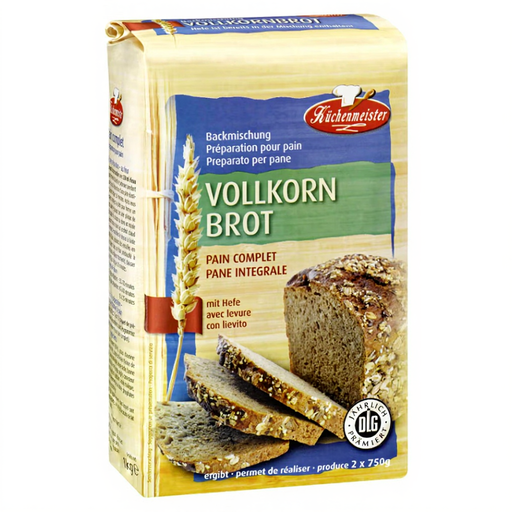 No image available
This bread mix is an option for a meal planned in advance, not for a lunch you need to serve straight away.
Pack size according to the product description: 500 g. Check the grain content of the mix before classifying the baked loaf as wholemeal bread.
No. Visible seeds don’t prove that the dough is made with wholemeal flour, according to the NDR. Lebensmittelklarheit states that at least 90% of the grain content in bread labelled as wholemeal is wholegrain, so check the product description and ingredients list.
Yes. If your child turns down stronger-flavoured wholemeal bread, a milder bread with a clear wholegrain content could be a practical stepping stone. Don’t treat it as the same thing as wholemeal bread, and check the ingredients rather than relying on appearance alone.
Check the ingredients, highlighted allergens and any ‘may contain’ warnings on the specific pack. If you’re buying loose bread, ask for allergen information. Ordinary bread made with wheat, rye or spelt isn’t gluten-free and isn’t suitable for someone with coeliac disease.
Only if you have enough time to prepare it. A bread mix needs to be made up and baked first, so if lunch is coming up soon, check whether your chosen bread is ready to eat.