If you want to make sure your bread has a meaningful wholegrain content for your Italian evening, look for the name ‘Vollkornbrot’ (wholemeal bread). The German Food Code’s guidelines for bread and small baked goods specify that at least 90 per cent of the grain used must be wholegrain. If your guests prefer a milder loaf, mixed bread could be a good option, but its name or colour doesn’t tell you how much wholegrain it contains. For packaged bread, check the product name, ingredients and allergens. For unwrapped bread, ask for the allergen information.
Which option matters to you?
For hosts looking for clearly labelled wholemeal bread
You don’t want to rely on a dark colour or visible grains to decide whether bread is wholemeal. Check the product name and ingredients: under the German Food Code’s guidelines for bread and small baked goods, at least 90 per cent of the grain used in wholemeal bread should be wholegrain.
For hosts who prefer milder bread
You’re looking for a less seedy loaf to serve with antipasti, cheese or spreads, for guests who don’t enjoy wholemeal bread. Compare the product name and ingredients rather than assuming you know what’s in it from the name alone.
For hosts who need to check allergens
If you’re serving several guests, check the allergen information for each type of bread before serving. For unwrapped bread, you can ask for the written information available.
What should you look for when buying bread?
First decide whether you want to serve clearly labelled wholemeal bread or a milder loaf. Then check the ingredients and allergens for the specific product, and plan when to buy or bake it to suit your evening.
| Priority |
What to check when buying |
Who it matters to |
| Clearly stated wholegrain content |
Look for the product name ‘Vollkornbrot’ and check the ingredients. The German Food Code’s guidelines for bread and small baked goods set the 90 per cent threshold in relation to the grain used. |
If I specifically want to serve wholemeal bread, a dark colour and visible grains aren’t enough to go on. Around 40% of consumers put clearly stated wholegrain content first. |
| Mild flavour |
Compare the product names and ingredients of different breads. Don’t assume that ‘Mischbrot’ (mixed bread) has a particular wholegrain content. |
For guests who don’t like seedy bread, I want to offer a milder loaf without passing it off as wholemeal bread. This flavour preference is the main consideration for around 30% of consumers. |
| Ingredients and allergens |
For packaged bread, read the ingredients list and check which allergens are highlighted. For unwrapped bread, ask for the allergen information available. |
If I’m choosing bread for guests with food allergies, I need to check the information for the specific product before serving it. This is a priority for around 20% of consumers. |
| Freshness and preparation |
Plan when and how much to buy. If you’re baking the bread yourself, allow for the instructions and preparation time. |
If the bread needs to be ready for the evening, I want to plan my shopping or baking in good time and store any leftovers appropriately. Around 10% of consumers put this kind of planning first. |
Common pitfalls
-
Assuming dark bread is wholemeal
Bread that looks grainy isn’t necessarily wholemeal. If you’re specifically looking for wholemeal bread, you can’t tell what it’s made from by appearance alone.
Look for the product name ‘Vollkornbrot’ and read the ingredients. Under the German Food Code’s guidelines for bread and small baked goods, this name means at least 90 per cent of the grain used must be wholegrain.
-
Assuming you know the allergens from the type of bread
Whether bread is called wholemeal or mixed bread doesn’t tell you what other allergenic ingredients it contains. If your guests have allergies, it’s important to check the specific product.
For packaged bread, check the allergens highlighted in the ingredients list. For bread from the counter, ask for the written allergen information available.
-
Buying bread early and storing it in the fridge
Bread can go stale more quickly in the fridge. How long it stays fresh also depends on the type of bread.
The consumer advice centre recommends storing bread at room temperature in a dry place away from light. You can freeze leftovers in portions. If you see mould, throw the whole loaf away.
Buying too much bread too early risks some of it going off before the meal or afterwards.
Brands and ranges to help you choose
REWE
REWE has an online category for bread mixes, with a range of different types of bread.
- Useful if you want to compare bread mixes for different types of loaf.
- For the mix you choose, the ingredients and allergens listed on the specific pack are what matter.
EDEKA
EDEKA publishes product information for bread and bread mixes, including spelt bread.
- Product information can help you narrow down your options before visiting a store.
- EDEKA notes that products may not be available in every store and that the information may differ from what’s on the pack. Check the ingredients and allergens on the product itself.
Lidl
Lidl lists spelt bread and ciabatta among the breads in its ‘Unser Brot’ bakery range.
- You can see whether another type of bread, rather than wholemeal, might suit your evening.
- The name ‘ciabatta’ doesn’t tell you how much wholegrain it contains. Check the product and allergens in store.
Seitenbacher
Seitenbacher sells a wholemeal bread mix. The manufacturer says that one pack contains ingredients for one or two loaves and includes baking instructions.
- An option if you want to plan ahead and bake for the evening.
- Check the ingredients and allergens on the pack, as well as those in anything else you add.
Bread mixes at Joybuy
These bread mixes are worth considering if you’d like to bake your own bread for an Italian evening. To choose between clearly labelled wholemeal bread and a milder mixed loaf, you’ll still need to check the information on the relevant pack.
 No image available
Küchenmeister Whole Grain Spelt Bread Baking Mix, 1 kg
A bread mix for hosts who’d like to make their own spelt bread. Before buying, check whether the finished loaf is labelled ‘Vollkornbrot’ on the German packaging.
Pack size: 1 kg. Follow the baking instructions when preparing it, and check the ingredients and allergen information on the pack if you have allergies to consider.
View at Joybuy
 No image available
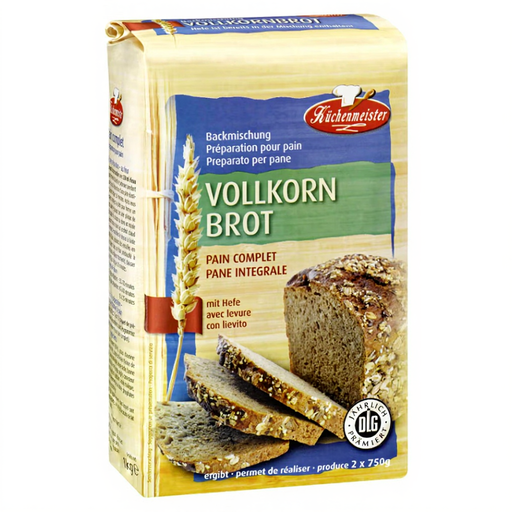
Küchenmeister Wholemeal Bread Baking Mix, 500 g
Another bread mix for anyone planning to bake at home. The English word ‘Wholemeal’ alone doesn’t confirm whether the finished loaf is labelled ‘Vollkornbrot’ on the German packaging.
Pack size: 500 g. Before buying, compare the grain ingredients and allergen information on the pack with your guests’ needs.
View at Joybuy
Frequently asked questions
How can I tell if bread is wholemeal?
First, look for the name ‘Vollkornbrot’, then check the ingredients. Under the German Food Code’s guidelines for bread and small baked goods, at least 90 per cent of the grain used should be wholegrain – not 90 per cent of the total weight of the loaf.
Is dark bread automatically wholemeal?
No. The colour and visible grains don’t prove that it’s wholemeal. The Federal Office of Consumer Protection and Food Safety explains that trade names and made-up names don’t replace the legally required name of the food.
How can I check allergens in bread for my guests?
For packaged bread, read the ingredients list and check the allergens highlighted there. Allergen information must be available for unwrapped bread. If you need it to choose a loaf, ask at the counter for the written information.
How should I plan when to buy bread for the evening?
Choose when to buy it based on the type of bread and how you plan to store it. The consumer advice centre says wheat-and-rye bread stays fresh for around two to four days and recommends keeping bread at room temperature in a dry place away from light. You can freeze leftovers in portions.
What should I look for when buying packaged bread online?
Check the product name, ingredients and allergen information on the specific listing before choosing bread for your guests. If the ingredients aren’t clear, don’t rely on a mild-sounding or English product name.


