Households keeping an eye on fibre
If wholemeal rye bread is a regular feature on your table, it’s worth checking the ingredients list and fibre content per 100 g. This lets you compare different breads on the same nutritional basis.


When shopping on a budget, a product explicitly labelled wholemeal rye bread is a good place to start. GUT&GÜNSTIG lists wholemeal rye meal as its first ingredient. If you’re mainly comparing fibre content or buying bread to stock up, also check the nutritional information per 100 g, pack size and best-before date. Always use the ingredients and allergen information on the current pack to guide your choice.
If wholemeal rye bread is a regular feature on your table, it’s worth checking the ingredients list and fibre content per 100 g. This lets you compare different breads on the same nutritional basis.
If you need to keep an eye on particular ingredients or allergens, check the information on the specific pack. Rye contains gluten, and some breads may also include other ingredients or carry warnings about possible traces.
When buying bread to stock up, practical things to consider include pack size, whether the slices are pre-cut, storage instructions and the best-before date. Check that the information matches the product you’re actually buying.
When choosing wholemeal rye bread on a budget, the product name is the first clue to the type of bread. Then check the ingredients, nutritional information and pack details to compare products according to what matters most to you.
| What to consider | What to check | Who it matters most to |
|---|---|---|
| Wholemeal ingredients and fibre | The product name “wholemeal rye bread”, the order of the ingredients and fibre per 100 g. | If I’m specifically looking for wholemeal rye bread, I don’t want to judge the type of bread by its dark colour alone. I also want to be able to compare nutritional information. For around 46% of consumers, this focus on wholemeal ingredients and fibre comes first. |
| Pack size when shopping on a budget | The pack weight and the size of the pack actually on offer. | When my household budget is tight, I want to know how much bread is in a pack before comparing packs of different sizes. Shopping on a budget is the main priority for around 36% of consumers. |
| Ingredients, allergens and storage | The current ingredients and allergen information, along with the best-before date and storage instructions. | If I need to check ingredients or store bread, the information on my pack will tell me whether it suits my needs. This check is the priority for around 18% of consumers. |
Colour alone doesn’t tell you whether a bread can be described as wholemeal rye bread. For packaged bread, the product name and ingredients list give you a clearer idea of what you’re buying.
Look for “wholemeal rye bread” and check where wholemeal rye flour or wholemeal rye meal appears in the ingredients list. According to the German Food Federation, ingredients are listed in descending order by weight.
Organic wholemeal rye bread still contains rye, so it isn’t gluten-free. Any other ingredients or warnings about possible traces that may matter to you depend on the specific product.
Before buying, read the highlighted allergens and any warnings about possible traces on the current pack.
The information on a product page may differ from the label on the pack in store. This is particularly important when checking ingredients, allergens and storage suitability.
Check the ingredients list, allergen information, storage instructions and best-before date on the product itself.
The examples below relate to specific wholemeal rye breads or product ranges. The features of a particular bread don’t automatically apply to other products from the same brand.
EDEKA’s own-label range includes a 500 g pack of wholemeal rye bread.
REWE sells wholemeal rye bread under its ja! own-label range in 500 g packs.
ALDI Nord describes “Wholegrain” as sliced wholemeal rye bread in a 500 g pack.
EDEKA describes the wholemeal rye bread in this range as a 500 g product made with natural sourdough.
Mestemacher makes Westphalian Wholemeal Bread, among other products. The manufacturer’s information for a 250 g version lists a short list of ingredients.
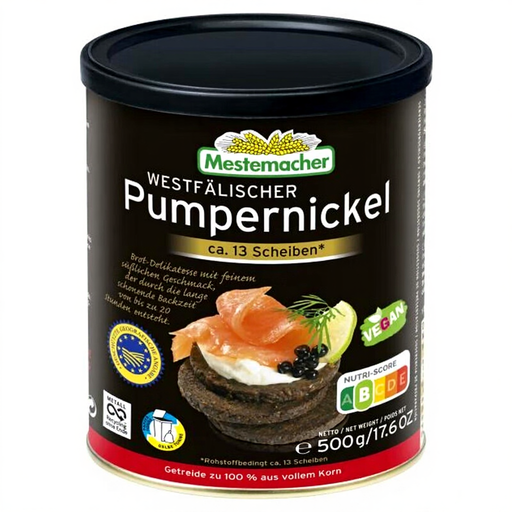
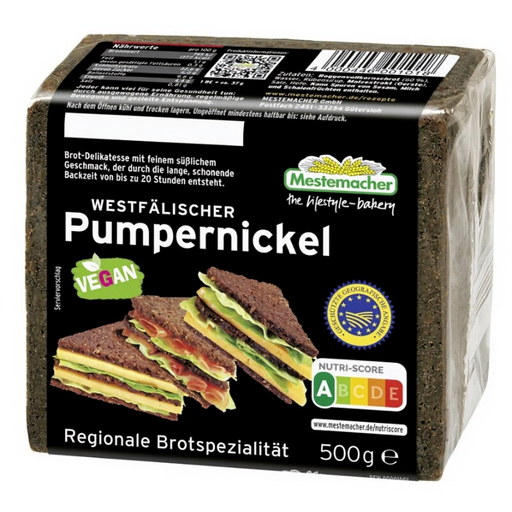
This selection features two 500 g packs of Mestemacher pumpernickel. If you’re looking for wholemeal rye bread on a budget, check the current legal name of the food, ingredients list and nutritional information for each product rather than assuming that features of other Mestemacher breads apply.
 No image available
This 500 g pack may suit households choosing pumpernickel to keep in stock. Before buying, check the ingredients, fibre per 100 g and allergen information on the pack. In particular, make sure the information about milk is clear.
 No image available
This 500 g pack is another pumpernickel option to keep in stock. If you’re specifically looking for wholemeal rye bread, check the product name and ingredients on the pack. A statement about the proportion of wholemeal rye in the finished loaf doesn’t, by itself, tell you how the flour used is made up.
First, look for the product name “wholemeal rye bread”, then read the ingredients list. REWE explains that at least 90% of the flour used must be wholemeal rye flour or wholemeal rye meal. According to EDEKA, wholemeal rye meal is the first ingredient in GUT&GÜNSTIG’s wholemeal rye bread.
No, rye contains gluten. Check the current pack for information on any other gluten-containing ingredients or allergens that apply to a particular bread.
Compare the stated weight to see how much bread each pack contains. If you’re stocking up, also check the product’s best-before date and storage instructions.
Compare the fibre information per 100 g, where it’s provided for the breads you’re looking at. Fibre per serving can also be useful if the serving size is clearly stated, but it doesn’t replace a comparison using the same measure.