Households looking for wholemeal bread and fibre
You’d like to offer a wholemeal option instead of white toast at Easter breakfast. The product description and fibre per 100 g matter more than the colour or visible grains.


A loaf described as wholemeal may be a good choice for Easter sandwiches and toast, provided the product details suit how you plan to use it. A dark colour or visible grains alone aren’t enough to make your decision. Compare fibre per 100 g, ingredients and allergens, and choose a pack size based on the number of guests and how you plan to use any leftovers.
You’d like to offer a wholemeal option instead of white toast at Easter breakfast. The product description and fibre per 100 g matter more than the colour or visible grains.
You need slices for sandwiches or toast. As well as checking that it’s described as wholemeal, see whether the particular bread is pre-sliced and suitable for how you plan to serve it.
If guests need to avoid certain ingredients, check the ingredients and allergen information on the specific pack. The term wholemeal doesn’t tell you whether a bread is suitable for someone with a gluten intolerance or an allergy.
For your Easter brunch, first check that the wholemeal option you want comes in the right sliced format. Then use the ingredients, allergens and pack size you need to help you choose a specific product.
| Criterion | What to check when buying | Who it matters most to |
|---|---|---|
| Wholemeal and fibre | Look for the term wholemeal and compare fibre per 100 g. | If wholemeal matters to me at Easter breakfast, I want to compare the fibre content of different breads on the same basis. Around 50% of consumers would make wholemeal and fibre their top purchasing priority. |
| Slice format and how you’ll use it | Check whether it’s pre-sliced and whether it’s suitable for sandwiches or toast, as well as whether the pack size will suit your gathering. | For filled Easter sandwiches, I need slices that are ready to use, rather than having to cut a loaf at the brunch table. Around 30% of consumers would prioritise whether a bread is suitable for sandwiches and toast. |
| Ingredients and allergens | Read the ingredients, highlighted allergens and any ‘may contain’ warnings on the pack you’re actually buying. | If guests need to avoid certain ingredients, I don’t want to rely on the word wholemeal alone. Around 20% of consumers would prioritise checking ingredients and allergens. |
Multigrain, seeds and a dark crumb don’t in themselves prove that a bread has a high wholemeal content. According to the guidance for wholemeal bread and rolls explained by Lebensmittelklarheit, at least 90% of the grain used should be wholemeal.
Look for wholemeal in the product description, then check the ingredients list and fibre per 100 g.
A wholemeal sandwich loaf may contain wheat and other declared allergens. The term wholemeal doesn’t mean that a bread is suitable for people with coeliac disease or an allergy.
If you have specific requirements, check each product against its current packaging, including any ‘may contain’ warnings.
A larger pack may suit a gathering with lots of guests, while a smaller household could have more bread left over after brunch.
Estimate how many slices you’ll need. Verbraucherzentrale recommends storing bread at room temperature; you can freeze leftover slices in portions. If you see mould, the entire loaf should be thrown away.
These examples cover different bread formats, as well as an alternative you can bake yourself. Always compare the details of the specific product when shopping.
REWE offers a Beste Wahl wheat wholemeal sandwich loaf in a 750 g pack and an organic wheat wholemeal sandwich loaf in a 375 g pack.
EDEKA describes its GUT&GÜNSTIG wholemeal sandwich loaf as suitable for sandwiches and toasting, and also lists a Herzstücke wholemeal sandwich loaf.
Lidl describes ‘Unser Brot’ as its in-store bakery range. However, a fresh loaf for the table won’t necessarily serve the same purpose as ready-sliced sandwich bread.
RUF is a baking alternative here: its published wholemeal bread recipe uses wholemeal spelt flour, sunflower seeds, chia seeds and pumpkin seeds.
These bread options could suit an Easter brunch with filled sandwiches. Check each specific product to see whether it meets your requirements for wholemeal labelling, pre-sliced bread and toasting.
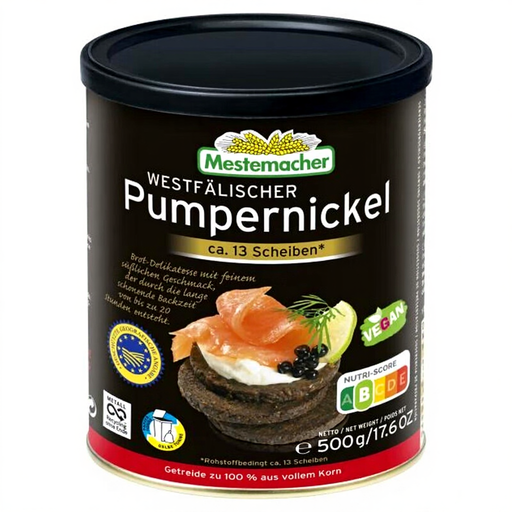 No image available
If pumpernickel suits the filled sandwiches you’re serving at Easter brunch, you can factor the 500 g pack into your quantity planning.
Check the wholemeal labelling and slice format, and make sure to read the latest allergen information on the pack.
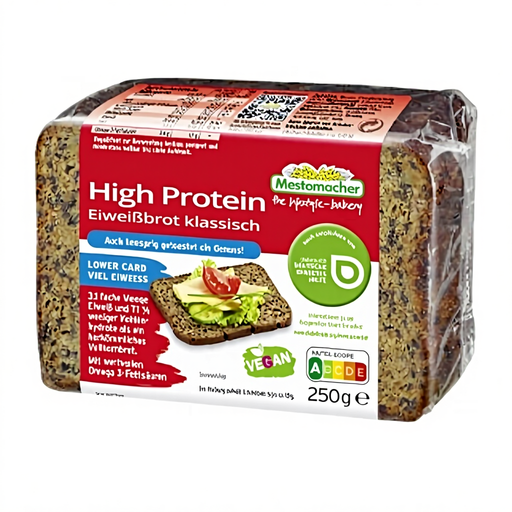 No image available
The 250 g pack could be a good fit if you’re planning a smaller brunch.
If you want to compare fibre or toast the bread, check the nutritional information per 100 g and the serving instructions. If you have specific dietary requirements, check the latest allergen information too.
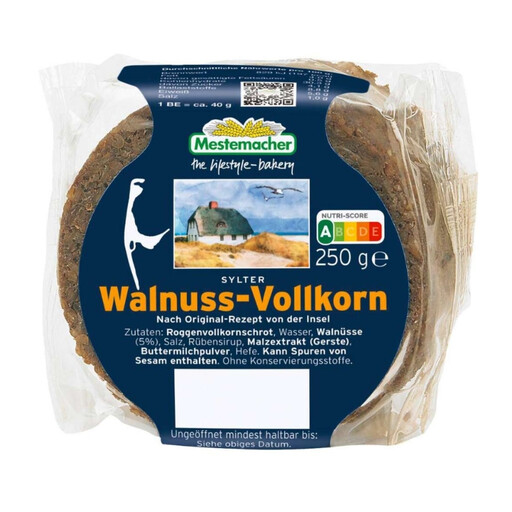 No image available
If walnut bread suits your Easter brunch, this product is available in a 250 g pack to help you plan quantities.
Before buying, check whether the bread is pre-sliced. If you have allergies, read all the information on the pack.
Look for wholemeal in the product description and check the ingredients list. Lebensmittelklarheit explains that the guidance for wholemeal bread and rolls is that at least 90% of the grain used should be wholemeal. A dark colour or the term multigrain alone doesn’t prove this.
No. Wholemeal isn’t the same as gluten-free. The EDEKA and REWE wholemeal sandwich products mentioned here contain wheat. If you have coeliac disease or a wheat allergy, check whether a specific product is suitable by looking at its current packaging.
Compare the fibre information for similar products per 100 g, rather than figures based on different amounts. REWE lists 6.4 g of fibre per 100 g for its organic wheat wholemeal sandwich loaf and 7.7 g for its Beste Wahl wheat wholemeal sandwich loaf. These figures alone don’t tell you whether either product is suitable for your overall diet.
Store bread at room temperature and, if needed, freeze leftover slices in portions. Verbraucherzentrale recommends storing bread at room temperature; if you see mould, the entire loaf should be thrown away.
Use online information to help you narrow down your choices, but check the labelling on the pack you actually buy. EDEKA notes that the information shown for its listed wholemeal sandwich loaf may differ from the packaging.