If wholemeal is your priority, start with bread that is clearly labelled as wholemeal. The German Nutrition Society describes wholemeal bread as higher in fibre than white bread. For busy school mornings, it also matters whether you can prepare, portion and top the bread in good time. Packaged bread, bread from the bakery counter and homemade bread all require different amounts of preparation. Check the ingredients, allergens and storage guidance for the specific product.
Which bread is right for you?
Families choosing wholemeal as a priority
If you want wholemeal bread as the basis for a packed lunch, look for an explicit wholemeal label rather than relying on a dark colour or visible grains. The German Nutrition Society describes wholemeal bread as a higher-fibre alternative to white bread.
Families short on time in the morning
For these families, bread that’s easy to portion and top before school is a practical choice. For packaged bread, the storage instructions after opening can help you plan how much you’ll need.
Households that check ingredients carefully
If you need to avoid particular grains or other ingredients, check the details for the specific product. Wholemeal and sourdough labels alone don’t tell you whether a bread is gluten-free.
What should you look for when choosing?
Packaged wholemeal bread
A good choice if: You want to plan a pack for the school week and check the ingredients and storage guidance before buying.
Worth considering: Whether the bread is pre-sliced and how long you plan to use the opened pack will depend on the product.
Wholemeal bread from the bakery counter
A good choice if: You’d like to buy a loaf, slice it as needed and portion it for the lunchbox.
Worth considering: Slicing and wrapping are part of the preparation. Check the ingredients and allergens for your chosen bread or ask the bakery staff.
Homemade wholemeal bread
A good choice if: You can make time to bake, cool and slice the bread before the school day.
Worth considering: A bread mix won’t save you that time, and you’ll still need to check the ingredients of the particular mix.
Whatever way you shop, checking the ingredients comes first if you need to avoid particular items. For everything else, these questions can help you choose:
| Criteria |
What to check when buying |
Who it matters most to |
| Wholemeal base |
Look for the explicit “wholemeal” label and read the ingredients list for the specific product. |
If wholemeal is the most important feature of the packed lunch, a dark colour and visible grains aren’t enough to go by. For around 40% of consumers, a wholemeal base is the top priority when choosing. |
| Preparation and storage |
Check whether the bread is sliced and what the storage instructions say once it’s opened. |
If you’re short on time in the morning and only need a few slices, you’ll want to make the sandwich quickly and store the rest appropriately. Around 30% of consumers put this everyday practicality first. |
| Flavour and texture |
Consider the grain, cracked grains and seeds in your chosen bread. |
For your child to enjoy their packed lunch, the flavour and bite need to suit the person eating it. This is the main criterion for around 20% of consumers. |
| Ingredients and allergens |
Read the ingredients and allergen information on the packaging, or ask about unpackaged bread. |
If you need to avoid particular ingredients, their labelling will determine whether the bread is suitable. Around 10% of consumers say checking ingredients is their main reason for choosing a product; if you have a specific ingredient to avoid, checking is essential regardless. |
Which common mistakes can you avoid?
-
Assuming dark bread is wholemeal
A dark colour and visible grains don’t prove that bread is sold as wholemeal. If you’re specifically looking for wholemeal, the product description is a more reliable guide.
Look for “wholemeal”, then read the ingredients list and nutrition information for the specific product.
-
Assuming sourdough means you don’t need to check allergens
Sourdough doesn’t change the fact that bread may contain gluten-containing grains. Depending on the product, other ingredients and ‘may contain’ information may also be relevant.
Check the packaging or ask about the allergens in your chosen bread if it’s sold unpackaged.
-
Packing a chilled filling without a suitable way to keep it cool
If your filling is perishable, plan how it will be kept on the way to lunchtime at school. The German Federal Institute for Risk Assessment warns that inadequate cooling during transport and storage can allow harmful germs to multiply.
Follow the storage instructions for the filling and use a suitable cool bag or other cooling solution for chilled ingredients. Prepare the sandwich hygienically.
-
Choosing a pack without considering how much you’ll use
If you only need a few slices for each school day, you’ll also need to store the rest appropriately once the pack is open. Pema Rye Sourdough Bread, listed by REWE, includes specific storage guidance.
Compare the pack size with the amount you need and follow the storage instructions for the product you choose.
Brands and ranges to help you choose
EDEKA Bio
Portioned bread varieties may be useful if your household likes to have different types of bread.
- EDEKA lists five varieties in its “Brotkorb” range, including wholemeal rye bread and pumpernickel, as well as three-stage natural sourdough.
- EDEKA notes that the product may not be available in every store and that packaging details may vary. Always check the pack you’re buying.
Lidl Unser Brot
The bakery-counter range is an option if you’d like to buy a loaf and portion it as needed.
- Lidl Germany describes several speciality breads in its range as made with natural rye sourdough, and lists wholemeal and multigrain breads.
- The range description doesn’t confirm the ingredients or wholemeal status of every individual bread. Check both for the loaf you choose.
REWE Sortiment
Product details for packaged bread can help you check the ingredients and storage guidance before you shop.
- REWE lists Pema Rye Sourdough Bread as wholemeal rye bread with natural sourdough, and provides its ingredients, nutrition information and storage guidance for the opened pack.
- Pema is the brand of the bread mentioned, not a REWE own-brand product. Always check the details on the specific pack you’re buying.
Seitenbacher
This bread mix is aimed at households that can make time to bake a wholemeal loaf.
- Seitenbacher lists wholemeal rye flour, wholemeal wheat flour and spelt in its wholemeal bread mix.
- The mix is labelled as containing wheat. Seitenbacher’s general information about sourdough doesn’t confirm that this particular bread mix contains sourdough.
Suitable bread at Joybuy
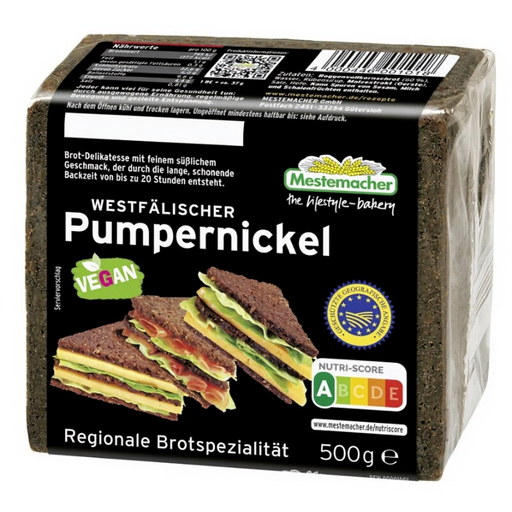
If you’re planning a lunchbox with pumpernickel as the base, this packaged bread could be an option if you enjoy the flavour and can portion it as needed. Check the product label before buying to confirm whether this particular variety is sourdough bread.
 No image available
Mestemacher Traditional Westphalian Pumpernickel, 500 g
A pumpernickel option for a school lunchbox if you enjoy this variety and can prepare the amount you need.
Pack size: 500 g. Before buying, check the label on the specific pack for sourdough, ingredients and allergen information.
View at Joybuy
Frequently asked questions
How can I tell if bread is wholemeal and suitable for a lunchbox?
Look for the explicit “wholemeal” label rather than relying on the colour or visible grains. The German Nutrition Society recommends checking for this label when choosing bread. You should also read the ingredients list for the specific variety.
Does sourdough automatically make bread suitable for a school lunch?
No. Sourdough alone doesn’t tell you whether a bread is wholemeal or whether its ingredients and portion size are right for a lunchbox. Check these features separately, and remember to allow time to slice a whole loaf.
What should I bear in mind when choosing a perishable filling?
Perishable fillings need to be stored appropriately until they’re eaten. The German Federal Institute for Risk Assessment warns of the risks of inadequate cooling during transport, so follow the storage guidance for the ingredients you use and plan a suitable cooling solution if they need to be kept chilled.
Is wholemeal sourdough bread automatically gluten-free?
No. Bread made with rye, wheat or spelt contains gluten-containing grains, and the sourdough label doesn’t change that. Check the ingredients and allergen information for the specific variety to decide whether it’s suitable for a gluten-free diet.


