Who should consider this?

Students dealing with Wi-Fi dead spots

If you download materials at set spots across several floors, first check whether you have a signal there. Telekom and TP-Link both highlight the planning and positioning of additional Wi-Fi nodes as important factors for coverage.

Households with an existing router

If your broadband connection is working, adding a suitable Wi-Fi node could be an alternative to replacing your main router. Telekom’s setup guidance for Speed Home WLAN distinguishes between mesh-compatible and non-mesh-compatible routers.

Students downloading large files

For larger downloads, the connection between your router and an additional Wi-Fi node matters just as much as signal strength. TP-Link describes Ethernet backhaul as a possible wired connection, while ASUS notes that Wi-Fi 6 features require compatible devices.

What should you look for when buying?

Keep your router and extend your network with Ethernet

A good choice if: You have a network cable running to the floor with poor coverage, and your router supports the mesh or access point mode you want to use.

What to consider: The cable needs to reach the right location, and mesh features can vary between router and node combinations.

Extend your router wirelessly with mesh

A good choice if: There’s still a usable Wi-Fi signal between your router and the planned node, and you don’t have an Ethernet cable available.

What to consider: The node needs a usable connection to the router itself. It can’t reliably extend the connection if you place it directly in a dead spot.

Replace your main router

A good choice if: Your existing router isn’t suitable for your broadband connection or the features you need.

What to consider: Make sure the router suits your connection type and can be extended as needed. A newer Wi-Fi standard won’t guarantee coverage through every ceiling.

Consider powerline with Wi-Fi

A good choice if: Running Ethernet isn’t an option and the Wi-Fi connection between floors isn’t strong enough.

What to consider: Sockets and electrical interference can affect the connection. Powerline isn’t guaranteed to perform as well as an Ethernet cable.

Priority What to look for when buying Who will care most?
Signal at study spots Note your study spots and floors, check the existing signal there, and plan nodes around areas with poor coverage. If I download files at set study spots across several floors, reliable coverage there matters more to me than an advertised Wi-Fi speed. Around 36% of consumers put coverage across floors first.
Using your existing router Check that your connection type and router model are compatible with the mesh or access point mode you plan to use. If you want to keep using your working main router, first check that the additional node is compatible with your existing network. Around 29% of consumers prioritise keeping their router.
Connection for downloads Check for existing Ethernet cabling and the connection between your router and node. If you’re using powerline, test the intended sockets. For larger downloads, I also want to consider the connection between my router and the node on another floor. Around 21% of consumers prioritise connection quality for downloads.
Setup and maintenance Check how to set up your chosen mode, whether updates are supported and which Wi-Fi encryption standards are available. If I want to keep setup straightforward and maintain a secure network, I look for clear configuration options and updates. Around 14% of consumers prioritise ease of maintenance.

Common buying and planning mistakes

  • Assuming a new main router will automatically cover every floor

    The right way to extend your network also depends on the number of floors, the size of your home and your existing router. Telekom lists these as factors to consider when planning Speed Home WLAN; it doesn’t specify a universal number of additional nodes.

    First, check the signal at the study spots you actually use, then plan your network extension around areas with poor coverage.

  • Placing a Wi-Fi node directly in a dead spot

    An additional node needs a usable connection to the router itself. Telekom recommends moving Speed Home WLAN closer to the router or other Wi-Fi boosters if the connection is weak.

    Check the node’s connection at the spot where you plan to put it. If there’s no usable Wi-Fi signal there, consider using existing Ethernet cabling.

  • Assuming powerline’s rated speed guarantees your download speed

    Devolo notes that some sockets may provide low data transfer rates and that electrical devices can interfere with transmission.

    Test the connection at the sockets you plan to use before relying on powerline across several floors.

Key brands at a glance

FRITZ!

FRITZ!Box routers and matching FRITZ!Repeaters are an option if you want to consider your router and access across floors together.

  • AVM documents DSL and mesh support for the FRITZ!Box 7690, as well as a repeater’s LAN bridge mode.
  • According to the instructions, managing devices together in a mesh requires compatible FRITZ!OS versions. The documentation doesn’t show that the FRITZ!Box alone can cover several floors.

TP-Link

Deco X50 mesh systems are an option if you want to distribute multiple Wi-Fi nodes throughout your home.

  • TP-Link lists three Gigabit ports per Deco X50 unit and optional Ethernet backhaul.
  • The advertised coverage area is the manufacturer’s figure, not a measurement for your home. Check that the system supports the mode you want before buying.

ASUS

The ZenWiFi XD5 is a multi-unit Wi-Fi 6 mesh system with AiMesh support for compatible ASUS devices.

  • ASUS documents its AiMesh support.
  • According to ASUS, Wi-Fi 6 features require compatible devices. Advertised speed and coverage figures don’t guarantee downloads through several ceilings.

Telekom

Speed Home WLAN is one possible way to extend your network if you already have a suitable router.

  • Telekom describes different setup methods for routers with and without mesh support.
  • The router settings described in the instructions apply to the WPS setup method covered there, not to all mesh products.

devolo

Magic 2 WiFi 6 next is a powerline Wi-Fi option if you can’t run Ethernet and there’s no usable Wi-Fi connection between floors.

  • devolo offers a multiroom version with several adapters for use across multiple floors.
  • The manufacturer notes that some sockets may have low data transfer rates and that electrical interference can affect performance.

Mesh systems for multiple study spots

These mesh kits with two or three units are options for study spots in several rooms or across different floors. Whether a kit can replace your existing main router depends on your connection type and the mode you plan to use.

TP-Link Deco M4 mesh Wi-Fi system, AC1200, 3-pack

TP-Link Deco M4, AC1200, 3-pack

Three mesh units could be a good option if you want coverage for study spots in several rooms or on different floors. Check the signal at your planned locations.

The product name lists dual-band Wi-Fi and Gigabit ports.

View at Joybuy

MERCUSYS Halo H3000X, Wi-Fi 6, 2-pack

MERCUSYS Halo H3000X, Wi-Fi 6, 2-pack

This two-unit kit is an option if you want to connect two areas with a mesh network. Check that the node will still have a usable connection to the router at your planned location.

The product name lists Wi-Fi 6, AX3000, dual-band, WPA3 and three Gigabit ports per unit.

View at Joybuy

MERCUSYS Halo H1200G AC1200 mesh Wi-Fi system, 3-pack

MERCUSYS Halo H1200G AC1200, 3-pack

Three mesh units could suit study spots in several rooms or across different floors. Actual coverage depends on the conditions at each location.

The product name lists AC1200 and seamless roaming.

View at Joybuy
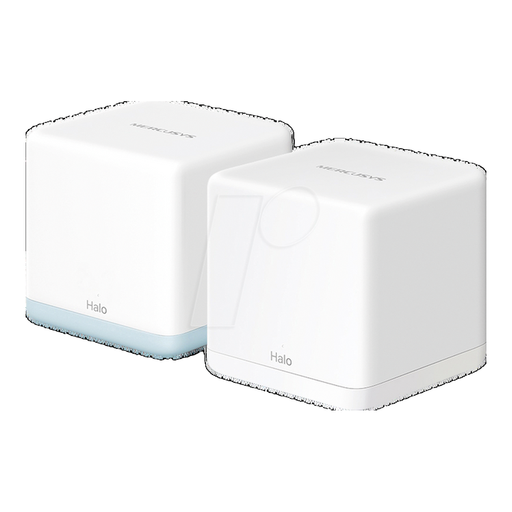
MERCUSYS Halo H1200G AC1200 mesh Wi-Fi system, 2-pack

MERCUSYS Halo H1200G AC1200, 2-pack

Two units could be a good option if you want an additional mesh node to reach another room. Check the signal at your planned location.

The product name lists AC1200, dual-band, seamless roaming and Gigabit ports.

View at Joybuy

MERCUSYS Halo H25BE Wi-Fi 7, 2-pack

MERCUSYS Halo H25BE, Wi-Fi 7, 2-pack

Two units could be a good option for study spots in different parts of your home. According to the product description, the second unit should be within range of the first.

The product name lists Wi-Fi 7, BE3600, dual-band, WPA3 and three Gigabit ports per unit.

View at Joybuy

Frequently asked questions

How do I work out how many additional Wi-Fi nodes I need?

Base your plan on the study spots that actually have poor coverage, rather than using a blanket number per floor. Telekom lists floor area, number of floors and router model as factors to consider for Speed Home WLAN; this doesn’t provide a universal number of units for other systems.

What should I do regularly after setting up my network?

Keep your router’s firmware up to date and change any insecure default passwords. Germany’s Federal Office for Information Security also recommends using a long Wi-Fi password; this doesn’t mean that any particular model is already set up securely.

What should I look out for with powerline Wi-Fi?

Test the connection at the sockets you plan to use before relying on powerline across several floors. Devolo notes that some sockets may have low data transfer rates and that electrical devices can affect transmission.

Can I use my own router with a fibre broadband connection in Germany?

On 22 January 2025, Germany’s Federal Network Agency confirmed that customers can choose their own end devices at the network termination point, including on passive optical fibre networks. Still, check that the device and interface are suitable for your specific connection.

Can I rely on General Allocation 12/2025 for a 6 GHz device?

No. Germany’s Federal Network Agency revoked Ruling 12/2025 and replaced it with Ruling 76/2025 for the 5945–6425 MHz frequency range. Check the conditions of the current allocation for your specific device. The Wi-Fi 7 label alone doesn’t mean it has a 6 GHz band or that a particular mode of operation is permitted.