A study spot with a Wi-Fi dead zone
You usually watch lectures in one fixed spot and want to check first whether you can extend your existing network to reach it.


First, check your internet connection and Wi-Fi reception right where you study. If the signal is weak only in that spot, a suitable addition to your existing router may be enough. For several floors, you could add access points connected by Ethernet or a sufficiently strong Wi-Fi signal. A mesh system does not automatically replace your modem, which must be compatible with your internet connection.
You usually watch lectures in one fixed spot and want to check first whether you can extend your existing network to reach it.
You need a connection in different places across several floors. The location of the access points and how they connect to one another are key.
Existing network cables could connect additional Wi-Fi access points and avoid a difficult wireless connection between floors.
| Buying priority | What to check | Who is it important to? |
|---|---|---|
| Reception at your study spot | Check your internet connection and Wi-Fi separately at the spot where you actually watch lectures. Then decide where to place any additional access points and how many you need. | If lectures mainly buffer in one fixed spot, I want to improve reception there rather than rush into overhauling the whole network. Around 36% of consumers put reception at their study spot first. |
| Connection between floors | Check whether Ethernet is available between floors and whether the specific system supports Ethernet backhaul. If there’s no cable, test the planned location for the access point. | If I need coverage across several floors, I want to know whether cables can connect the access points or whether I’ll need a strong Wi-Fi connection between them. Around 29% of consumers prioritise the connection between floors. |
| Connecting to your existing network | Check the connection type, router model, operating mode and mesh compatibility of the specific devices. | If I want to keep using my existing router or connect a replacement, the new solution must work with my current network setup. Around 21% of consumers prioritise compatibility with their router and internet connection. |
| Overall cost and effort | Plan the devices and cable runs you’ll need. Check the update and support information for the specific product. | If only one study spot is affected, I don’t want to plan for more devices and installation work than necessary. Around 14% of consumers place the greatest importance on running and ongoing costs. |
Advertised data rates and coverage areas don’t tell you whether the signal will pass through your existing ceilings to reach your study spot.
First, check reception at your study spot and look at possible locations for access points. Then decide how many devices you actually need.
With a wireless connection, the repeater also needs a usable connection to the rest of the network.
Find a suitable midway location. If Ethernet is available between floors, check whether a wired connection is an option.
Router and access point modes describe how a device connects to your network; they don’t automatically mean it can act as a modem for your internet connection.
Before switching, check your connection type, existing modem and the operating mode of the specific device.
The FRITZ!Repeater 1200 AX is designed to extend a FRITZ!Box network. The FRITZ!Mesh Set 1600 is available as a set with two or three devices.
The Deco X50 is a mesh option for households considering several access points and wanting to explore router or access point mode.
The ZenWiFi XD5 is a mesh option available in documented one-, two- or three-unit configurations, with several operating modes.
Orbi systems are another option if you’re considering mesh units connected wirelessly or via Ethernet.
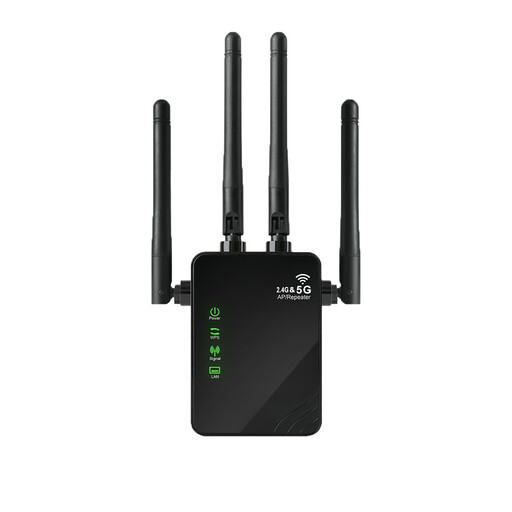
The Joybuy products below include Wi-Fi extenders for individual dead zones and mesh systems for covering several areas of your home.
 No image available
For extending an existing Wi-Fi network to a specific study spot.
Dual-band Wi-Fi; repeater, access point and router modes. For wireless extension, the device must be within range of your existing router.
 No image available
For covering several areas with Wi-Fi, if three mesh units suit your setup.
Dual-band Wi-Fi, Gigabit ports, and router and access point modes.
 No image available
For covering several areas with Wi-Fi; the product description also mentions video streaming as a use.
Wi-Fi 6, dual-band and three Gigabit ports per unit.
 No image available
For extending an existing Wi-Fi network. The description also lists an access point mode for a wired connection at your study spot.
Dual-band Wi-Fi 6; stated rates: 574 Mbit/s at 2,4 GHz and 2402 Mbit/s at 5 GHz. Includes a Gigabit port. For wireless extension, place within range of your router.
 No image available
For extending an existing Wi-Fi network when you want to connect the router and extender in an EasyMesh network.
Wi-Fi 7, dual-band, MLO, 2,5-Gigabit Ethernet port and EasyMesh compatibility. For wireless extension, place within range of your router.
It depends on the platform, picture quality and whether you’re just watching or sending video yourself. For webinar viewers with a speaker’s video, Zoom recommends roughly 1,2–1,8 Mbit/s download for 720p, or 2–3 Mbit/s for 1080p. These figures don’t apply to every lecture platform. If the video keeps freezing, check your internet connection separately from your Wi-Fi.
Compare the connection near your router with the one at your study spot. The German Federal Network Agency provides a desktop app for measuring the data transfer rate of a fixed internet connection. A single result won’t tell you how well Wi-Fi reaches across the floors.
No. In Germany, you can generally connect a router you’ve bought yourself, as long as it’s suitable for your connection. The German Federal Network Agency notes that your provider must supply the necessary login details. Whether a particular device will work without an additional modem is a separate technical question.
Check the connection between the units in their final positions and test your lecture at your study spot. For a wired Orbi setup, NETGEAR recommends updating the firmware on all Orbi devices before setting up Ethernet backhaul. This is the manufacturer’s recommendation for this product family.