A wireless repeater can transfer project files without the need for new cabling, provided it still has a stable connection to the router from its chosen location. If there’s already a network cable in your workspace, a dedicated access point or LAN bridge mode is a more targeted alternative. Powerline is worth considering when neither Wi-Fi nor cabling is suitable, but you’ll need to test it using the sockets you intend to use. For file transfers, it’s the entire connection between your devices that matters, not just the advertised Wi-Fi speed.
Who are these solutions for?
Teams working with large project files
If you regularly transfer files between fixed workstations, the connection to the room at the other end is crucial. Whether a LAN connection is available and how well the route to the router performs matter more than the maximum Wi-Fi speed printed on the box.
Home offices without a network cable
If you need Wi-Fi beyond thick internal walls, start by testing a wireless repeater in a suitable midway location. If the wireless connection is still weak, you can try Powerline using the sockets you actually plan to use.
Households with several workspaces
If you want to connect devices in several rooms to your existing Wi-Fi, consider router compatibility, the placement of access points and how each one is connected as part of the same setup.
What should you look for when buying?
Wireless repeater
A good fit if: you can find a location between the router and your workspace with a usable wireless connection, and you don’t want to run a cable.
What to consider: The connection to the router remains part of the route and needs to be checked from the repeater’s location.
LAN bridge or access point
A good fit if: a network cable already reaches the room, or you can run one there.
What to consider: You’ll need a suitable cable route and a model with the right operating mode.
Powerline with Wi-Fi
A good fit if: there’s no suitable location for a wireless repeater and no network cable.
What to consider: Your choice of socket and electrical interference can affect performance, so test the kit where you plan to use it.
| What you need |
What to check before buying |
Who is this important for? |
| Wireless connection through walls |
Check possible midway locations and the connection to the router, then test a typical file transfer. |
If I want to reach a workspace without running a cable, the repeater itself needs to receive a strong signal from the router. Around 33% of consumers make wireless range their main purchasing consideration. |
| Wired Wi-Fi access point |
Check the cable route and router connection, and confirm the model’s specified operating mode. |
If a network cable reaches my workspace, I want to set up a Wi-Fi access point there without having the connection travel wirelessly through thick walls. Around 27% of consumers prioritise a wired connection. |
| Connection without a LAN cable |
Check whether you need a starter kit or an additional adapter, and test the connection using the sockets you intend to use. |
If there’s no suitable location for a wireless repeater and no cable route, I want to check whether Powerline works over the existing electrical wiring. Around 20% of consumers prioritise a connection without a cable. |
| Several rooms and mesh |
Check compatibility with your existing router, as well as the connection and placement of every Wi-Fi access point. |
If several workspaces need to be connected to the existing Wi-Fi, the system must work with the router and each access point needs a suitable connection. Around 20% of consumers prioritise coverage across several rooms. |
Avoiding buying mistakes
-
Assuming the maximum Wi-Fi speed is the same as your file-copying speed
With a wireless repeater, the connection between the repeater and the router is also part of the route. So a high advertised Wi-Fi speed doesn’t tell you how quickly project files will transfer in your home.
Check the intended location, then test a typical file transfer between the devices you actually use.
-
Assuming Powerline can reliably get around every thick wall
Powerline uses your electrical wiring, but devolo notes that sockets and electrical interference can affect performance.
Check what’s included in the kit and test the connection using the sockets you plan to use.
-
Assuming “mesh” guarantees compatibility with every router
TP-Link requires an EasyMesh-compatible router for EasyMesh on the RE705X. ASUS also specifies a compatible router as a requirement for AiMesh with the RP-AX58.
Check your router’s mesh features, and distinguish them from basic repeater or access point operation.
Key brands at a glance
FRITZ!
FRITZ! offers repeaters to extend an existing Wi-Fi network. The 1200 AX and 3000 AX models are particularly worth considering if you’re looking to connect them to a compatible FRITZ! mesh network.
- FRITZ! lists a Gigabit LAN port for the 1200 AX, and three wireless units in total for the 3000 AX.
- The 1200 AX uses dual-band Wi-Fi. When operating wirelessly, its location still depends on the connection to the router.
TP-Link
The RE705X is an option if you want to choose between wireless repeater and wired access point operation.
- TP-Link lists dual-band Wi-Fi 6, a Gigabit port and an access point mode for the RE705X.
- According to TP-Link, EasyMesh requires an EasyMesh-compatible router. Advertised maximum band speeds don’t show how quickly files will transfer in your home.
devolo
Powerline kits with Wi-Fi are an alternative if the wireless connection isn’t strong enough and there’s no network cable to the room you want to reach.
- According to devolo, the Magic 2 WiFi 6 next Starter Kit includes two adapters, and the Wi-Fi adapter has two Gigabit ports.
- Actual performance depends on your electrical installation. devolo notes that certain sockets and electrical devices can affect it.
ASUS
The RP-AX58 combines a dual-band extender with access point operation and an AiMesh option for compatible routers.
- ASUS describes Ethernet connectivity in access point or AiMesh node mode.
- AiMesh requires a compatible router. Before buying, also check which wireless features are available in your region and supported by your devices.
Joybuy products
The products below include wireless repeaters, mesh systems and access point solutions. Before buying, check whether you can connect the chosen location via Wi-Fi, LAN or PoE.
 No image available
TP-Link Deco BE22 (2-Pack) Mesh Wi-Fi 7 System
An option if you’re considering a mesh system with two units for several rooms.
- Two units
- Wi-Fi 7, dual-band
- Gigabit Ethernet
Joybuy
 No image available
Ubiquiti U7 Mesh
A Wi-Fi access point for a wired location, provided you have the right PoE equipment.
- Power over Ethernet
- 5,000 Mbit/s according to the product name
- Compatible PoE++ equipment required
Joybuy
 No image available
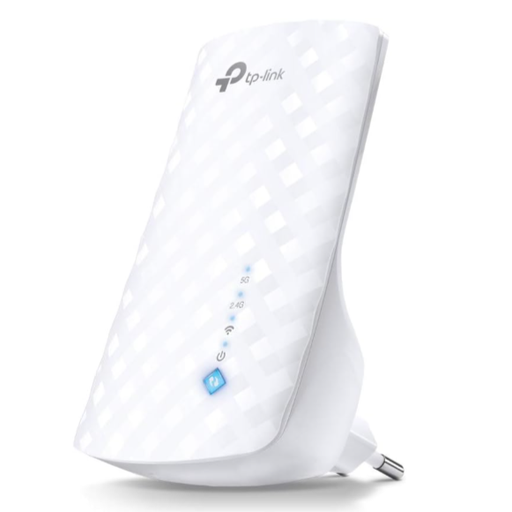
TP-Link RE190 AC750 Repeater
A wireless repeater option if you can find a location within range of your existing router.
- AC750
- 433 Mbps according to the product name
Joybuy
 No image available
MERCUSYS ME80X Wi-Fi 6 Range Extender
An option if you want to consider both repeater operation and access point mode.
- Dual-band, AX3000
- 574 Mbps at 2.4 GHz and 2,402 Mbps at 5 GHz according to the product name
- Gigabit port, AP mode
Joybuy
 No image available
TP-Link RE235BE BE3600 Wi-Fi 7 Range Extender
A wireless repeater option if the planned location is still within range of your existing router.
- Dual-band Wi-Fi 7
- 2.5G multi-gigabit port
- MLO; EasyMesh compatibility according to the product name
Joybuy
Frequently asked questions
Where should I place a wireless repeater?
Place it somewhere it can still get a stable signal from the router while also covering your workspace. FRITZ! recommends checking the connection from the intended location and avoiding obstacles where possible.
Is a LAN port on a repeater enough to use it as an access point?
Not necessarily. Also check whether the model has a dedicated access point mode. TP-Link documents this mode for the RE705X via its Gigabit port; you’ll also need a network cable running to the location you want to cover.
How can I check whether Powerline will work in my home?
Start by testing the adapters using the sockets you actually plan to use. devolo recommends plugging them directly into wall sockets where possible, and identifies power supplies, dimmers and chargers as potential sources of interference.
Do I need an individual frequency licence for a standard Wi-Fi repeater in Germany?
Frequencies are available for standard Wi-Fi in the generally allocated 2.4 GHz and 5 GHz bands, as explained by the Bundesnetzagentur. However, the device must still meet the applicable product and radio requirements. The Bundesnetzagentur lists CE marking, identifiability, German-language instructions and a declaration of conformity among these requirements. This applies to standard operation within the current frequency allocation, not to radio equipment that has been modified without restriction.


