Readers dealing with dead spots
If you want to download magazines in rooms on several floors, start by checking your Wi-Fi coverage and possible locations for additional access points.


Compare download speeds near the router with those in the rooms where you read. If things are slow only on distant floors, a Wi-Fi extender may be enough; if speeds are slow everywhere, check your internet connection too. If there are several dead spots, consider adding mesh nodes. Existing Ethernet cabling between floors can provide the connection between them, as TP-Link and ASUS explain for selected systems. Only replace your main router if your connection type or the router features you need make it necessary.
If you want to download magazines in rooms on several floors, start by checking your Wi-Fi coverage and possible locations for additional access points.
With compatible systems, existing network cables can link your Wi-Fi access points. TP-Link and ASUS describe Ethernet backhaul for selected models.
If you only want to replace what you need to, check that an extender is compatible with your existing router and its connection and phone features. Telekom lists compatible mesh extenders for the Speedport Smart 4.
Suitable if: Your internet connection and Wi-Fi are fine near the router, but coverage is poor in a particular room where you read.
Bear in mind: A wireless extender needs a strong enough connection to your existing network. Mesh features are not automatically interchangeable between product ranges.
Suitable if: There are dead spots on several floors and no network cable runs between suitable locations.
Bear in mind: Each node needs a reliable wireless connection to the router or another node. The number of nodes and where you place them will depend on your home.
Suitable if: You have usable network cables between floors and want to place Wi-Fi access points in several rooms where you read.
Bear in mind: Ethernet backhaul requires compatible ports, cabling and a suitable operating mode. TP-Link and ASUS describe this option for selected systems.
Suitable if: The features or Wi-Fi performance of your current router are not good enough, even nearby, and you need a replacement that works with your connection type.
Bear in mind: DSL, cable and fibre routers are not interchangeable just because of their Wi-Fi specifications. A new main router does not guarantee coverage through several floors.
First, work out what matters most in your home: Wi-Fi coverage, the connection between floors, compatibility with your internet service, what’s included in the box or ongoing maintenance.
| Priority | What to check before buying | Who it matters most to |
|---|---|---|
| Wi-Fi coverage | Compare download speeds near the router and in the rooms where you read; check possible locations and how many nodes are included. | If I want to download magazines in rooms further away, Wi-Fi needs to reach them. Around 31% of consumers therefore prioritise coverage in the rooms where they read. |
| Connection between floors | Check existing network sockets and the supported backhaul mode. TP-Link and ASUS describe Ethernet backhaul for selected models. | If I plan to use several Wi-Fi access points, they need to connect reliably to one another too. Around 25% of consumers therefore prioritise the connection between floors. |
| Internet connection and router | Check DSL, cable or fibre, your existing modem, phone requirements and the compatibility of any planned mesh extender separately. | If I want to keep or replace my current router, the device needs to work with my internet connection and the features I need. Around 19% of consumers put this compatibility first. |
| What’s included | Check whether it’s a single device or a multipack, how many units are included and whether you’ll need any additional devices. | If I only want to improve coverage in one area, I don’t want to plan for more devices than my setup needs. Around 13% of consumers prioritise getting the right number of units for their extension. |
| Security and maintenance | Check update options, Wi-Fi encryption and passwords. The Federal Office for Information Security recommends keeping router firmware up to date. | If I download magazines over my home network, I want to set up my router securely and keep it up to date. Around 12% of consumers prioritise security and ongoing maintenance. |
A high theoretical wireless data rate alone won’t tell you how quickly magazines will download in a distant room. Your internet connection and the link to the relevant Wi-Fi access point can also limit download speeds.
Compare your connection near the router with the connection in the rooms affected before choosing a faster main router.
The node itself needs a strong enough connection to your existing network. At the point with the poorest reception, that link may be missing.
Choose a location along the route back to the router, or use existing cabling between floors with a system that supports Ethernet backhaul.
An offer containing one mesh node provides a different number of Wi-Fi access points from a multipack. And not every mesh system replaces the modem needed for your internet connection.
Check what’s included, the connection type and whether the device is a main router or a Wi-Fi extender separately.
Depending on your setup, you may need additional nodes or a compatible device for your internet connection.
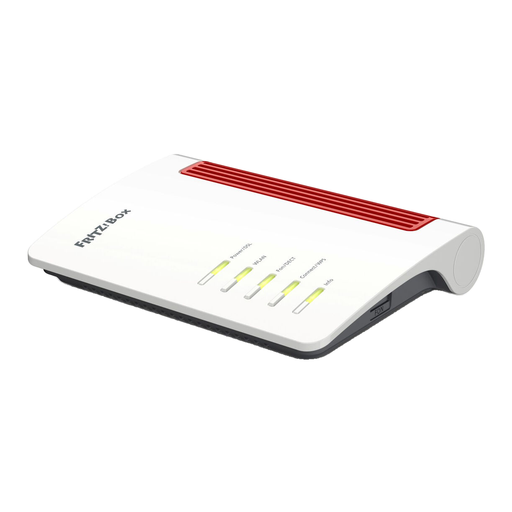
FRITZ! offers DSL main routers such as the FRITZ!Box 7690, as well as extenders for existing FRITZ! home networks.
Deco mesh systems such as the X50 are an option if you need several Wi-Fi access points.
The ZenWiFi XD5 is a mesh option if you want to use existing network connections in suitable locations.
The Speedport Smart 4 with a compatible Speed Home extender is an option if you want to keep using an existing Telekom router.
The products below include mesh Wi-Fi for several locations, a targeted way to extend an existing network and a DSL main router.
 No image available
This mesh set includes two units for providing Wi-Fi access points in several locations.
Wi-Fi 7, Dual-Band and Gigabit Ethernet.
 No image available
This three-pack provides mesh units for Wi-Fi coverage in several areas of your home.
AC1200, Dual-Band and Gigabit Ports.
 No image available
These two mesh units are designed to provide Wi-Fi access points in several locations.
Wi-Fi 7 BE3600, Dual-Band, 3 × Gigabit Ports per Unit, MU-MIMO and WPA3.
 No image available
This standalone main router is worth considering if you need a compatible DSL device; mesh support is listed.
VDSL Supervectoring 35b up to 300 Mbps and 4 × Gigabit LAN. The product description specifies an external modem for cable or fibre connections.
 No image available
This standalone extender is designed for an existing Wi-Fi network and can also be used in access point mode.
574 Mbps at 2.4GHz and 2402 Mbps at 5GHz; a Gigabit port is listed. In repeater mode, the device still needs a connection to your existing router.
No. Compare your connection near the router with the connection in the rooms affected, and check whether extending your existing network will solve the coverage problem. A wireless repeater needs a reliable connection to the router itself.
For a wireless connection, place the node somewhere it can still communicate reliably with the router or another node. It doesn’t necessarily need to go where reception is worst. If you have existing cabling between floors, check whether your system supports Ethernet backhaul instead.
Check whether an offer includes a single node or a multipack, and whether your setup needs additional nodes or a compatible device for your internet connection. The devices you need will depend on your connection type and Wi-Fi coverage at home.
The Federal Office for Information Security recommends keeping your firmware up to date and using automatic updates where available. You should also change the default passwords when setting up your router.
In principle, the Federal Network Agency says you can connect a suitable router of your choice; your provider must supply the necessary access details. In 2025, the Federal Network Agency confirmed that users can choose their own terminal equipment at the network termination point for passive optical fibre networks. Even so, check that the specific device is suitable for your connection and service.