Students with weak Wi-Fi at their study space
If your lecture works near the router but drops out behind thick walls, the connection at your study space matters more than the advertised maximum speed.


First, check whether the problem lies with your internet connection or just at your study space. If the connection is working and you can run a cable, a wired access point is a targeted way to bypass the Wi-Fi signal passing through thick walls. If you can’t run a cable, consider a mesh system or repeater, provided there’s still a decent connection where you plan to put the extra node. A new main router makes most sense if your connection or the features you need aren’t compatible with your current device.
If your lecture works near the router but drops out behind thick walls, the connection at your study space matters more than the advertised maximum speed.
If you can’t run a LAN cable to your study space, the key question is whether an additional wireless node can still get a decent connection to your existing network, or whether another type of connection might work better.
If you’re replacing your current router, check the connection type and modem first. Depending on your internet service, you may need a router with a built-in modem or a separate device in front of it.
Best if: your internet connection works at the main router and you can run a cable near your study space.
Things to consider: You’ll need to plan the cable route and the number of LAN ports required. This option bypasses the wireless signal between rooms.
Best if: you can’t run a cable, but there’s still a decent connection to the router where you plan to put the additional node.
Things to consider: The connection still depends on the location and the walls. A repeater relays the signal it receives where it’s placed.
Best if: you need to replace your current router, or its connection, security or network features aren’t suitable.
Things to consider: The modem must be compatible with your connection. A new router alone won’t guarantee coverage through thick walls.
Best if: you can’t run a LAN cable or find a spot with a decent wireless signal, and your home’s electrical wiring is suitable.
Things to consider: The connection travels through your electrical wiring instead of wirelessly through the walls. Sockets and electrical interference can affect performance.
| What you need | What to check before buying | Who it matters most to |
|---|---|---|
| Connection at your study space | Check the cable route and how many LAN ports you need; test the connection where you’ll actually be sitting. | If my lecture works near the router but drops out at my study space behind thick walls, the connection right there is what matters to me. Around 36 % of consumers put a reliable connection at their study space first. |
| Extending your network without a LAN cable | Check for a suitable location and compatibility with your existing router. If you’re considering Powerline, test it using the sockets you plan to use. | If I can’t run a LAN cable, I need a practical alternative way to connect. Around 29 % of consumers prioritise extending their network without running a cable. |
| Cause of the dropouts | Compare the connection near the router with the one at your study space. Check your internet connection and the requirements of your lecture platform separately. | If I want to find out whether the connection, Wi-Fi or platform is causing the dropouts before buying anything, it’s important to check the issue carefully. Around 21 % of consumers focus on troubleshooting and finding the right video-call setup. |
| A suitable main router | Check that the connection type, existing modem, provider settings, expansion options and security updates are compatible with the specific model. | If I need to replace my main router, I want a device that works with my existing connection. Around 14 % of consumers prioritise a new main router that’s compatible with their connection. |
A high advertised data rate doesn’t tell you how well the signal will reach your study space through the walls. When reviewing the Deco X50, connect points out that coverage figures don’t necessarily apply to the solid construction found in Europe.
Plan how the signal will reach your actual study space and test the connection there, rather than comparing router speeds alone.
A repeater relays the signal it receives. If its own connection to the router is weak where you’ve placed it, it won’t solve the problem at your study space.
Check the connection quality where you plan to put it before buying more nodes. If there’s no decent wireless signal there, consider a LAN connection or another way to connect.
According to devolo, electrical devices can affect data transmission over your home’s power lines. VDSL connections can also experience interference.
Test the sockets you plan to use. If you have VDSL, keep an eye on the stability of your internet connection too.
Worth considering if you’re looking for a main DSL router or want to extend an existing FRITZ! network.
Its range includes mesh systems such as the Deco X50, as well as routers whose suitability depends on your connection and configuration.
Powerline products with Wi-Fi are one option if you can’t run a cable or find a spot with a decent wireless signal.
AiMesh-compatible routers such as the RT-AX58U are worth considering if your devices and operating mode are compatible.
This selection includes mesh systems and access points to extend your network, as well as a main DSL router if you’re setting up a new connection and Wi-Fi network.
 No image available
An option if you want to add a two-unit mesh system or use it in router or access point mode.
Wi-Fi 7, dual-band and Gigabit Ethernet. The product description lists two units and mesh roaming.
 No image available
An option if you need an additional access point, have a compatible UniFi network and can use an Ethernet uplink.
Wi-Fi 6, 6 Spatial Streams and a Gigabit Ethernet port. The product description lists a PoE adapter in the box. Mesh requires a compatible UniFi network.
 No image available
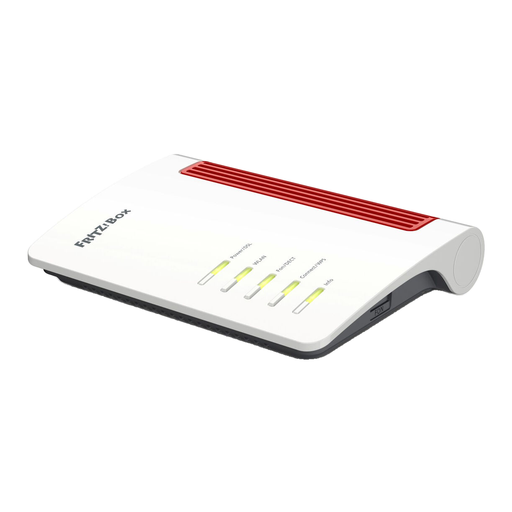
An option if you’re replacing a main DSL router and the built-in modem is compatible with your connection type.
Wi-Fi 6 up to 2400 Mbps, dual-band, VDSL Supervectoring 35b up to 300 Mbps, mesh and 4 × Gigabit LAN.
 No image available
An option if you want to use two mesh units to bring Wi-Fi to several rooms.
Dual-band. The product description lists three Gigabit ports per unit, a single network name and WPA3.
 No image available
An option if you’re looking for a two-unit mesh set with Gigabit ports on each unit.
Dual-band. The product description lists three Gigabit ports per unit and WPA3.
A wireless repeater needs a decent connection to the router where you place it. Don’t put it somewhere it can barely receive a signal itself. Check the connection quality at the intended location, and consider a wired access point if there’s no usable wireless signal.
It depends on the platform, video quality and whether you’re just watching or joining in with your own video. For 720p video, Zoom recommends around 1.2–1.8 Mbit/s download for webinar viewers. This is an example for Zoom only, not a general minimum for every lecture or a guarantee of uninterrupted Wi-Fi.
Not in general. Germany’s Federal Network Agency confirms that you can choose your own end device at the network termination point, including on passive optical fibre networks. It also refers to the same choice for VDSL and cable. Whether a particular device can be connected directly still depends on your connection and the technical requirements.
Germany’s Federal Office for Information Security recommends changing the router administration’s default password, keeping the firmware up to date and using a long Wi-Fi password, among other steps.
The 5945–6425 MHz frequency range is available for Wi-Fi in Germany, subject to the conditions of the applicable general allocation. The relevant regulation is Verfügung 76/2025 from the Federal Network Agency, which replaced the earlier Verfügung 12/2025. Check the current conditions for using the specific device and where you plan to use it. Don’t assume that a device supports the 6 GHz band just because it’s labelled Wi-Fi 7.