If a single router can’t reliably reach the workspace beyond a thick wall, an additional access point connected via Ethernet is an obvious option, provided the cabling route and devices are suitable. If you can’t run a cable, a compatible mesh system may help, as long as there’s still a usable wireless connection where you plan to place the additional unit. For large project files, you should also consider the entire transfer path, the storage location and the ports on the specific model.
Who is this selection for?
Teams with a Wi-Fi dead spot in the workspace
When shared files are on the other side of thick internal walls, a reliable connection at your desk is essential. TP-Link notes that dense walls may make additional network equipment necessary; running a cable to another access point could be an option.
Teams working with large project files
If you regularly transfer files, consider the LAN ports and storage location as well as the Wi-Fi connection. Which ports you need will depend on the specific router and the other devices involved in the transfer.
Teams without a suitable cable route
If the units can only be connected wirelessly, a mesh system may be worth considering. The key is whether there’s still a usable connection to the main router where you plan to place the additional unit, and whether the devices are compatible.
What should you look for when buying?
Single Wi-Fi router
Suitable if: repositioning the router would already provide reliable coverage in your workspace, without the need for an additional wireless node.
The trade-off: A higher advertised Wi-Fi data rate alone won’t fix a weak signal behind a thick wall.
Mesh with a wireless connection
Suitable if: you can’t run an Ethernet cable and can place an additional unit somewhere with a usable connection to the main router.
The trade-off: The connection between units still depends on the wireless path and compatibility of the specific devices.
Access point or mesh with Ethernet backhaul
Suitable if: you can run an Ethernet cable to the other side of the wall or close to the workspace.
The trade-off: The cable replaces the wireless connection between units at that point; the ports and Ethernet backhaul support must be compatible with both devices.
For project files behind thick internal walls, a reliable connection at your desk matters more than the advertised maximum speed. Next, consider the storage route, the ports you need and—if you’re using mesh—where to place the additional unit.
| Buying criterion |
What to look for |
Who it matters most to |
| Connection through thick walls |
Check the signal at your actual workstation. If you can run a cable, check that both devices support Ethernet backhaul. |
If I need reliable access to shared files in the room beyond the wall, coverage comes first for me. Around 36% of consumers focus primarily on a stable connection at their workstation. |
| Speed when transferring large files |
Consider the LAN ports, storage connection and wireless path together; a Wi-Fi speed rating alone doesn’t show how fast the entire transfer will be. |
If we regularly transfer large project files, I want to know whether all the connections between the work device and storage are compatible. Around 29% of consumers prioritise transfer speeds. |
| Shared storage |
Decide where the files will be stored in advance, then check the USB or LAN ports you’ll need and the sharing permissions required. |
If several team members need the same storage location, it matters to me how it’s connected and who can access it. Around 21% of consumers prioritise organising shared storage. |
| Secure access |
Check supported Wi-Fi encryption, firmware updates, user permissions and whether you can set up a separate guest network. |
If project files should only be accessible to authorised devices, I want to be able to manage access and sharing permissions. Around 14% of consumers place particular importance on secure file access. |
Common buying mistakes
-
Assuming Wi-Fi data rate is the same as file-copying speed
There are several connections between your work device and storage. For example, the FRITZ!Box 7690 has a 2.5-Gbit/s LAN port and Gigabit LAN ports, alongside a USB 2.0 port for storage. This alone doesn’t tell you the actual file-copying speed.
Check the entire transfer path and the ports on the exact model, rather than comparing only the Wi-Fi rating.
-
Placing a mesh satellite beyond the obstacle and assuming reception will improve
A wirelessly connected mesh unit still needs a usable wireless path to the main router. Ethernet backhaul can replace this wireless link if the devices involved support it.
Check the planned location and consider whether you can run an Ethernet cable to it.
Running a cable may involve extra routing and installation work.
-
Assuming similarly named models or mesh technologies are identical
The FRITZ!Box 6690 Cable and the FRITZ!Box 6690 Pro are different model names. TP-Link also states that Ethernet backhaul over EasyMesh only works when the main router and satellite support the feature and use the required firmware.
Before buying, check the full model name, connection type, device compatibility and firmware.
Key brands at a glance
FRITZ!
FRITZ!Box models vary in connection type and features; what matters is what the specific router can do.
- According to FRITZ!, the FRITZ!Box 7690 has a 2.5-Gbit/s LAN port, two Gigabit LAN ports and USB 2.0.
- These specifications apply to the 7690, not every FRITZ!Box model. A router alone is not a proven solution to a poor connection through a wall.
TP-Link
TP-Link offers both Deco mesh systems and EasyMesh-compatible routers as ways to extend Wi-Fi coverage.
- TP-Link describes Ethernet backhaul between two EasyMesh routers when both devices and their firmware support the feature.
- According to TP-Link, Deco systems require a TP-Link ID and the mobile app for setup. Deco and EasyMesh shouldn’t be treated as interchangeable by default.
ASUS
The RT-AX88U Pro may suit buyers who need LAN ports and the option to expand their setup with AiMesh.
- ASUS lists a 2.5-Gbit/s LAN port, four Gigabit LAN ports and USB 3.2 Gen 1 in its specifications.
- An Ethernet backhaul in an AiMesh setup requires the right configuration. Port specifications don’t measure how well a signal travels through walls.
NETGEAR
Orbi mesh systems are an option if you need extra Wi-Fi coverage and the specific router-and-satellite combination suits your planned setup.
- NETGEAR describes Ethernet backhaul for the Nighthawk Mesh WiFi 6 products named in its guide.
- This guide doesn’t automatically confirm Ethernet backhaul support for every Orbi model. Check support for the specific devices you’re considering.
Joybuy products
The selection below includes mesh systems, wired access points and standalone routers for Wi-Fi coverage at your workstation, as well as wired devices for your home network.
 No image available
TP-Link Deco BE22, Wi-Fi 7 mesh system, 2-pack
This two-unit mesh set is an option if you need extra Wi-Fi coverage and want to connect several wired devices.
Dual-band Wi-Fi 7; two Gigabit WAN/LAN ports per unit; router and access point modes; WPA3.
View at Joybuy
 No image available
Ubiquiti UniFi U6+ Wi-Fi 6 access point
This access point may suit you if you can connect it via Ethernet near your workspace and want to provide Wi-Fi there.
Dual-band Wi-Fi 6; Gigabit Ethernet; requires PoE in accordance with 802.3af. The installation described requires a suitable Ethernet connection and PoE power supply.
View at Joybuy
 No image available
Ubiquiti U7 Mesh
This model is an option if a wired network uplink and PoE are available at your planned location.
Wi-Fi 7; 2.5-Gigabit Ethernet uplink with PoE. Installation requires a suitable network connection and PoE power supply.
View at Joybuy
 No image available
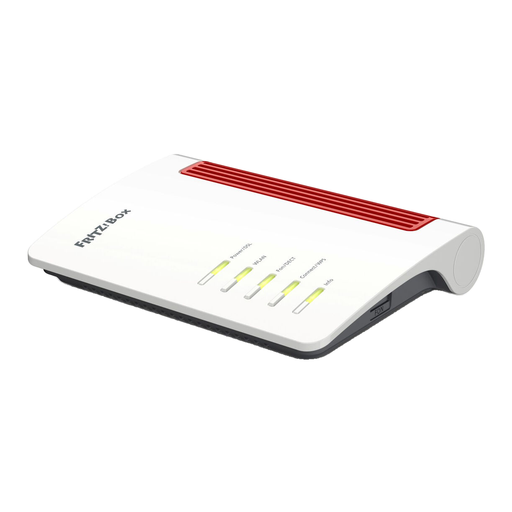
FRITZ!Box 7530 AX, Wi-Fi 6 DSL router
This DSL router is an option if its location already provides coverage in your workspace or you’re considering extending your setup with mesh later.
VDSL Supervectoring 35b modem; four Gigabit LAN ports; USB; mesh support. The stated connection compatibility includes IP-based ADSL and VDSL connections.
View at Joybuy
 No image available
TP-Link Deco S4 mesh system, 3-pack
This three-unit set may suit you if you plan to use several mesh stations for Wi-Fi coverage and want to connect wired devices.
Dual-band Wi-Fi 5; two Gigabit ports per unit. According to TP-Link, setup and management are handled through the Deco mobile app, which requires a TP-Link ID.
View at Joybuy
Frequently asked questions
Will a router with a higher advertised Wi-Fi speed automatically help behind a thick wall?
No. A higher stated Wi-Fi data rate doesn’t guarantee a reliable connection at your workstation. Check the wireless path there; if reception is weak, an additional access point may help, particularly if you can connect it via Ethernet.
Can I simply connect an EasyMesh device by LAN cable as an additional station?
Only if both the main router and the additional station support Ethernet backhaul and have the required firmware installed. TP-Link’s guide describes this connection for the EasyMesh routers listed there; check support for your specific devices.
How can I protect access to shared project files?
Keep your router’s firmware up to date and use secure passwords. Germany’s Federal Office for Information Security (BSI) identifies WPA3 as an encryption standard offering a higher level of protection than WPA2. Also check the permissions on your storage solution and, where possible, set up a separate guest Wi-Fi network for visitors.
Can I use my own router with my internet connection in Germany?
Germany’s Federal Network Agency confirms that you’re free to choose your terminal equipment at the network termination point, including on passive fibre-optic networks, as well as on VDSL and cable networks. Even so, check that the specific device is technically compatible with your connection.
What should I check for compliance when buying a Wi-Fi router for the German market?
Radio equipment covered by the relevant EU harmonisation legislation and placed on the EU market must carry the CE marking. Check the conformity documents for the specific product version on offer; the CE marking alone says nothing about Wi-Fi range.


