Workshop attendees dealing with a Wi-Fi dead spot
If you’re attending the workshop on another floor, the connection needs to reach both from the router to the repeater and from the repeater to your workspace.


A wireless repeater is a good option if it can still get a usable signal from the router at its chosen location and reach the workshop area. If the wireless connection between floors is too weak there, a wired connection using an access point or LAN bridge is a better choice, provided you have an existing network cable. Advertised Wi-Fi data rates don’t guarantee a stable connection for an online workshop.
If you’re attending the workshop on another floor, the connection needs to reach both from the router to the repeater and from the repeater to your workspace.
If other people are using the same internet connection during the workshop, the repeater’s location matters, as does how the available connection is shared between devices.
If a network cable reaches the area where you’ll be working, you can use an access point or LAN bridge there instead of relying on a wireless connection between floors.
A good fit if: There’s still a usable connection to the router where you plan to place the repeater, and you mainly need to extend coverage to the workshop area.
Consider: Adding another wireless link won’t fix a poor connection to the router at the repeater’s location.
A good fit if: A reliable wireless connection is possible, and you need extra wireless capacity and flexibility over where to place the unit.
Consider: More wireless units won’t reach through a completely shielded floor, and manufacturers’ maximum speeds aren’t measurements taken in your workshop area.
A good fit if: A network cable reaches the workshop floor, or the wireless connection between floors is too weak at any suitable repeater location.
Consider: This option requires a usable wired connection. Any advertised mesh features also need to be compatible with your router.
A good fit if: You don’t have a LAN cable and the wireless connection between floors isn’t strong enough at a suitable location.
Consider: Performance can depend on the sockets and electrical interference, so test it where you plan to use it.
| Priority | What to check before buying | Who it matters most to |
|---|---|---|
| Connection between floors | Check the positions of the router and workspace, as well as any possible repeater location. | If I’m attending the workshop on another floor, I need a signal at my seat, while the repeater itself still needs to reach the router. Around 36% of consumers pay particular attention to the connection between floors. |
| Reliable workshop access | Test the connection where you’ll actually be sitting, under typical household conditions. If you’ll be sending video too, check the upload speed as well. | If I need reliable audio and, if applicable, video transmission, a strong Wi-Fi indicator alone isn’t enough. Around 29% of consumers prioritise a reliable connection for their workshop. |
| Compatibility with your router | Check your router model and the specific mesh technology it supports. | If I want to keep using my existing router and make use of mesh features, the two need to work together. Around 21% of consumers pay particular attention to compatibility with their router. |
| Another way to connect between floors | Check whether you have an existing LAN connection; consider Powerline only as an alternative to test on site. | If the wireless connection between floors isn’t strong enough, I’d consider a network cable or a Powerline connection that I can test first. Around 14% of consumers prioritise another way to connect between floors. |
The connection between the router and repeater matters just as much as coverage in the workshop area. FRITZ! points out that both wireless links affect connection quality.
Check a possible midway location before choosing a wireless repeater. If the connection to the router is poor there, consider using an existing LAN connection.
Manufacturers’ maximum Wi-Fi data rates aren’t measurements taken at your workspace. And according to Bitkom e. V. and VATM, the household’s broadband speed is shared between the people using it.
Don’t choose a product based solely on its highest wireless speed. Test the connection where you’ll actually be working, under typical household conditions.
Wi-Fi compatibility and support for a specific mesh feature aren’t the same thing. TP-Link states that the RE705X’s advertised EasyMesh feature requires an EasyMesh-compatible router.
Check that the repeater’s mesh technology is compatible with your existing router. If you have a network cable available, also check whether access point mode is an option.
Devolo warns that electrical devices can cause interference. With VDSL connections using profiles 17a and 35b, Powerline can also occasionally cause interference.
Test the connection using the sockets you plan to use. If you have problems with VDSL, follow the manufacturer’s troubleshooting advice.
FRITZ! lists the 1200 AX as a dual-band option and the 3000 AX as a model with three wireless units and two Gigabit LAN ports.
The RE705X is a dual-band Wi-Fi 6 option for extending wireless coverage or operating as an access point through its Gigabit Ethernet port.
The EAX15 is a plug-in dual-band Wi-Fi 6 repeater with a Gigabit Ethernet port.
devolo offers the WiFi 6 Repeater 5400 as a repeater option and its Magic Powerline range as another way to connect.
This product selection includes access points for existing LAN connections, as well as wireless repeaters and mesh systems. For wireless connections, the chosen location still needs to have a usable signal from the router.
 No image available
A wired access point option if a network cable is available on the workshop floor.
Dual-band Wi-Fi 7; 2.5 Gigabit Ethernet port; PoE power supply.
A suitable PoE or PoE+ injector, or a PoE switch, is required to power the device.
 No image available
A mesh system for several rooms, if you want to improve Wi-Fi coverage around your home using multiple units.
Dual-band Wi-Fi; three units; two Gigabit ports per unit.
The product description lists router and access point modes.
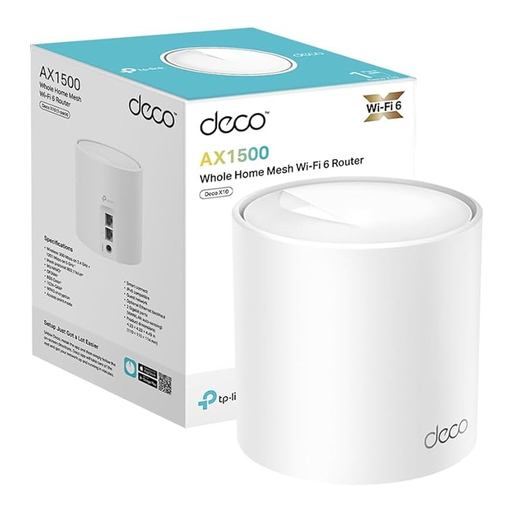 No image available
An additional mesh unit for expanding an existing Deco system, provided it can connect to the main unit as intended.
Dual-band Wi-Fi 6; AX1500.
 No image available
For a limited coverage gap, if there’s still a connection to your existing router where you plan to place the repeater. A signal strength indicator can help you assess the location.
Dual-band; 574 Mbit/s at 2.4 GHz and 2,402 Mbit/s at 5 GHz according to the product specifications; Gigabit LAN port; access point mode.
The product description says it’s designed for indoor use.
 No image available
A wireless coverage extension option if you can place the extender within range of your existing router.
Dual-band Wi-Fi 7; 2.5 Gigabit Ethernet port; EasyMesh compatible.
For EasyMesh to work, your router also needs to support the compatible technology.
Don’t place it in a complete Wi-Fi dead spot, or so far from the router that the connection is too weak. Test the connection at the intended location; under the conditions described, the FRITZ!App WLAN can assess the placement.
Not necessarily. Zoom recommends different bandwidths for webinar viewers using its web app and for people sending their own video. These recommendations vary by application and role; they aren’t a general minimum requirement for every workshop or a product specification for a repeater.
First, check the connection using the sockets you plan to use, and look for possible sources of electrical interference. Devolo also warns of possible interference with certain VDSL connections.
Check the details for the specific model and version, especially the CE marking, manufacturer information and the relevant declaration of conformity. The Federal Network Agency highlights these points, along with German instructions and safety warnings, in its product market surveillance guidance.