For photographing wildflowers while camping, a rugged compact camera with a close-up mode is an easy place to start if you’d rather not change lenses. For tiny flower details, consider a compatible macro lens with a stated reproduction ratio; for flowers and landscapes, a standard zoom may be enough, provided you check its minimum focusing distance and weather protection. Wind and the rules at your chosen location can also affect your choice of camera and where you set it up.
Who are the different types of camera best suited to?
Campers photographing in changeable weather
If you want to take close-up shots of flowers on the go without changing lenses, look for protection ratings and a built-in close-up function. OM SYSTEM lists these features for the TG-7, while Ricoh Imaging Europe describes the protection features of the WG-8.
Photographers capturing tiny flower details
If you want stamens and other small structures to stand out clearly in your images, check the reproduction ratio of a suitable macro lens. Sony and Nikon list a 1:1 reproduction ratio for their respective lenses.
Hikers photographing flowers and landscapes
If you want to switch between individual flowers, whole plants and the surrounding scenery, a zoom lens can be a practical way to get started. The Canon EOS R50 kit includes an RF-S 18–45 mm lens; Canon lists a maximum magnification of 0.16x at 45 mm with autofocus.
What should you look for when choosing?
Rugged compact camera
A good fit if: You want a camera for camping with a close-up function and no need to change lenses. OM SYSTEM lists a Microscope Macro mode, as well as water and dust protection, for the TG-7.
Bear in mind: The lens is fixed; a short minimum focusing distance is not the same as a 1:1 reproduction ratio.
Mirrorless camera with a standard zoom
A good fit if: You want to photograph flowers and landscapes with one lens. The Canon EOS R50 kit includes an RF-S 18–45 mm lens.
Bear in mind: Canon lists a maximum magnification of 0.16x at 45 mm with autofocus for this lens, and it has no dust or splash protection.
Mirrorless camera with a macro lens
A good fit if: You want to capture tiny parts of flowers at a larger scale and choose your camera body and lens to suit. Sony and Nikon list a 1:1 reproduction ratio for their respective macro lenses.
Bear in mind: The mount and what’s included in the box need to match; in windy conditions, the flower can move even if the camera is steady.
| Consideration |
What to check before buying |
Who is it particularly relevant to? |
| Weather protection and carrying |
Check the protection ratings for the specific model and its close-up function. |
If I want to take photos in changeable weather without changing lenses, protection and ease of use matter. Around 33% of consumers prioritise weather protection. |
| Tiny flower details |
Compare the maximum reproduction ratio and the compatible lens mount. |
If I want stamens or small flower structures to fill the frame, the reproduction ratio is key. Around 33% of consumers put these details first. |
| Flowers and their surroundings |
Check the focal length range and what is actually included in the kit. |
If I want to photograph both individual flowers and the campsite or landscape, I need a suitable range of framing options. Around 25% of consumers prioritise versatile subjects. |
| Taking photos in windy conditions |
Check how easy it is to frame shots from a low position and whether you can use fast shutter speeds. |
If a flower is swaying in the wind, keeping the camera steady won’t stop the subject from moving. Around 9% of consumers focus above all on ease of use in these situations. |
Which mistakes should you avoid?
-
Assuming “macro” means 1:1
A short minimum focusing distance alone doesn’t tell you how large a detail will appear on the sensor. Canon lists a maximum magnification of 0.16x at 45 mm with autofocus for the RF-S 18–45 mm; Sony and Nikon list a 1:1 ratio for their respective macro lenses.
First, think about how small the detail you want to capture is. Then compare the reproduction ratio, lens mount and what’s included in the box.
If the components have different protection ratings, bear that in mind for the whole kit; you may also want to consider additional protection.
-
Stepping into a protected area to get a close-up of a flower
Taking a photo does not give you the right to enter protected areas or damage plants. Under § 23 BNatSchG, access to a nature reserve depends on its conservation purpose and the applicable regulations.
Follow the rules for the specific area and take photos from a permitted spot without picking the plant.
Which brands and product ranges are worth considering?
OM SYSTEM
The Tough TG-7 is a rugged compact camera with a fixed lens and close-up features.
- OM SYSTEM lists a Microscope Macro mode, as well as water and dust protection, for the TG-7.
- The lens cannot be changed. Focus Stacking for this model is described by dkamera.de; this feature is not automatically available across the whole brand.
PENTAX
The WG-8, offered by Ricoh Imaging, is a rugged compact camera with a fixed 5x zoom.
- Ricoh Imaging Europe describes water, shock, dust and frost protection for the WG-8.
- Ruggedness ratings alone do not confirm a particular macro reproduction ratio.
Canon
The EOS R50 kit with the RF-S 18–45 mm is a good starting point for switching between different types of shot.
- Canon lists a vari-angle screen for the EOS R50; the kit includes the RF-S 18–45 mm.
- Canon lists a maximum magnification of 0.16x at 45 mm with autofocus for this lens, and it has no dust or splash protection.
Sony
The separate SEL30M35 APS-C macro lens is designed for a compatible E-mount system.
- Sony lists a 1:1 reproduction ratio and a weight of 138 g for the SEL30M35.
- Check that your chosen camera body is compatible with E-mount and that the lens is included in the kit you plan to buy.
Nikon
The NIKKOR Z MC 50 mm 1:2.8 is a separate macro lens for a suitably matched Z-mount system.
- Nikon lists a 1:1 reproduction ratio for this lens.
- The lens is not a camera on its own; the body and what’s included need to suit the kit you have in mind.
Joybuy products for life on the go
The selection below is suited to compact photography on the go and of your surroundings; for tiny flower details, check the reproduction ratio you need.
 No image available
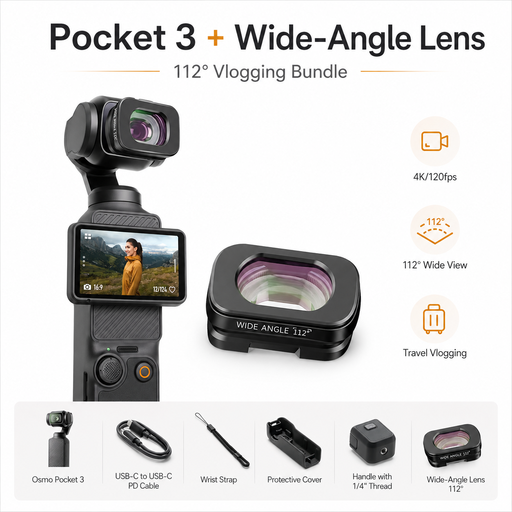
DJI Osmo Pocket 3 Standard Combo with ULANZI F35 112° wide-angle lens
For photos on the go and of landscapes, the product description highlights a compact, lightweight camera and a wide-angle lens for a broader field of view.
The bundle includes a magnetic 112° wide-angle lens, 1-inch CMOS sensor, 4K/120fps and a 3-axis gimbal.
View at Joybuy
Frequently asked questions
Is a short minimum focusing distance enough to fill the frame with flower details?
Not necessarily. You should also compare the maximum reproduction ratio of the specific lens. Canon lists 0.16x at 45 mm with autofocus for the RF-S 18–45 mm; Sony lists 1:1 for the SEL30M35.
Does a tripod help when wildflowers are swaying in the wind?
A tripod can reduce camera movement, but it won’t keep the flower itself still. Canon’s macro photography guide recommends fast shutter speeds for moving subjects; make sure you’re also in a permitted spot.
What should I do after using a rugged camera in the rain?
Follow the care and sealing instructions for your specific model. OM SYSTEM’s water protection ratings apply to the TG-7 and do not automatically apply to a different camera body or a separately attached lens.
What extra purchases might I need for a mirrorless camera?
Check whether the kit on offer includes the lens you need for your subjects. The Canon EOS R50 kit includes the RF-S 18–45 mm; Sony and Nikon’s 1:1 macro options each require their own specifically named lens.
Can I go anywhere or remove flowers to photograph wildflowers in a nature reserve?
No. Access is governed by § 23 BNatSchG, the conservation purpose and the specific regulations for each area. The Federal Ministry for the Environment explains that the small-bouquet rule does not apply to specially protected plants. Wherever possible, photograph the plant where it grows and follow local rules.


