Which camera option is right for you?

Photographers focused on flower details

If you want to capture petals or stamens in close-up, check the magnification ratio and working distance of the specific lens. OM SYSTEM states that the TG-7 can focus from 1 cm in Microscope mode; Canon and Sony specify magnification figures for certain lenses.

Spontaneous park photographers

If you want to switch between flowers and other park scenes on a walk, ease of use and what’s actually included in the box are important considerations. The OM SYSTEM TG-7 has a fixed lens, while the Canon EOS R50 kit includes an interchangeable RF-S 18–45 mm lens.

Photographers who need to keep their distance

If you’re taking photos from a path or can’t get any closer to a plant, compare the working distance with the position you’re allowed to shoot from. Sony clearly distinguishes between minimum focusing distance and the clear space in front of the lens.

What should you look for when choosing?

Compact camera with macro mode

A good fit if: You want to capture very small details from close enough without changing lenses. OM SYSTEM states that the TG-7 can focus from 1 cm in Microscope mode.

Trade-off: The TG-7 has a fixed lens. Its short focusing distance is only useful if you can get close enough to the flower from a permitted position.

Interchangeable-lens camera with standard zoom

A good fit if: You want to photograph other park scenes as well as individual flowers, and would rather start with one lens. The Canon EOS R50 kit includes an RF-S 18–45 mm lens.

Trade-off: At 45 mm with autofocus, Canon specifies a maximum magnification of 0.16x for this zoom. That’s not a 1:1 macro shot.

Interchangeable-lens camera with macro lens

A good fit if: Flower details are your priority and you want to choose a suitable lens. Sony specifies a 1:1 magnification ratio for the E 30 mm F3.5 Macro, as does Nikon for the NIKKOR Z MC 50 mm F2.8.

Trade-off: The camera body and macro lens need to be compatible, and you may need to buy them separately. According to Sony, the working distance of its 30 mm lens is around 2 cm at maximum magnification.

What you want to do What to look for when buying Who should pay particular attention?
Capture flower details in close-up Check the maximum magnification ratio for the specific lens and focus mode; for a compact camera, look for a dedicated macro mode. If you want to show petals or stamens in close-up, magnification matters more than resolution alone. For around 36% of consumers, capturing small flower structures is the top priority.
Take spontaneous photos in the park Check what’s included in the box and whether the lens is fixed or interchangeable. Think about what you want to photograph on a walk. If you want to switch between flowers and other park scenes without changing lenses, a straightforward setup is key. Around 29% of consumers prioritise spontaneous park photography.
Photograph from a position you can reach Compare the working distance, not just the minimum focusing distance, and check any local restrictions and signs. If you can only reach the flower from a path, the working distance needs to suit your position. For around 21% of consumers, shooting distance is the most important buying consideration.
Expand your system later Check that the camera and lens mounts are compatible, and confirm exactly what’s included in the kit. Don’t assume a standard kit zoom is a 1:1 macro lens. If you want to choose a different lens later, the mount and options for expanding your kit are important. Around 14% of consumers prioritise expanding their system in the future.

Common misconceptions when buying

  • Assuming “close-focusing” means 1:1 macro

    A lens can focus at close range without delivering high magnification. At 45 mm with autofocus, Canon specifies a maximum magnification of 0.16x for the RF-S 18–45 mm; Sony specifies 1:1 for the E 30 mm F3.5 Macro.

    Compare the maximum magnification ratio in the relevant focus mode, and check which lens is actually included in the kit.

    For greater magnification, you may need an additional lens that’s compatible with your camera.

  • Misreading minimum focusing distance as the space in front of the lens

    Minimum focusing distance is not measured from the front of the lens. For the Sony E 30 mm F3.5 Macro, Sony specifies a minimum focusing distance of 9.5 cm, but a working distance of around 2 cm at maximum magnification.

    Plan around the actual working distance and the position you’re allowed to take photos from – particularly when flowers are behind a barrier.

  • Assuming Microscope mode is suitable for every park flower

    The TG-7’s stated focusing distance of 1 cm or more, as specified by OM SYSTEM, assumes you can get that close to your subject. A camera mode is no reason to enter protected areas.

    First choose a permitted position, then work out what distance and image size you can achieve from there.

Key camera brands at a glance

OM SYSTEM

The TG-7 is a compact camera with a fixed lens and Microscope mode for close-up subjects within reach.

  • OM SYSTEM states that Microscope mode can focus from 1 cm.
  • This short distance assumes you can get close to your subject; the lens isn’t interchangeable.

Canon

The EOS R50 with RF-S 18–45 mm is a kit for a variety of park scenes; the RF 35 mm F1.8 MACRO IS STM is a separate close-up option.

  • The EOS R50 supports RF and RF-S lenses. Canon specifies a 1:2 macro magnification ratio for the RF 35 mm.
  • According to Canon, the kit zoom delivers a maximum magnification of 0.16x at 45 mm with autofocus; “macro” doesn’t automatically mean 1:1.

Sony

The α6400 is an APS-C E-mount camera body; the E 30 mm F3.5 Macro is a separate lens for close-up photography.

  • Sony specifies a 1:1 magnification ratio for the E 30 mm F3.5 Macro.
  • According to Sony, the working distance is around 2 cm at maximum magnification. The lens isn’t included with the α6400 kit version featuring the 16–50 mm II.

Nikon

The Z50II is a DX mirrorless camera; the NIKKOR Z MC 50 mm F2.8 is a separate Z-mount macro lens to consider.

  • Nikon specifies a 1:1 magnification ratio for the NIKKOR Z MC 50 mm F2.8.
  • This feature belongs to the lens, not automatically to the Z50II camera body or every Z50II kit.

Joybuy products for park photography

The following Joybuy models are described as compact digital cameras for general park photography. If you want to capture flower details in particular, check that the camera offers the close focusing you need before buying.
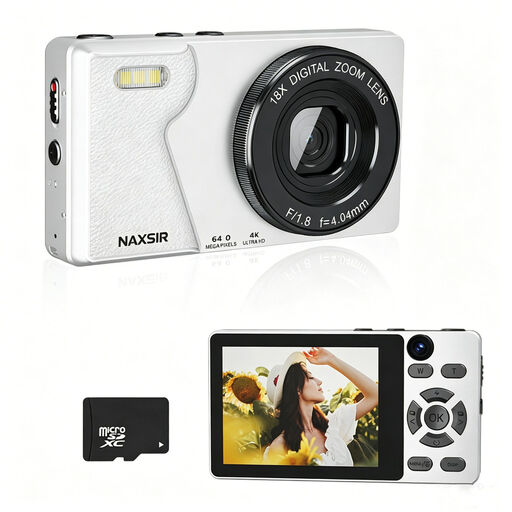
NAXSIR 4K Ultra HD digital camera with 64 MP, 18x digital zoom and 32 GB memory card

NAXSIR 4K Ultra HD digital camera, 64 MP, 18x digital zoom, 32 GB memory card

Described as a compact digital camera with autofocus for general, spontaneous park photography.

The product title lists 4K, a 64 MP photo resolution, 18x digital zoom and a 32 GB memory card.

View at Joybuy
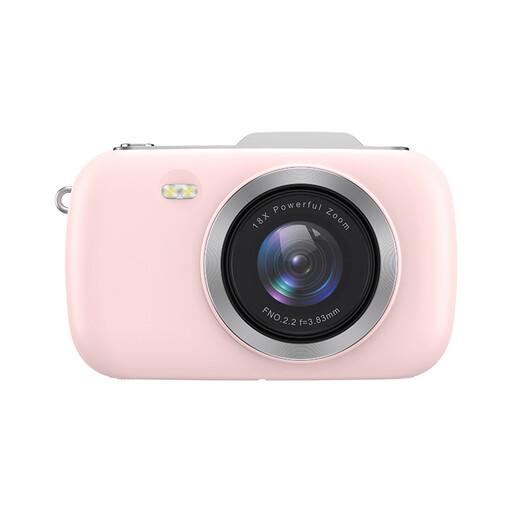
KOMERY G7-A 4K digital camera with 80 MP, 18x zoom, pink

KOMERY G7-A 4K digital camera, 80 MP, 18x zoom, pink

Described as a portable point-and-shoot camera for general park photography.

The product title lists 4K, 80 MP and 18x zoom. According to the product description, the camera isn’t waterproof and should be protected from water, rain and high humidity.

View at Joybuy

Frequently asked questions

What matters more for sharp flower details: megapixels or macro specifications?

First check the maximum magnification ratio of the lens you’re using and the shooting distance available. Sony explains magnification ratio as the size of the projected subject compared with its actual size; minimum focusing distance alone doesn’t tell you how large the subject will appear in the image.

What can I do if the camera won’t focus when it’s too close to a flower?

First, move back a little and check the minimum focusing distance of the lens you’re using. Canon notes that focusing isn’t possible if you get closer to the subject than the lens’s minimum focusing distance.

Do I need to buy a macro lens separately for an interchangeable-lens camera?

Only if the lens you already have, or the one included with the camera, can’t deliver the magnification you need. The Canon EOS R50 kit in question includes an RF-S 18–45 mm lens; Canon specifies a maximum magnification of 0.16x at 45 mm with autofocus.

Can I enter any area of a city park or move a flower to take a wildflower photo?

No. Taking a photo doesn’t give you permission to ignore protected-area rules or damage plants. Among other things, the Federal Nature Conservation Act prohibits removing or using wild plants without good reason, or damaging their populations; nature reserves are also subject to specific protection rules. Check the rules and signs for the park you’re visiting.