
Lieferung heute & morgen

Qualitätsgarantie

Willkommens-Angebote freischalten: KOSTENLOSE Lieferung | Bis zu 80 % RABATT | Kostenlose 30-Tage-JoyPlus-Testphase
App herunterladen
A window blind without drilling is practical for rented homes, renovated rooms and flexible interior design. Installation usually involves clamp brackets, adhesive mounts or special frame fittings. This keeps walls and window frames largely undamaged.
Even so, inaccurate measurements, unsuitable mounting surfaces and unclear information about light transmission often lead to unsuitable purchases. If you are looking for a clamp-fit roller blind, a pleated blind without drilling or a blackout blind, you should therefore consider more than just colour and price.
For many roller blinds, the measurement refers to the total width, including the brackets. The actual fabric may be several centimetres narrower. The width of the glass is therefore crucial for effective privacy.
As a practical guide:
A privacy blind for windows that is too narrow allows light and prying eyes in at the sides. A model that is too wide, on the other hand, may block the handle or interfere when opening the window.
A light-filtering blind reduces visibility and glare while still allowing daylight into the room. A blackout pleated blind or a blind with an opaque coating is more suitable for bedrooms and rooms where light sensitivity is a concern.
However, “blackout” should not automatically be taken to mean a completely light-proof installation. Light gaps at the sides, bright window frames and areas that are not fully covered may still let brightness into the room. If you need the darkest possible environment, check the fabric, coating, overall width and installation position together.
A roller blind with clamp brackets is generally hooked onto the frame. The frame thickness must fall within the specified range. For example, some WOLTU models are designed for a frame thickness of 13 to 23 mm or 16 to 22 mm.
Adhesive mounts require a clean, dry and preferably smooth surface. Adhesion may be limited on rough, dusty, damp or uneven surfaces. Before installation, clean the surface according to the instructions and allow it to dry completely.
First measure:
For pleated blinds, the recommended width is often the window glass width plus approximately 3 to 4 cm. For roller blinds with a chain control, also check whether the chain can be fitted on the left or right and that it will not collide with handles or furniture.
A double roller blind without drilling, also known as a Zebra blind, uses alternating transparent and denser fabric strips. Sliding the two layers changes the amount of light entering the room. It offers a flexible middle ground between an unobstructed window, privacy and stronger screening.
Chain controls must be installed so that they are out of reach of children and pets. Some models have a chain holder or cordless operation via a bottom rail. For blinds in children’s rooms, a cordless design is worth considering.
Also look out for:
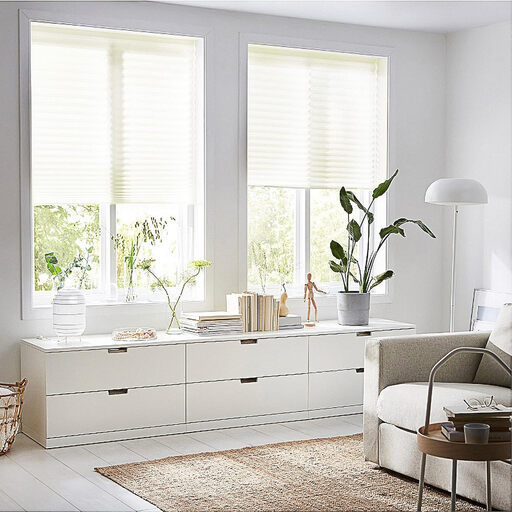
Why this product suits the profile: The 65 × 120 cm size is suitable for small to medium-sized interior windows. Clamp-fit installation requires no drilling, while the height can be adjusted using the handle or the intended operating mechanism.
The product details specify light filtering rather than making a blanket claim of complete blackout. This makes it easier to assess whether it is suitable for use in a living room, home office or kitchen.
Polyester fabric, clamp brackets and a relatively compact size. According to the product description, the material can be cleaned with a damp cloth.

Why this product suits the profile: This double roller blind combines two fabric layers with alternating transparent and opaque stripes. Light control is adjusted using a side chain, which can be fitted on the left or right.
The design offers more than simply choosing between open and closed. Before buying, you should still check the frame thickness, handle position and chain routing.
100% polyester according to the product details, clamp-fit installation for frames measuring 13 to 23 mm, plus a chain holder for tidy routing.

Why this product suits the profile: The opaque design is intended for bedrooms, children’s rooms and spaces exposed to strong sunlight. It is operated without a chain using the handle on the lower aluminium rail.
The product description specifies the suitable frame thickness of 16 to 22 mm and points out that the fabric is narrower than the overall width. This information helps you check the measurements before buying.
Cordless handle operation, polyester-based fabric with a coated reverse side, and installation options using clamp brackets or screw fixing.
We have compiled a complete, regularly updated list of products that fully meet these strict selection criteria and the safety regulations applicable in the EU.
Durability depends on the frame thickness, weight, installation quality and daily use. Before installation, the clamp brackets must be seated correctly, while adhesive surfaces must be clean and dry. If the brackets are loose, do not continue using the blind until the fastening has been checked.
That depends on the design. Pleated blinds with upper and lower brackets can be guided more securely on suitable rectangular tilt-and-turn windows. A traditional roller blind with side brackets, on the other hand, may swing when the window is tilted. The details provided for the individual product are decisive.
No. A manual interior sun blind, pleated blind or double roller blind does not require electricity to operate. Running costs are therefore essentially limited to cleaning and, where necessary, replacing brackets or accessories. Motorised versions have different requirements.