
Lieferung heute & morgen

Qualitätsgarantie

Willkommens-Angebote freischalten: KOSTENLOSE Lieferung | Bis zu 80 % RABATT | Kostenlose 30-Tage-JoyPlus-Testphase
App herunterladen
Expansive window fronts, conservatories, or hard-to-reach skylights fill living spaces and offices with light and a sense of openness. However, the joy they bring is often overshadowed by the effort required to clean them. Streaks, smears, and the tedious use of ladders and squeegees are common frustrations. A window cleaning robot can be a significant time-saver here. These devices automate the cleaning of glass surfaces.
This article serves as a guide. It explains the essential features you should look for when making a selection and presents a range of models with different characteristics. The goal is to provide you with an objective basis for your decision.
Many users look for a window cleaning robot review to help them decide. Instead of a formal test, we have summarised the most important features that are relevant when choosing a device.
The suction power, measured in Pascals (Pa), is crucial for ensuring the window cleaning robot adheres securely to the vertical glass surface. Higher suction power provides a firmer grip, even on slightly uneven surfaces like some tiles.
Another key feature is the safety system. Almost all models have a backup power supply (usually an integrated battery) that keeps the device on the window for 20 to 30 minutes in the event of a power failure. Additionally, every device comes with a safety tether, which should be attached to a fixed point before use to prevent a fall.
A good automatic window cleaner should work systematically to cover the entire surface. Most devices use intelligent navigation systems to map out paths and avoid missing any spots. Efficient route planning is especially important for large windows.
A window robot with a spray function offers a clear advantage: it moistens the surface with water or a cleaning solution before cleaning. This helps to effectively loosen stubborn dirt such as fingerprints or water spots. Some models feature ultrasonic spray nozzles that create a fine mist, optimising liquid consumption.
Modern glass cleaning robots are versatile. Besides windows, they are often suitable for tiles and mirrors. The prerequisite is a smooth, frameless, or framed surface with a minimum size, which is usually 30x30 cm.
Control is typically managed via an included remote control or a smartphone app. A remote control allows for straightforward operation without the need to pair another device. App controls often offer advanced features, such as selecting specific cleaning modes or viewing cleaning progress.
Here is a selection of devices that cater to different needs. The descriptions are based on data provided by the manufacturer.
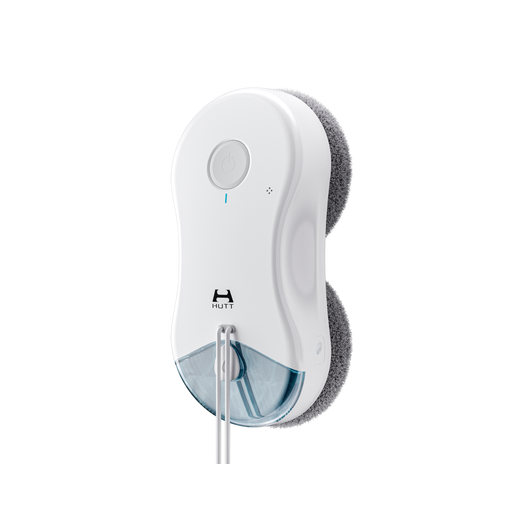
Why this model stands out The HUTT DDC55 Pro focuses on straightforward and effective cleaning. It deliberately omits app connectivity and can be controlled directly on the device or via remote. Its design is engineered for reliable cleaning right up to the edges, preventing unsightly missed streaks along the frame.
Advantages
Who is it for? For users who want a solution that is ready to use out of the box and easy to operate without a smartphone app. Ideal for households where various glass surfaces like shower cabins, mirrors, and windows need to be cleaned quickly and easily.

Why this model stands out The ECOVACS WINBOT Mini 2 is a compact window cleaning robot that utilises advanced technologies. According to the manufacturer, the WIN-SLAM 5.0 navigation system ensures systematic coverage, while the ultrasonic dual-nozzle spray function efficiently distributes the cleaning solution. Its high suction power supports safe operation.
Advantages
Who is it for? For tech-savvy users who value precise navigation, advanced spray technology, and app-based control. Its high suction power makes it an excellent choice for large and tall window fronts.

Why this model stands out The Hutt 10 is designed as a versatile all-rounder that can be used on large, small, and even round glass surfaces. It combines high suction power with intelligent sensors for edge detection and offers two cleaning modes. Operation is flexible via remote control or directly on the device.
Advantages
Who is it for? For users with various window shapes and sizes, including narrow or round windows. Its ease of use makes it a practical assistant for anyone looking for a flexible and powerful cleaning solution.
The models presented already cover a wide range of use cases. However, if you are looking for further alternatives or specialised devices for cleaning glass surfaces, you can find a larger selection of products in our Glass Windows category.
The cleaning performance in corners depends on the device's design. Square models naturally get into 90-degree corners better than round ones. However, many modern devices have special edge-cleaning modes where they travel along the frame multiple times to achieve the cleanest possible result. A minimal uncleaned border may still remain, depending on the model and window frame.
Yes, most window cleaning robots are designed for use on all smooth, non-porous, and vertical surfaces. In addition to glass, this includes smooth, large-format tiles (without deep grout lines), mirrors, glass shower cabins, and even glass tables (in vertical operation).
The devices are equipped with multi-level safety systems. The strong suction power ensures they stay attached, while an integrated backup battery keeps the device on the window for a certain period during a power outage. The mandatory safety tether, which is attached to a fixed point (e.g., a radiator or a heavy piece of furniture) before use, prevents a fall in the unlikely event of adhesion loss.