Households with marks on the hallway mirror
If particles from the area around your shoes get onto the mirror, gently loosen them before removing the moisture. How often this happens depends on your hallway.


A window vacuum is most worthwhile if you clean your hallway mirror with water regularly; for the odd mark, a clean, slightly damp cloth may be enough. First, gently loosen any particles: Saint-Gobain Glass Deutschland recommends cleaning glass with water that is as clean as possible, so dirt particles do not scratch the surface. Choose a nozzle to suit the clear width of your mirror and the space available for the appliance body. Check exactly what’s included in the set to see whether it comes with a narrow head.
If particles from the area around your shoes get onto the mirror, gently loosen them before removing the moisture. How often this happens depends on your hallway.
If your mirror has a frame or there’s limited room to manoeuvre, the head width and exactly what’s included in the set are especially important. Also check that the appliance body will fit alongside the mirror frame.
If you’d also like to use the vacuum on other suitable glass surfaces, battery life and tank capacity may matter more than they would for a single hallway mirror.
A good choice if: you’re removing the odd mark or fingerprint and only use a small amount of water.
The trade-off: You’ll need to dry the liquid and the edge of the mirror yourself; there’s no need for a battery or dirty-water tank.
A good choice if: you regularly clean a narrow or framed mirror with water, and the nozzle and appliance body fit the space available.
The trade-off: Check the exact set version: some models don’t include a narrow head as standard.
A good choice if: you regularly clean other suitable windows or smooth surfaces as well as your hallway mirror.
The trade-off: A longer battery life is only useful if the cleaning width also suits your hallway mirror.
| Your priority | What to check before you buy | Who is this important to? |
|---|---|---|
| Gently loosen particles | Check whether a washer is included; use clean, soft tools and follow the mirror’s care instructions. | If I want to loosen any particles before removing the water, pre-cleaning is an important step. Consumers who prioritise gentle dirt removal are likely to account for around 36%. |
| Guide the nozzle and appliance body | Measure the clear width of the mirror and check the head width, clearance for the appliance body and exact set number. | With a narrow or framed mirror, I want to be sure that the nozzle and appliance body will fit the available space. Around 29% of consumers are likely to put nozzle fit first. |
| Collect the water used for cleaning | Check how the tank on the specific version can be removed and emptied; dry any remaining moisture around the edge of the mirror. | If I clean the mirror with water regularly, I want to collect the dirty water and be able to empty the tank easily afterwards. Consumers whose main priority is water collection are likely to account for around 21%. |
| Clean other glass surfaces | Compare the head width with the other surfaces; for models with interchangeable batteries, check whether the battery and charger are included. | If you’re planning to use the vacuum on other suitable glass surfaces too, battery life and tank capacity are more important. Around 14% of consumers are likely to consider additional surfaces their main reason for choosing a model. |
A window vacuum removes liquid, but it doesn’t replace loosening any dirt particles beforehand. Saint-Gobain Glass Deutschland recommends using clean water to avoid particles scratching the surface.
First, remove particles with clean water and a suitable soft tool. Follow the care instructions for your mirror.
What’s included depends on the version: the Leifheit Dry & Clean Complete Set 51016 comes with 17-cm and 28-cm nozzles; the 51000 basic model is available with the narrow nozzle sold separately.
Before you buy, check the exact set number against the listed contents.
The Einhell BRILLIANTO 3437100 is supplied without a battery or charger.
Check whether you already own compatible Power-X-Change components and whether the contents are suitable for how you plan to use it.
According to Bosch, the GlassVAC Complete Set 06039G6000 comes with two heads for accessible glass areas of different widths.
The Dry & Clean range includes models for wider surfaces and, depending on the set, narrower sections of mirror.
The WV 6 Plus 1.633-741.0 is one option if you regularly clean other glass surfaces as well as your hallway mirror.
The BRILLIANTO 3437100 is worth considering if you already use compatible Power-X-Change batteries.
These products are described as suitable for cleaning mirrors and other suitable glass surfaces with water.
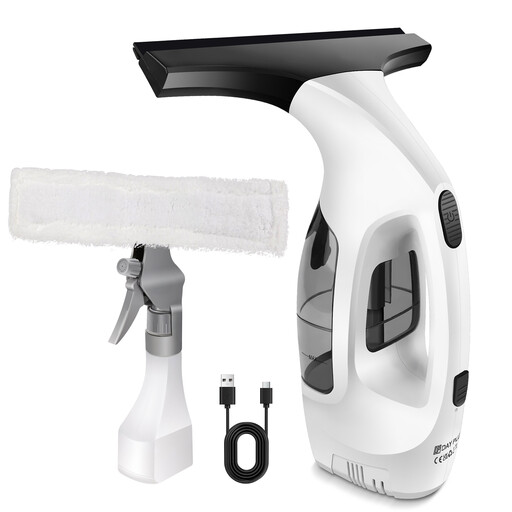 No image available
A suitable option if you’d like to use a spray bottle and microfibre cover when cleaning with water.
The description lists a 28-cm squeegee blade, a removable 150-ml tank and a battery life of up to 50 minutes.
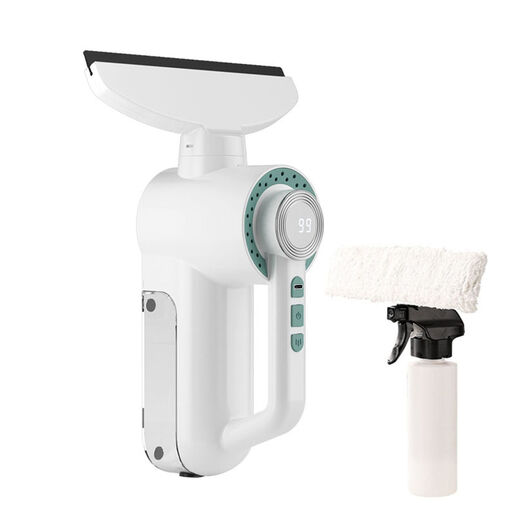 No image available
A possible choice if you’d like to spray, wipe and vacuum in one cleaning pass.
Features listed include two suction settings, a removable 150-ml tank and a battery life of up to 30 minutes. The product name also specifies a 3000-mAh battery.
No, a window vacuum shouldn’t replace pre-cleaning. First, loosen any particles with a clean, soft tool; Saint-Gobain Glass Deutschland recommends using water that is as clean as possible on glass to avoid scratching. You can then vacuum up the liquid. Always follow your mirror’s care instructions.
Dry the edge of the mirror and make sure moisture doesn’t remain in the joints. Schreinerei Haas’s care instructions identify prolonged dampness as a risk for discolouration around the edges; a window vacuum won’t necessarily dry every edge.
Check what’s included with the exact set version. The 17-cm nozzle for the Leifheit Dry & Clean 51000 is sold separately, while the Einhell BRILLIANTO 3437100 is supplied without a battery or charger. Whether compatible accessories are included depends on the specific offer.
No. The German Environment Agency recommends collecting waste electrical equipment separately and returning it to a local collection point. Removable batteries should be handed in separately wherever possible.