
Lieferung heute & morgen

Qualitätsgarantie

Willkommens-Angebote freischalten: KOSTENLOSE Lieferung | Bis zu 80 % RABATT | Kostenlose 30-Tage-JoyPlus-Testphase
App herunterladen
Large panes of glass, exterior windows on upper floors or simply having little time for household chores can all make a window cleaning robot a tempting choice. This type of window cleaning device can reduce the amount of manual work involved, but it is not suitable for every pane or cleaning situation. Depending on the size of your windows, a window squeegee or window and frame cleaner may be the more practical option.
Before buying, you should therefore look beyond suction power and spray functions. The power supply, safety mechanisms, glass compatibility, availability of spare parts and whether the device can reach frames and corners are equally important.
Suction power is often stated in Pascals (Pa). A higher figure may indicate strong adhesion, but it does not, on its own, show whether the robot will work reliably on every pane. Dust, grease, moisture, textured surfaces or damaged glass can all affect adhesion.
Additional safety features are important, including:
Many window cleaning robots have an integrated battery solely as an emergency power reserve. They still need to remain connected to the mains via the power adapter while cleaning. If you expect a fully cordless automatic window cleaner, check the product description and operating instructions carefully.
A window robot with a spray function can apply cleaning solution or water in measured quantities. However, on heavily soiled panes, dirt particles may be dragged across the glass, causing streaks. Dry pre-cleaning, clean cleaning cloths and the correct amount of liquid therefore remain important.
A robot may also be unable to reach frames, window rebates and narrow areas along the edges sufficiently well. A separate window and frame cleaner is a sensible choice for these areas.
Do not compare only the stated suction pressure; consider the complete safety system. The PuRuiKai PRK-21B, for example, is listed with 2,500 Pa suction power, an internal battery for fall protection and a 4.5-metre safety rope. The device must remain connected to the mains while in operation.
According to the product details, the ECOVACS WINBOT W2 PRO Omni offers suction power of up to 5,500 Pa, an integrated power and safety cable, and a 5.5-metre safety rope. The station must be placed on a stable, level surface. Always follow the specific manufacturer’s instructions before use.
A window cleaning robot is generally designed for smooth glass surfaces. Cracked, shattered, uneven or wet glass may pose a safety risk and should not be used. Rain, high humidity and temperatures outside the specified range can also affect adhesion or the electronics.
You should also check:
The cloths should be removable and washable according to the instructions. A wider cleaning path can save time on large windows, but is less flexible on windows with glazing bars or narrow panes. If you regularly want to clean windows without using a ladder, you should also consider the cable length and the safety rope’s reach.
For smaller glass surfaces, a traditional window squeegee is often sufficient. The Leifheit Professional Window Squeegee has a 45-centimetre rubber blade, a sliding handle and the Top-Lock system for connecting it to compatible telescopic poles.

Why this product suits this profile: The PRK-21B combines automatic and manual spray functions with remote control, making it an interesting option for households looking for an electric window cleaner for smooth glass surfaces.
The product details explicitly state that it requires mains operation and highlight the safety rope and UPS protection. This makes it clear that the battery should not be mistaken for a completely cordless power supply.
Stated suction power of 2,500 Pa, 50-ml water tank, automatic edge detection and 4.5-metre safety rope.
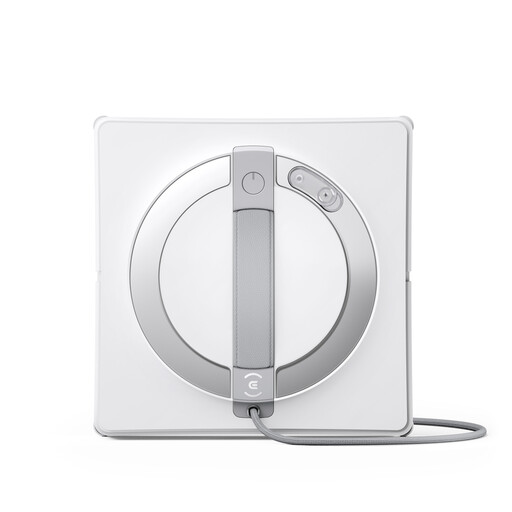
Why this product suits this profile: The multifunction station, app control and three-nozzle spray system are designed for users with larger window areas who value a structured operating concept.
The safety equipment is clearly described as including 12 protection mechanisms, a safety rope and a station that must be positioned securely. This makes it easier to check everything before use.
According to the product details: 60-ml tank, three-nozzle spray head, Win-SLAM-4.0 route planning and charging while in operation.
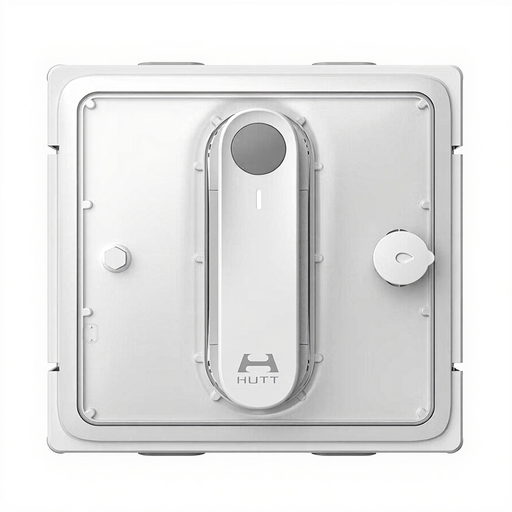
Why this product suits this profile: This model is an appealing choice for people who want to clean large, smooth glass surfaces regularly and value a spray function, edge detection and automatic return to the starting point.
The description mentions controlled cleaning right up to the edge, along with edge and obstacle detection. However, a safety rope and a suitable glass surface are still required.
150-ml tank, stated suction power of 3,800 Pa, remote control and automatic return to the starting point.
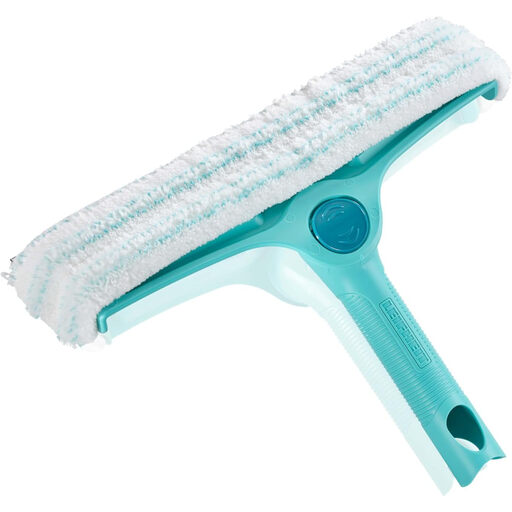
Why this product suits this profile: For individual windows, mirrors, shower glass and frames, a manual window squeegee is often simpler than a robot. This model is also suitable for compatible Leifheit Click telescopic poles.
It requires neither a power supply nor adhesion to glass. This eliminates battery, cable and suction-power concerns for small or easily accessible surfaces.
32-cm silicone blade, washable microfibre cover, three adjustable angles and an integrated frame-cleaning function.
We have put together a complete, regularly updated list of products that fully meet these strict selection criteria and the safety regulations applicable in the EU.
Before starting, the pane should be dry, smooth and free from coarse dust. Always attach the safety rope to a secure internal fixing point. The device must not operate unattended, particularly near children or pets.
You should also:
A glass cleaning robot can help with suitable surfaces, but it is not a substitute for checking the pane, edges and fixing point.
A window cleaning robot uses vacuum pressure to adhere to a smooth pane. Sensors detect edges and movement, while cleaning cloths collect dirt. Depending on the model, it can be controlled automatically, by remote control or via an app. Most devices require an external power supply while in operation.
For exterior or hard-to-reach windows, a window cleaning robot can make cleaning without a ladder easier. The safety rope must still be attached to a secure point. Damaged, very uneven or surfaces excluded by the manufacturer are not suitable.
In addition to electricity consumption, the main costs are for cleaning cloths, replacement pads and approved cleaning solution. Before buying, it is worth checking whether accessories are available separately and whether the cloths are machine washable. With a manual window squeegee, ongoing costs are generally limited to water, cleaning product and the occasional replacement of the rubber blade.