
Lieferung heute & morgen

Qualitätsgarantie

Willkommens-Angebote freischalten: KOSTENLOSE Lieferung | Bis zu 80 % RABATT | Kostenlose 30-Tage-JoyPlus-Testphase
App herunterladen
A window-cleaning robot can make it easier to clean large glass surfaces, but it does not replace careful preparation and supervision. This is especially important for tall windows, balcony doors, mirrors, or shower doors, where choosing the right device is essential. Not every model is suitable for every glass surface, window frame, or narrow area.
As a Joybuy Product Recommendation Officer, I review technical specifications and common purchasing concerns to help you assess marketing claims more effectively and choose a window-cleaning robot that suits your household.
Specifications such as 5,400, 6,500, or 8,000 Pa describe suction performance or the holding pressure stated by the manufacturer. However, this figure alone says little about the actual cleaning results. The cleaning pad, contact pressure, navigation, edge handling, and the correct amount of cleaning solution also affect performance.
A window-cleaning robot with a spray function can moisten dirt, but heavily dusty exterior windows often require pre-cleaning. Too much liquid can reduce adhesion.
An automatic window cleaner must be monitored while operating. The device generally requires a power supply, a correctly secured safety rope, and a suitable, undamaged glass surface. The backup battery is usually designed only to keep the robot attached to the pane temporarily in the event of a power failure.
A safety rope cannot prevent every type of damage. It must be attached to a stable, suitable anchor point and must not hang loosely.
Frames, handles, muntins, silicone joints, or uneven transitions can affect navigation. A window-cleaning robot for large windows needs sufficient open space, while a window-cleaning robot for narrow windows must have a compact design. Before buying, therefore, check the minimum working area, the device dimensions, and the permitted surfaces.
Compare the manufacturer’s stated suction power in Pa, but always consider the specific usage instructions as well. Many devices are designed for smooth, undamaged glass surfaces. Cracked, shattered, heavily textured, or wet glass can impair adhesion.
For mirrors, tiles, or shower doors, check whether the manufacturer explicitly approves these surfaces. Sloped roof windows are not automatically suitable. For example, the HUTT 10 and HUTT DDC55 Pro specify a maximum recommended angle of 60 degrees; according to the product information, conventional sloped roof windows are excluded.
Look for several independently operating safety mechanisms:
According to the product information, the ECOVACS WINBOT W2S OMNI and WINBOT W2 PRO OMNI feature multi-level safety systems as well as integrated safety and power cables. The W2S OMNI is also specified as providing up to 30 minutes of adhesion when the battery level is low. These are manufacturer specifications and should not be interpreted as a guarantee for every installation scenario.
Depending on the model, a window-cleaning robot may use different movement patterns, including N-shaped, Z-shaped, or combined routes. App control generally provides additional cleaning modes and status information. A remote control may be more convenient for users who prefer not to set up an app.
For a window-cleaning robot with a spray function, tank capacity and cleaning-solution compatibility are important. According to the product data, the ECOVACS WINBOT W2S OMNI has an 80 ml tank and multiple cleaning modes. A specially designated 1-litre cleaning solution is also available for ECOVACS WINBOT devices. Use only liquids approved for the specific model.
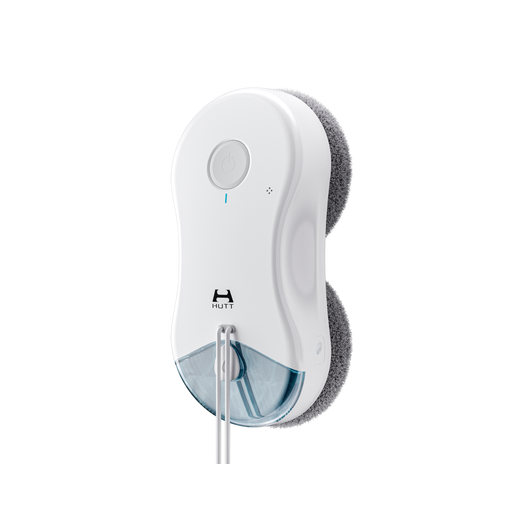
Why is this model a good fit? For households that want to clean glass, mirrors, and tiles without app control and prefer operating the device directly or via remote control.
The product specifications list a 4.5 m safety rope, a backup-power function lasting up to 30 minutes, and a minimum working area of 30 × 30 cm.
Up to 5,400 Pa of suction power, an 80 ml water tank, and edge cleaning according to the manufacturer’s specifications.
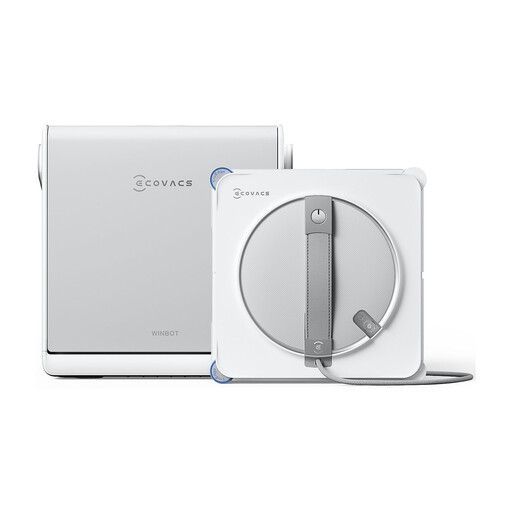
Why is this model a good fit? For large windows and users who want to combine app control, multiple cleaning modes, and a mobile multifunction station.
According to the product description, TruEdge edge cleaning and optical sensors are designed to handle edge areas and obstacles. The safety rope is still required.
8,000 Pa of suction power, up to 110 minutes of runtime, an 80 ml tank, and seven selectable cleaning modes according to the manufacturer’s specifications.
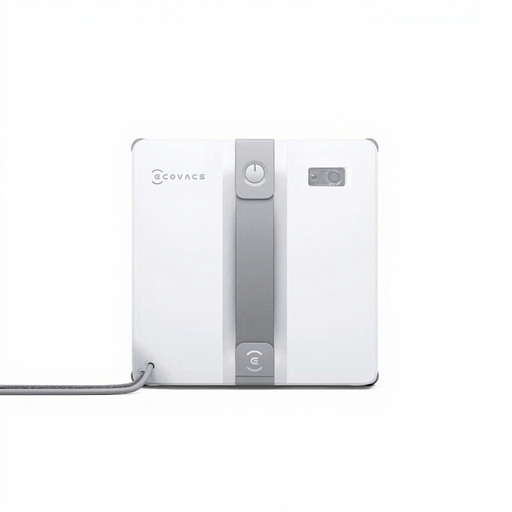
Why is this model a good fit? For homes with narrow windows, confined glass panels, or hard-to-reach areas where larger devices may reach their limits.
According to the product specifications, the compact housing, measuring 55 mm in height and 215 mm along each side, is designed for narrow glass surfaces and tight passages.
7,500 Pa of suction power, ultrasonic spray technology, app control, and a nine-stage safety system according to the manufacturer’s description.
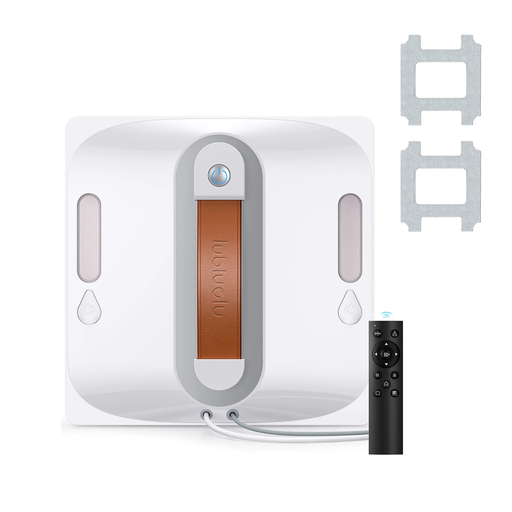
Why is this model a good fit? For households with large, hard-to-reach glass surfaces and users who want to select multiple movement and cleaning modes via remote control.
The product data lists eight safety mechanisms, four fall sensors, eight collision sensors, and a 5 m safety rope. The device must still be monitored during use.
6,500 Pa of suction power, automatic route planning, and N-shaped, Z-shaped, and combined movement patterns according to the manufacturer’s specifications.
Our complete selection includes various window-cleaning robots for glass, mirrors, tiles, large and narrow windows, as well as different control concepts.
Before starting, remove loose dust from the pane and inspect the cleaning pad. A dirty pad can drag particles across the surface and leave streaks. First attach the safety rope, connect the power supply, and check that the robot is fully adhered.
Ongoing costs include replacement or washable pads, cleaning solution, and, where applicable, electricity consumption. With spray models, using the correct cleaning solution can be more important than choosing a seemingly low purchase price. Pads should be washed or replaced after every use in accordance with the instructions. No general service life can be specified; it depends, among other factors, on cleaning frequency, storage, pad care, and battery usage.
First inspect the glass surface, attach the safety rope to a stable anchor point, and fit the cleaning pad correctly. Then position the device on the dry, suitable pane, connect it to the power supply, and start it according to the instructions. An adult should remain present throughout the entire process.
That depends on the model’s minimum working area and dimensions. Compact devices such as the ECOVACS WINBOT MINI are designed for narrower glass areas according to the product information. Before buying, measure the width, height, frame clearance, and any potential obstacles precisely.
In addition to the purchase price, you will incur costs for cleaning solution, replacement or washable pads, and electricity. For devices used frequently, the availability of compatible accessories is also important. Do not use arbitrary household cleaners if the manufacturer specifies particular solutions or dosages.