
Lieferung heute & morgen

Qualitätsgarantie

Willkommens-Angebote freischalten: KOSTENLOSE Lieferung | Bis zu 80 % RABATT | Kostenlose 30-Tage-JoyPlus-Testphase
App herunterladen
A wine fridge can keep bottles at the right temperature while making efficient use of space at home, in the office or in a hospitality setting. However, not every appliance with a glass door is automatically the right solution. Focusing only on the stated bottle capacity or an elegant LED display can mean overlooking important differences in footprint, noise levels, energy consumption and interior layout.
Manufacturers usually refer to standard bottles with a capacity of 0.75 litres. Burgundy, champagne and larger sparkling wine bottles need more space and may not fit on every shelf. Flexible shelving or additional space between bottles can also reduce the practically usable capacity.
So check the following before buying:
A wine fridge for 15 bottles is better suited to a modest stock. A model for 36 bottles, on the other hand, already requires a considerably larger footprint and should not be placed too close to a wall.
A wine fridge with 2 zones can be useful if you regularly want to store red and white wine at different temperatures. For a household that mainly drinks one type of wine, however, a single-zone appliance may be simpler and more space-efficient. What matters is whether both compartments can be adjusted independently and which temperature range can actually be reached.
A wine climate cabinet or wine storage cabinet is also not necessarily the same as a simple wine cooler. Appliances designed for longer-term storage may include additional features such as UV protection, vibration reduction or humidity control. These features are more relevant to collectors than to those storing drinks for short-term use.
A wine fridge with a glass door is often kept in the living room, dining area or office. The figure in dB(A) is therefore more important than a general description such as “quiet”. Even a difference of a few decibels can be noticeable in everyday use, although the perceived noise also depends on the location and flooring.
Also pay attention to:
The energy class alone is not enough for comparing costs. The annual consumption gives you a more practical idea of the ongoing running costs.
When choosing a model, the lowest temperature is not the only factor that matters. Check whether the adjustable range is suitable for your drinks and whether the temperature needs to be maintained consistently over time. A single-zone appliance is straightforward, while two zones offer greater flexibility for different types of wine.
If you want to store red wine, white wine, sparkling wine and champagne together, check the interior layout and the height of the shelves. A bottle cooler with a wider interior may be more suitable for mixed drinks than a tightly packed wine cabinet.
Compare the usable capacity in litres with the stated bottle capacity. A high figure does not automatically mean that every bottle will fit comfortably. For private households, 15 to 36 standard bottles may be sufficient. Private wine collectors or hospitality businesses may need a larger wine storage cabinet.
With tall appliances such as a freestanding wine cabinet, you should also consider ceiling height, the route used to transport it and its stability against tipping. The floor area must be level and stable.
A wine fridge with LED lighting improves visibility, but the light should be switchable if it is not needed permanently. A wine fridge with a touch display allows you to operate the appliance from the front, but it does not replace a well-designed interior layout.
With a glass door, information about UV protection and insulation is important. A bottle cooler with a metal door may have different priorities when it comes to energy consumption and concealing the contents. Also check whether the door can be reversed and how much clearance is needed to open it fully.
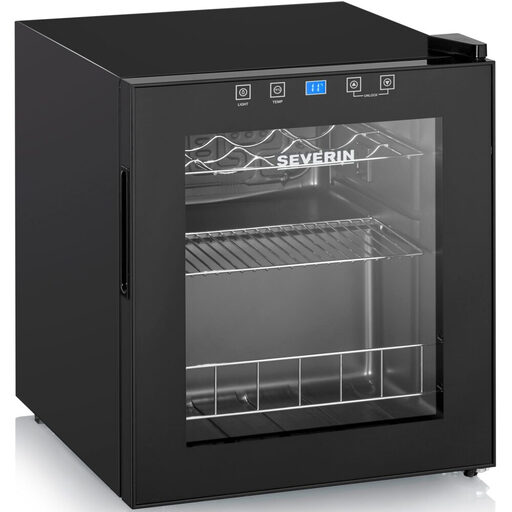
Why this product suits this profile: This compact appliance takes up comparatively little space and offers a manageable capacity for regular private wine storage.
The stated capacity specifically refers to 15 standard bottles of 0.75 l. This makes it easier to assess the space required before buying.
46 l usable capacity, temperature control from 4 to 18 °C, touch display, switchable LED lighting and a noise level of 42 dB(A).
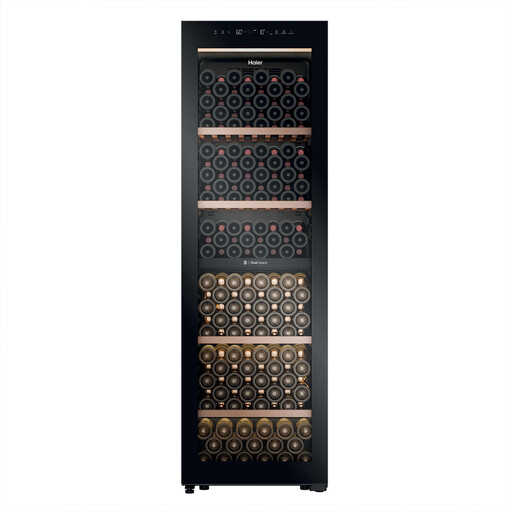
Why this product suits this profile: This freestanding wine climate cabinet is aimed at collectors with a larger stock and a need for two independently adjustable temperature zones.
The capacity, dimensions of 597 × 1.925 × 594 mm and energy consumption of approximately 126 to 147 kWh per year are clearly specified.
Up to 201 standard bottles, two zones from 5 to 20 °C, a UV-protected glass door, wooden shelves, electronic display and a noise level of approximately 35 to 37 dB.
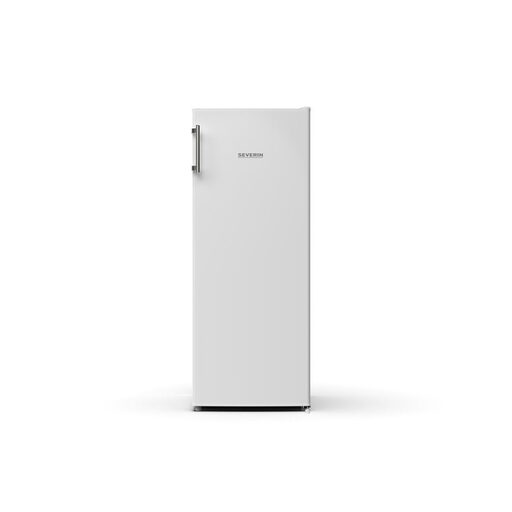
Why this product suits this profile: For offices, hosts and frequent users who want to store cans or drinks bottles of different sizes as well as wine, the spacious interior offers practical flexibility.
The metal door reduces visibility of the contents, but avoids the common misconception that a glass door is essential for every use. Consumption is stated as 81 kWh per year.
225 l capacity, five height-adjustable shelves, 39 dB, LED interior lighting and a reversible door hinge.
We have put together a complete, regularly updated list of products that fully meet these strict selection criteria and the safety regulations applicable in the EU.
Place the appliance on a level, stable surface and observe the ventilation clearances specified in the instructions. After transport, a compressor appliance should be left to stand for the period specified by the manufacturer before being switched on. The ventilation openings must not be covered.
The following points are also important when using the appliance:
Consumption depends on the size, energy efficiency class, ambient temperature, ventilation and usage. Compare the manufacturer's stated annual consumption in kWh. A smaller appliance is not automatically more economical if it is operated in unfavourable conditions.
This depends on the wine and how you intend to use it. Check the adjustable temperature range of the specific model. If you store several types of wine, a wine fridge with 2 zones can make it easier to set different temperatures. For uniform storage, one zone is often sufficient.
There is no reliable way to give a general lifespan. Regular cleaning, sufficient ventilation, a level position and avoiding unnecessary door openings can help support reliable operation. The manufacturer's conditions, frequency of use and maintenance of the individual components are also important.