
Lieferung heute & morgen

Qualitätsgarantie

Willkommens-Angebote freischalten: KOSTENLOSE Lieferung | Bis zu 80 % RABATT | Kostenlose 30-Tage-JoyPlus-Testphase
App herunterladen
Laying a boundary wire is often the most laborious part of setting up a robotic lawn mower. It requires careful planning and effort to correctly route the wire along lawn edges and around flower beds and other obstacles. A wire-free robotic lawn mower eliminates this step, offering a modern, convenient alternative for automated lawn care.
This article provides a practical overview of how these devices work and presents a selection of models for different garden sizes. The goal is to give you the necessary information to make an informed decision for your garden.
When choosing a model without a boundary wire, a few technical aspects are crucial. The following points will help you understand the differences between the devices and find the right one for your needs.
The type of navigation determines how precisely and reliably the robot identifies and covers its mowing area.
Manufacturers specify a maximum area capacity for each model. It is advisable to choose a model whose recommended area is slightly larger than your own garden size. This ensures the robot can manage the area efficiently without constantly operating at its limit. Whether you need a robotic mower for small gardens (e.g., 150 m?) or a model for areas up to 800 sqm, selecting the right device for your lawn size is crucial for a satisfactory mowing result.
Modern robotic mowers offer much more than just automatic mowing. Reliable robotic mower with obstacle detection is an important feature to protect toys, garden furniture, or pets left in the garden. Control via a smartphone app has become standard. A good robotic mower with app control allows you to schedule mowing times, set up virtual no-go zones, and track mowing progress in real time.
Based on the criteria mentioned, we have compiled a selection of models suitable for various requirements and garden sizes.
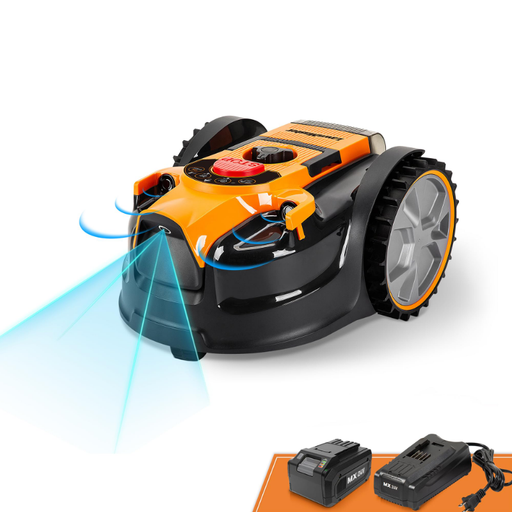
Why it stands out This wire-free robotic mower is designed for the hassle-free maintenance of small lawns. It uses a self-driving system with integrated obstacle detection and requires no complex installation or mapping. Its strength lies in its ease of use: charge it, place it on the lawn, and start.
Advantages
Who is it for? Ideal for owners of small gardens, front yards, or terraced house gardens who are looking for a simple and cost-effective solution without laying a wire.
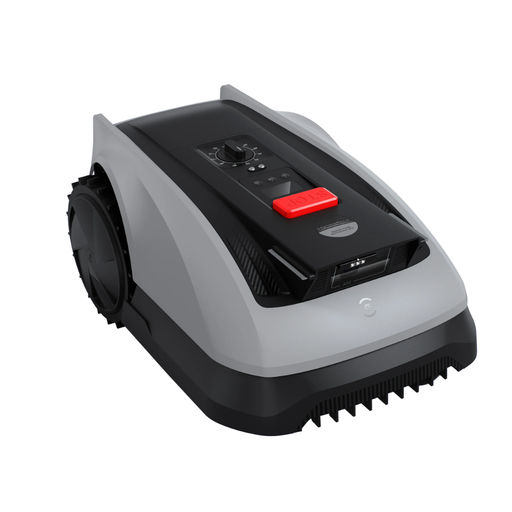
Why it stands out The GOAT O600 combines RTK navigation with an AIVI camera for obstacle detection. This technology enables centimetre-level accuracy and efficient, orderly mowing paths without a boundary wire. Setup is done via the app, which is used to set virtual boundaries for the garden.
Advantages
Who is it for? A great choice for tech-savvy owners of medium-sized gardens who value high precision, intelligent navigation, and smart app features.
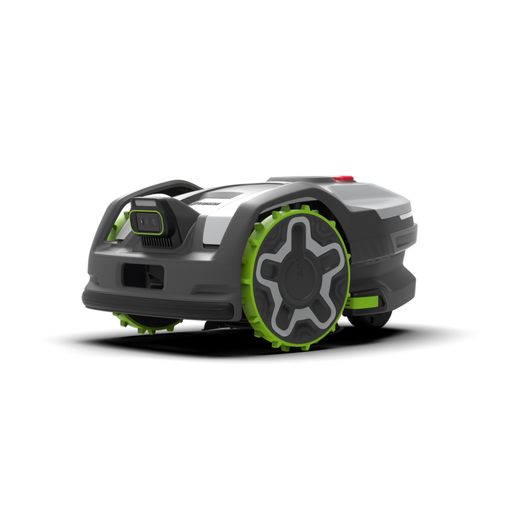
Why it stands out This model uses a combination of RTK-GPS, dual cameras, and 3D-ToF sensors for reliable navigation and obstacle detection in all lighting conditions. It automatically maps the garden and allows you to set up virtual boundaries via the app. With its area capacity, it is also suitable for larger properties.
Advantages
Who is it for? Suitable for owners of larger and more complex gardens up to 800 m? who need a powerful, wireless solution with advanced obstacle detection and flexible zone management via an app.
Robotic mower technology is constantly evolving. If the models presented here do not exactly meet your requirements or if you are looking for other lawn care solutions, you can find more options in our broader selection.
Discover more cordless lawn mowers and find the right device for your garden.
A wire-free robotic mower uses modern technologies to virtually map the boundaries of the garden. Instead of a physical wire, it orients itself using data from satellites (GPS, RTK), cameras (Vision), and other sensors. After an initial mapping—either by manually driving it along the edges or automatically—the robot stores the mowing area and navigates independently within these virtual boundaries.
The reliability of obstacle detection has improved significantly in recent years. Modern systems use a combination of different sensors such as cameras, ultrasound, infrared, or 3D-ToF (Time-of-Flight) to detect and avoid objects like garden furniture, toys, or pets. Models that fuse camera and sensor data generally offer more robust detection performance in varying light and weather conditions.
Yes, most robotic mowers, including wire-free models, are designed for very quiet operation. The noise level is often below 60 dB(A), which is roughly equivalent to the volume of a normal conversation. This low noise level makes them a quiet robotic mower that can be used even in densely populated residential areas without disturbing neighbours.