
Lieferung heute & morgen

Qualitätsgarantie

Willkommens-Angebote freischalten: KOSTENLOSE Lieferung | Bis zu 80 % RABATT | Kostenlose 30-Tage-JoyPlus-Testphase
App herunterladen
Wireless Bluetooth headphones are part of everyday life for many people: on the way to work, working from home, during exercise or while travelling. The choice ranges from true wireless headphones and classic on-ear models to open-ear headphones. However, the sheer number of technical specifications can make comparing them difficult.
Not every advertised feature is suitable for every use. For example, long battery life says little about wearing comfort, while “noise cancelling” may apply either to playback or only to voice transmission. The following criteria will help you understand marketing terms and avoid unsuitable purchases.
Manufacturers often state the maximum playback time under specific conditions. With true wireless headphones, this figure may refer to a single charge or to the combined total for the earbuds and charging case. So check both values:
ANC, or Active Noise Cancelling, reduces ambient noise during playback. This can be useful on trains, aeroplanes or in the office. ENC, or Environmental Noise Cancelling, primarily relates to microphone processing during phone calls.
A pair of Bluetooth headphones with a microphone can therefore provide clear voice transmission without actively suppressing outside noise while you listen to music. If you need both functions, look for an explicitly stated combination of ANC and ENC.
Ratings such as IPX4 or IPX5 describe protection against specific levels of water exposure. IPX4 typically means protection against splashing water, while IPX5 covers water jets under defined test conditions. This does not mean that the earbuds are suitable for swimming.
Even with waterproof Bluetooth headphones, you should pay attention to the charging case, charging port and the manufacturer’s instructions. Sweat and splash protection is sufficient for many sports, but it does not replace approval for submersion.
Bluetooth in-ear headphones sit inside the ear canal and can provide different levels of sealing depending on the silicone tips used. Several tip sizes make it easier to achieve a comfortable fit. For Bluetooth sports headphones, ear hooks, retaining clips or a flexible connection are also useful when a secure fit is required during movement.
Open-ear headphones and clip-on earbuds sit outside the ear canal. Ambient sounds remain audible, which can be beneficial in the office, while walking or in traffic. How you perceive the sound depends more heavily on the fit, surroundings and volume.
On-ear models do not completely cover the ear and can often be folded down to save space. They may be an appealing choice for longer listening sessions, but are generally less secure during exercise than models with ear hooks.
Bluetooth 5.3 or Bluetooth 5.4 describes the wireless generation, but alone does not guarantee an optimal connection in every environment. Look out for:
For gaming or watching videos, low transmission latency can be important. Models with an additional 2.4-GHz connection are more suitable for users who want particularly low latency alongside Bluetooth.
A large driver unit or wide frequency range is not, on its own, proof of a particular sound quality. More informative factors include the combination of design, passive sealing, app equaliser and personal fit.
For phone calls in the office or while out and about, ENC, multiple microphones and a suitable microphone position are relevant specifications. ANC can be an additional benefit for commuters and travellers. Open-ear headphones, on the other hand, are designed to keep your surroundings audible and therefore follow a different usage concept.
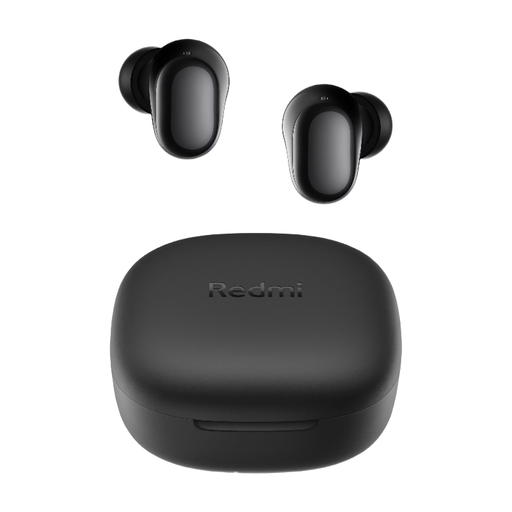
Why this product suits this profile: These true wireless in-ear headphones offer Bluetooth 5.4, a microphone, touch controls and up to 7.5 hours of playback per charge. IPX4 protection is designed for everyday use and light sporting activities.
Playback time is specified separately for a single charge and the charging case. The IPX4 rating clearly indicates protection against splashing water.
10-mm drivers, Bluetooth 5.4, up to 7.5 hours of playback per charge and Android/iOS compatibility.
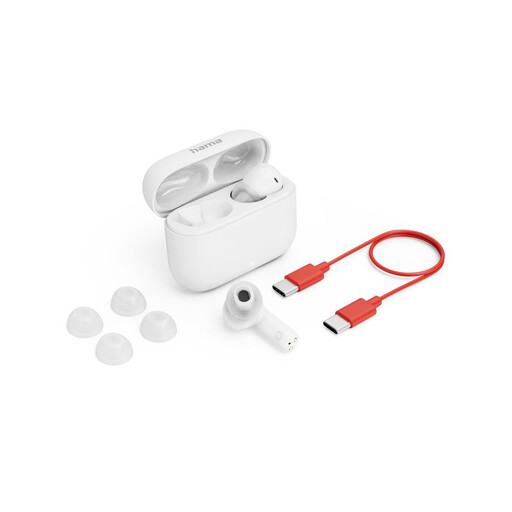
Why this product suits this profile: This model combines a true wireless in-ear design with three ANC modes, ENC, the Hama Home app and equaliser settings. This makes it easy to adapt use to the office, travel and commuting.
ANC and ENC are listed separately. The up to 20 hours refers to the earbuds and charging case combined; up to 5 hours is specified per charge.
Three ANC modes, app equaliser, transparency mode, USB-C and fast charging, providing up to 1.5 hours of playback after 10 minutes.
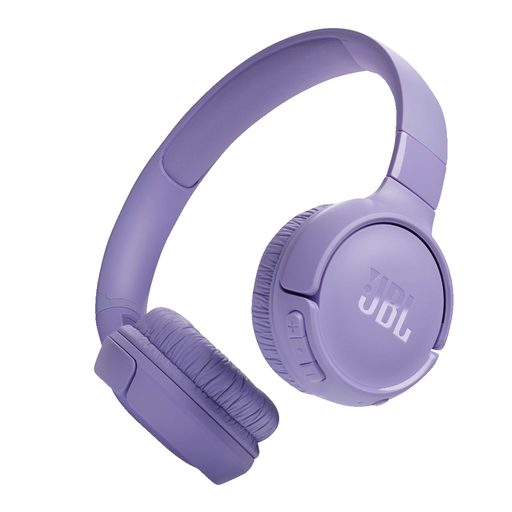
Why this product suits this profile: These on-ear headphones are ideal for users who need long playback time, a foldable design and the ability to switch between multiple devices.
The manufacturer states 57 hours of continuous playback, rather than just a combined case runtime. The on-ear design is clearly differentiated from in-ear models.
Bluetooth 5.3, up to 57 hours of playback, Multipoint, folding mechanism and app support with equaliser.
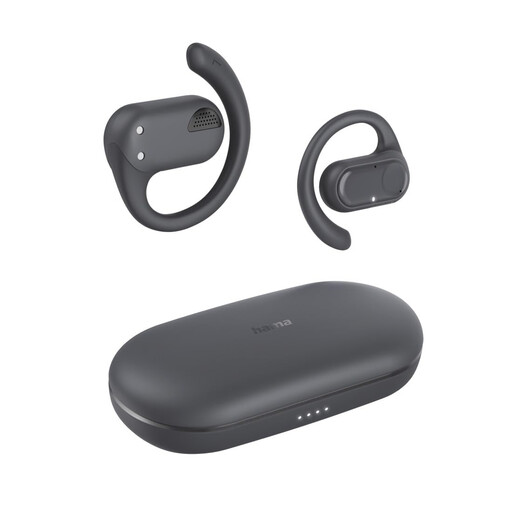
Why this product suits this profile: The open-ear design with ear hooks keeps ambient sounds audible and is aimed at office use, walks and light sporting activities.
The open design avoids creating the false expectation of complete isolation. The IPX4 rating indicates splash protection, not resistance to submersion.
Bluetooth 5.3, ENC for phone calls, app control, touch controls and a stated battery life of around 18 hours.
We have compiled a complete, regularly updated list of products that fully meet these strict selection criteria and the safety regulations applicable in the EU.
First, charge the earbuds and charging case. Then open the case or activate pairing mode using the button. Open the Bluetooth settings on your smartphone and select the displayed product name. After the first connection, many true wireless headphones will connect automatically.
Their practical service life depends on charging cycles, temperature, humidity and care. Lithium-ion batteries lose capacity over time. Use certified USB-C chargers, avoid extreme heat and store the headphones in a dry place. The stated playback time describes the condition of a new battery under defined conditions.
Active noise cancellation generally requires additional power. As a result, playback time with ANC enabled may be lower than when the function is switched off. If you want to listen for a long time without recharging, check the stated playback times with and without ANC, or choose a model with fast charging and a sufficiently large charging case.