
Lieferung heute & morgen

Qualitätsgarantie

Willkommens-Angebote freischalten: KOSTENLOSE Lieferung | Bis zu 80 % RABATT | Kostenlose 30-Tage-JoyPlus-Testphase
App herunterladen
Dark corners in your home can make daily routines challenging. Whether you're searching for clothes in a dimly lit wardrobe, fumbling in poorly illuminated kitchen cabinets, or navigating a dark hallway at night, the lack of a light source is often impractical. However, a complex electrical installation involving running cables and drilling isn't always a feasible or desirable option, especially in rented properties.
This article introduces a practical alternative: the motion sensor cabinet light. We will explain the key features to consider when making your choice and present a selection of models known for their ease of use and versatile applications. Our goal is to provide you with an informed basis for selecting the perfect lighting solution.
The range of lighting solutions is vast. To find the right model for your needs, a few technical specifications are crucial.
A light's flexibility largely depends on its power source. A rechargeable LED cabinet light offers the advantage of being reusable. Models with an integrated battery are typically charged via a standard USB cable, making them compatible with power banks, laptops, or standard USB power adapters. This reduces ongoing costs and waste. In contrast, there is the classic battery-operated wardrobe light. This can be a practical choice if a charging point is hard to reach. For rechargeable models, pay attention to the capacity, measured in milliampere-hours (mAh), as this gives an indication of the usage time per charge.
For many users, especially those in rented properties, damage-free installation is a key criterion. A no-drill under-cabinet light for the kitchen is an ideal solution for this. The most common methods are:
Modern LED strips often offer more than just on/off functionality. Adjustable colour temperatures allow you to tailor the lighting ambiance to the room and the task at hand:
Based on functionality and user-friendliness, we have compiled a few models that provide straightforward and effective lighting.
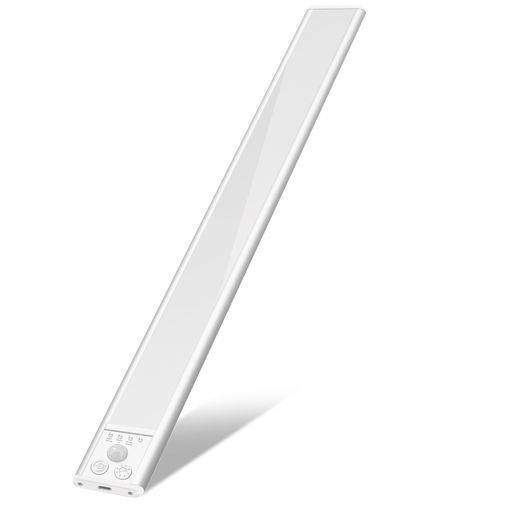
What Makes This Model Stand Out This set consists of two 30 cm long lights, making it an economical solution for outfitting multiple areas. With a height of just 10 mm, it blends discreetly into cabinets and under shelves. The integrated PIR sensor reacts to motion within a range of 3-5 metres. A special feature is the ability to choose between three colour temperatures, which can be changed at the touch of a button.
Pros
Who Is It For? This set is ideal for users looking for flexible lighting for different rooms who value an adjustable lighting ambiance. The two-pack makes it a practical starter kit.
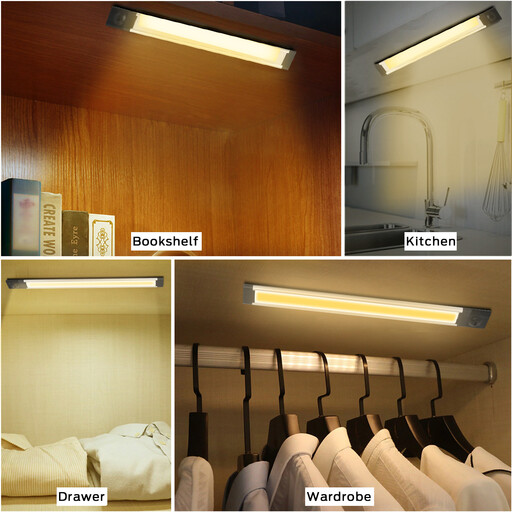
What Makes This Model Stand Out This light stands out with its gesture control operation. A wave of the hand turns the light on or off, while holding your hand steady underneath it steplessly dims the brightness. The housing, made of aluminium and ABS plastic, gives it a robust feel. With 36 Epistar SMD LEDs, it achieves an impressive brightness of 400 lumens, which is evenly distributed by a PMMA light guide plate.
Pros
Who Is It For? This model appeals to tech-savvy users who appreciate modern controls. Due to its high luminosity, it is also suitable for workshops, garages, or as a bright, rechargeable night light.
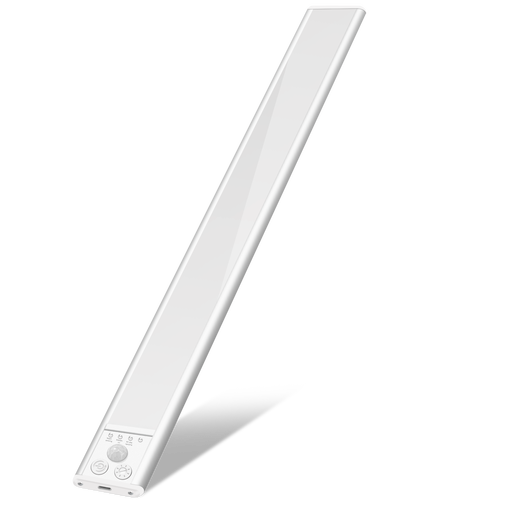
What Makes This Model Stand Out As a more compact version, this 2-pack of 20 cm lights offers a solution for smaller nooks, drawers, or narrow cabinets. Despite its smaller size, it has the same core features as the larger model: a PIR motion sensor, three selectable colour temperatures, and simple, drill-free installation. The battery has a capacity of 800mAh.
Pros
Who Is It For? Perfect for anyone who wants to specifically illuminate smaller, dark areas like drawers, shoe cabinets, or spice racks without sacrificing functional versatility.
The models presented here cover common use cases. However, if you are looking for different dimensions, designs, or specific features, it's worth taking a look at the wider range.
In our Sensor LED Lighting category, you will find a diverse selection of smart lighting solutions for every need.
1. How does a motion sensor cabinet light work? Most of these lights use a passive infrared (PIR) sensor. This sensor detects the heat radiation from bodies moving within its detection range. As soon as motion is registered, the light turns on automatically. If no further movement is detected for a predefined time (usually 15-30 seconds), it switches off again to save energy.
2. How long does the battery of an LED cabinet light last? The battery life depends on the battery capacity (mAh) and the frequency of use. In automatic mode (motion detection), a single charge can last from several weeks to months, depending on the model and activation frequency. In continuous-on mode, the runtime is significantly shorter. Models with a higher mAh rating generally offer longer usage time.
3. Can I install an under-cabinet light in the kitchen without drilling? Yes, that is one of the main advantages of these lights. Installation is typically done using a self-adhesive metal strip to which the light attaches magnetically, or directly with strong double-sided tape. It is important to thoroughly clean and dry the surface before application to ensure an optimal and long-lasting hold.