
Lieferung heute & morgen

Qualitätsgarantie

Willkommens-Angebote freischalten: KOSTENLOSE Lieferung | Bis zu 80 % RABATT | Kostenlose 30-Tage-JoyPlus-Testphase
App herunterladen
The integration of smartphones in vehicles via Apple CarPlay and Android Auto has fundamentally changed how we navigate, communicate, and listen to music. Many modern vehicles built since 2016 come with these systems from the factory—but often only with a wired connection. Constantly plugging and unplugging your smartphone can be cumbersome in daily use and leads to cable clutter in the cockpit.
A Wireless CarPlay Adapter offers a simple and effective solution. This small device enables a wireless connection between your smartphone and your car's infotainment system. This article serves as a guide to help you understand how these adapters work and make an informed decision for your vehicle and needs.
Before you decide on an adapter, there are a few technical aspects to consider to ensure seamless performance.
The most important prerequisite is that your vehicle already has factory-installed, wired CarPlay or Android Auto. Adapters will not work in vehicles without this base functionality. Also, check for compatibility with your smartphone's operating system. Most adapters require at least iOS 10 for iPhones or Android 11 for Android devices. Upgrading to wireless CarPlay is therefore limited to vehicles that already support the wired version.
A stable and fast data transfer is crucial for a lag-free experience. Look for adapters that use the 5 GHz Wi-Fi frequency band. Compared to the older 2.4 GHz band, this technology offers higher bandwidth and is less prone to interference. The result is smoother map rendering, uninterrupted music playback, and lower latency during operation.
Most devices are designed as a Plug and Play CarPlay solution. Installation is typically limited to plugging the adapter, often referred to as a CarPlay stick or Android Auto dongle, into the vehicle's designated USB port. After a one-time pairing via Bluetooth, the smartphone will connect automatically whenever you start the car. A good USB car adapter should make this process seamless and require no manual intervention.
Based on functionality, compatibility, and user-friendliness, we have compiled a selection of adapters that cover different needs.
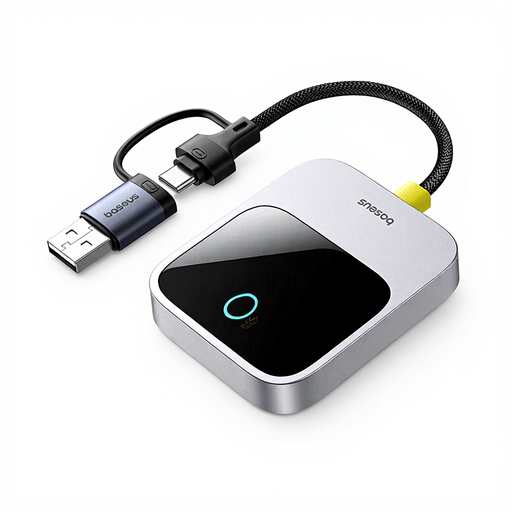
Why it stands out: The Baseus SafeJourney adapter focuses exclusively on converting wired CarPlay to wireless. Its space grey design blends discreetly into modern vehicle interiors. The connectivity is engineered for stable and responsive performance for iPhone users.
Advantages:
Who is it for? This adapter is an excellent choice for dedicated iPhone users looking for a purpose-built and aesthetically pleasing solution to upgrade their wired CarPlay system.
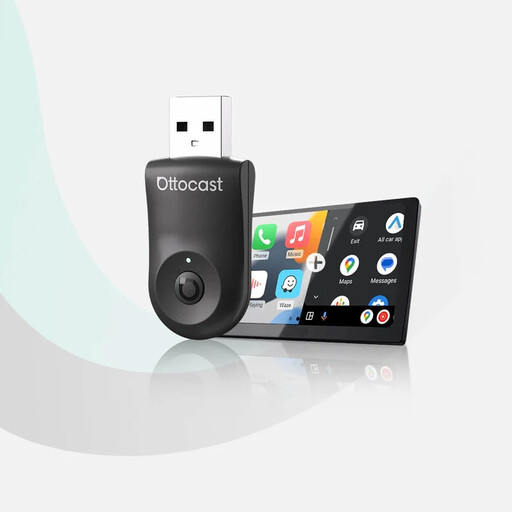
Why it stands out: The greatest strength of the OTTOCAST Mini Dongle is its flexibility. It supports both Wireless CarPlay and Wireless Android Auto in a single device. This makes it a versatile solution for drivers or families who use different smartphone brands.
Advantages:
Who is it for? Ideal for users who need flexibility—whether because they switch between an iPhone and Android, or because multiple people with different devices use the vehicle.
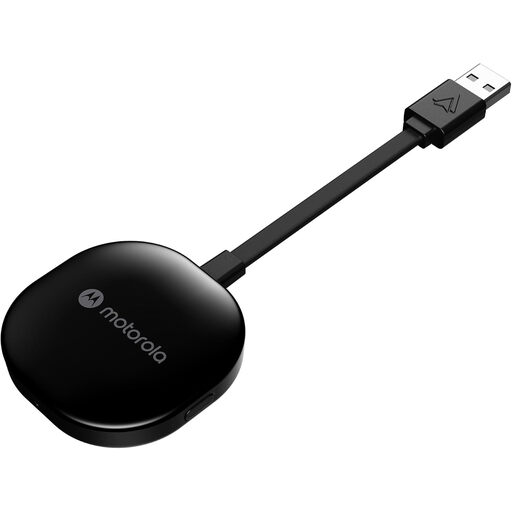
Why it stands out: The Motorola MA1 is a specialised solution designed specifically for Android Auto. As a Google-licensed product, it offers high compatibility and optimised performance for Android users.
Advantages:
Who is it for? This adapter is the right choice for Android users who prefer a dedicated solution tailored to their system for a wireless Android Auto experience.
If the featured models don't exactly meet your requirements or if you are interested in other types of connectivity solutions for your vehicle, there are other alternatives available.
Discover our entire range of Bluetooth Converters and find the perfect solution for your vehicle.
A Wireless CarPlay Adapter is plugged into the vehicle's USB port that is normally used for the wired connection. The adapter then establishes a local wireless link (usually a combination of Bluetooth for the initial handshake and Wi-Fi for data transfer) with your smartphone. To the car's infotainment system, the adapter simulates a wired connection, while the communication with the smartphone happens wirelessly.
Typically, no. Data transmission over 5 GHz Wi-Fi provides sufficient bandwidth to transfer high-quality digital audio signals. The sound quality should therefore be indistinguishable from a wired connection, as the audio data is passed to the vehicle's sound system via the same digital pathway.
No. The ability to retrofit wireless CarPlay is only available for vehicles that are already equipped with a factory-installed wired CarPlay or Android Auto system. These adapters act as a bridge to convert the existing wired function into a wireless one. They cannot add this functionality to a vehicle that does not have CarPlay or Android Auto to begin with.