
Lieferung heute & morgen

Qualitätsgarantie

Willkommens-Angebote freischalten: KOSTENLOSE Lieferung | Bis zu 80 % RABATT | Kostenlose 30-Tage-JoyPlus-Testphase
App herunterladen
In competitive gaming, every millisecond counts. Lag-free, precise control isn't a luxury—it's a prerequisite for success. However, the search for the right wireless gaming mouse can quickly become overwhelming, given the countless technical specs and marketing promises.
This article serves as an objective guide. We'll analyse the crucial features of modern wireless gaming mice and present a selection of models tailored to specific performance needs. Our goal is to provide you with an informed basis for your decision, so you can find the right tool for your playstyle.
Before making a decision, it's important to understand the core technologies that separate a good gaming mouse from an outstanding one.
A mouse's weight directly impacts agility and fatigue. An ultra-lightweight gaming mouse weighing under 60 grams allows for faster changes in direction and reduces wrist strain during long sessions. The shape is just as crucial:
The days when wireless mice were considered slow are long gone. Modern 2.4 GHz wireless technologies offer a stable and virtually latency-free connection, on par with their wired counterparts. The centrepiece, however, is the sensor. Models like the Pixart 3395 sensor are considered the industry standard, delivering flawless 1:1 tracking without unwanted acceleration or smoothing.
Another key factor is the polling rate, which indicates how often the mouse reports its position to the computer. While 1000 Hz was the standard for a long time, the 8K polling rate mouse is becoming increasingly prevalent. With 8,000 reports per second, latency is reduced to as low as 0.125 milliseconds, resulting in visibly smoother cursor movement on high-refresh-rate monitors.
Nothing is more disruptive than a dead battery mid-game. A gaming mouse with long battery life of 70 hours or more ensures you can focus entirely on the game without constantly thinking about the next charge. Look for models with a USB-C port, which allows for fast and straightforward charging.
Based on the criteria above, we have compiled a selection of models that stand out for their specific performance features.

Why it stands out: The CHERRY XTRFY M64 Wireless is distinguished by its unique ergonomic design featuring an extremely low front. This construction brings your fingers closer to the mousepad, enabling exceptional control and precision for quick "flick shots" and precise tracking. It is a fast gaming mouse developed specifically for the demands of esports.
Pros:
Best for: This model is ideal for right-handed competitive gamers seeking an ergonomic gaming mouse with maximum control and precision for fast, reactive playstyles.
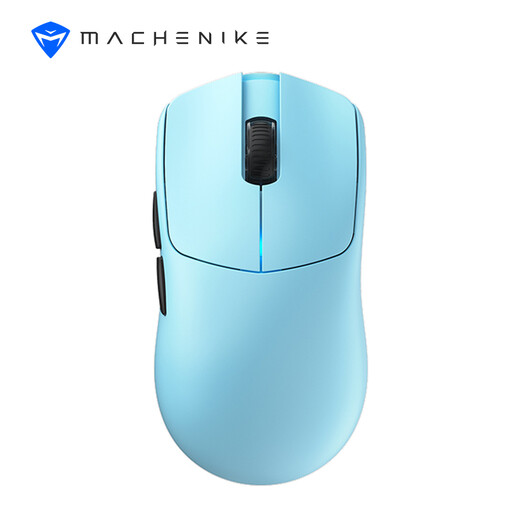
Why it stands out: The Machenike L9 X1 is an 8K polling rate mouse that achieves a polling rate of 8000 Hz in both wired and 2.4 GHz modes. This results in an extremely low latency of 0.125 ms and exceptionally smooth cursor movement. At just 49 grams, it is also one of the lightest mice on the market.
Pros:
Best for: Perfect for esports professionals and ambitious gamers who play on high-refresh-rate monitors and need the lowest possible input lag for a tangible competitive edge.
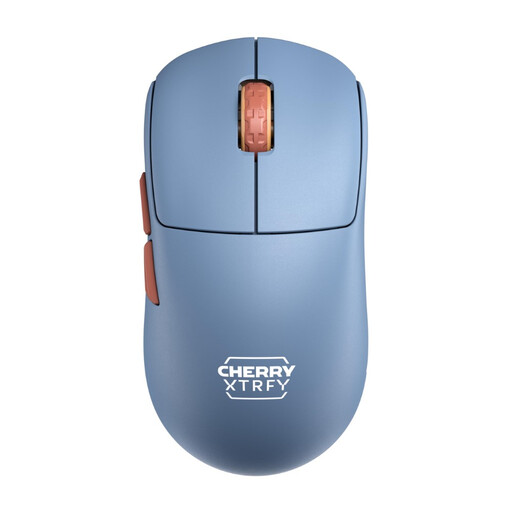
Why it stands out: The CHERRY XTRFY M68 combines the benefits of an ultra-lightweight gaming mouse with a versatile symmetrical shape. Like the M64, it features the signature ultra-low front for enhanced control but is designed for players who prefer an ambidextrous shape or frequently switch between different grip styles.
Pros:
Best for: An excellent choice for gamers looking for a lightweight gaming mouse with a symmetrical design that offers maximum flexibility for different hand sizes and grip styles (claw, fingertip).
Choosing the right mouse is a highly personal decision that depends on hand size, grip style, and aesthetic preferences. If the models presented here don't exactly match what you're looking for, there are other options to explore.
Discover our entire selection of blue gaming mice to find the perfect model for your setup.
Yes. Modern wireless mice using 2.4 GHz technology offer signal stability and latency comparable to wired models. Many professional esports athletes now use wireless models because they provide freedom of movement without sacrificing performance.
An 8K polling rate mouse reports its position to the computer 8,000 times per second, compared to the 1,000 times of a standard 1 kHz mouse. This reduces latency from 1 ms to 0.125 ms. On high-refresh-rate monitors (240 Hz and above), this can lead to a noticeably smoother and more responsive cursor movement.
An ultra-lightweight gaming mouse (typically under 60g) has lower inertia. This means less force is required to start and stop the mouse's movement. This allows for faster, more precise motions, especially during quick directional changes, and can reduce hand and arm fatigue during long gaming sessions.