
Lieferung heute & morgen

Qualitätsgarantie

Willkommens-Angebote freischalten: KOSTENLOSE Lieferung | Bis zu 80 % RABATT | Kostenlose 30-Tage-JoyPlus-Testphase
App herunterladen
Having a light switch in an inconvenient location—or lacking one altogether—is a common problem in many apartments and houses. Especially in rental properties or older buildings, running new cables for an additional switch often involves significant effort, mess, and expense, or it is simply not permitted. A wireless light switch offers a practical and straightforward solution.
This article serves as your guide. It explains how they work, highlights the key criteria to consider when making a selection, and presents specific models. Our goal is to provide you with a solid basis for making an informed decision to upgrade your lighting—without having to break open any walls.
Before you decide on a model, several technical aspects should be considered to ensure the product meets your requirements.
The type of installation is crucial for its intended use. There are essentially three main variations:
The choice of technology determines the range of functions and the setup process:
Consider whether you might want to integrate more lamps or switches into the system in the future. Many manufacturers offer an expandable wireless switch kit, allowing you to easily pair additional transmitters and receivers from the same system. Ensure that the components are compatible with each other, as products from different brands generally cannot communicate.
Here is a selection of products that cover different use cases—from simple retrofitting to full smart home integration.

What makes this product stand out: This kit is designed for discreetly retrofitting a light switch. The compact receiver is installed directly in the supply line to the lamp (e.g., in a junction box or the lamp base), eliminating the need for new in-wall wiring. The wireless switch itself can be placed on any wall surface.
Advantages:
Who is it for? For homeowners and renovators who want to control an existing ceiling or wall light with an additional, freely placeable switch without making major changes to the existing electrical installation.

What makes this product stand out: This remote control socket with a switch is a plug-and-play solution. No installation is required. The clever feature is the detachable switch: it attaches magnetically to its wall mount, allowing it to be used as a fixed wall switch or a portable remote control.
Advantages:
Who is it for? Ideal for renters and anyone looking for a quick, flexible solution to control floor lamps, string lights, or other electrical devices with a switch, without altering the building's structure.
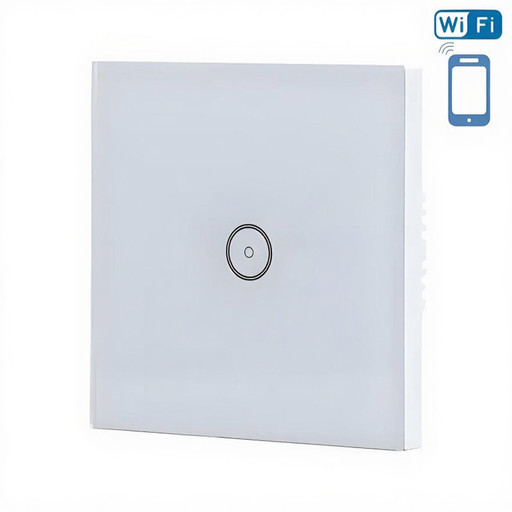
What makes this product stand out: This Wi-Fi light switch replaces a conventional in-wall switch and integrates your lighting into your smart home. With its elegant glass surface and touch controls, it modernizes not only the function but also the look of your wall.
Advantages:
Who is it for? For tech-savvy users who want to make their lighting smart and integrate it into an existing smart home system. Requires installation in an existing flush-mounted box with a connection to the 230V mains.
The products featured here cover common scenarios. However, if you need a different style or a specific design, a wide range of alternatives is available.
Discover more models and find the perfect solution for your home in our White Wall Switches category.
1. How does a wireless light switch work? A wireless light switch consists of two components: a transmitter (the switch) and a receiver. When you press the switch, the transmitter sends a radio signal (RF or Wi-Fi) to the receiver. The receiver, which is connected to the power supply and the lamp, then switches the electrical circuit on or off based on the signal it receives.
2. Does a wireless light switch need a battery? In most cases, yes. The transmitter (the actual switch) is battery-powered (often with long-lasting coin cells like CR2032) because it is not connected to the mains. This allows it to be placed anywhere. The receiver, on the other hand, is permanently powered by the 230V mains, either through a socket or a direct connection.
3. Can I install a wireless light switch myself? That depends on the model. A remote control socket can be safely used by anyone without prior experience. Attaching a battery-powered surface-mounted switch to the wall is also straightforward. For models that require a connection to the 230V mains (e.g., flush-mounted receivers or Wi-Fi wall switches), any work on the electrical installation should only be carried out by a qualified electrician in accordance with legal regulations and for your own safety.