
Lieferung heute & morgen

Qualitätsgarantie

Willkommens-Angebote freischalten: KOSTENLOSE Lieferung | Bis zu 80 % RABATT | Kostenlose 30-Tage-JoyPlus-Testphase
App herunterladen
A wireless mechanical gaming keyboard should respond reliably during gaming, take up minimal desk space and connect to several devices when needed. At the same time, models vary considerably in terms of layout, switches, battery capacity and wireless technology. If you focus only on RGB lighting or a high key count, you may overlook important details.
This buying guide from the Joybuy Product Recommendation Officer explains which specifications really matter when buying a wireless mechanical keyboard and which models suit different usage scenarios.
For users in Germany, the keyboard layout is particularly important. A QWERTZ keyboard places the “Z” and “Y” keys differently from a QWERTY keyboard, among other differences. Special characters, key labels and the position of umlauts may also vary.
In Windows, a US layout can often be switched to German using software settings. However, the labels on the keycaps remain unchanged. If you regularly write German text, look for “German”, “ISO-DE” or “QWERTZ” on the product page before buying.
A Bluetooth 2.4 GHz gaming keyboard may offer several connection options. Bluetooth is generally suitable for laptops, tablets and several mobile devices. A 2.4 GHz receiver is useful for desktop PCs and wireless gaming, while USB-C provides a wired alternative.
With a Bluetooth-only keyboard, setup may require more attention depending on the device. A tri-mode keyboard with Bluetooth, 2.4 GHz and USB-C offers greater flexibility. Before buying, check whether the USB receiver is included and which operating systems are actually supported.
Battery life depends on factors including RGB brightness, wireless mode and usage. Figures such as “up to” usually refer to specific conditions, often with the lighting switched off. Active RGB lighting can use considerably more energy.
It is therefore practical to choose a model that can also be used via USB-C while charging. For everyday use, you should also consider the charging indicator, cable connection and how easily you can switch between modes.
The form factor affects key reach and the amount of space required:
A number pad can be useful for office work, programming and spreadsheets. For FPS games or minimalist setups, 65% and 75% layouts often offer a better balance of functionality and desk space.
Linear switches glide through the key travel without a noticeable actuation bump. Tactile switches provide noticeable feedback when pressed. Clicky variants also produce a distinct sound. The right choice depends on personal preference, the type of games you play and your noise environment.
A hot-swap keyboard allows you to replace compatible switches without soldering. You need to check whether it supports 3-pin or 5-pin switches. The keyboard should be switched off before replacing switches. Pull them straight upwards to avoid damaging the connections.
PBT keycaps are often more resistant to shiny wear than ABS keycaps. However, actual durability depends on material thickness, surface finish and usage. RGB lighting may be available per key or as a selection of pre-set effects. It does not automatically improve input performance, but it can enhance visibility and help you customise your setup.
A keyboard with a rotary knob lets you adjust the volume or control media without using keyboard shortcuts. This can be useful for video editing, streaming or office work. Only install additional software if it is provided by the manufacturer and is compatible with your operating system.
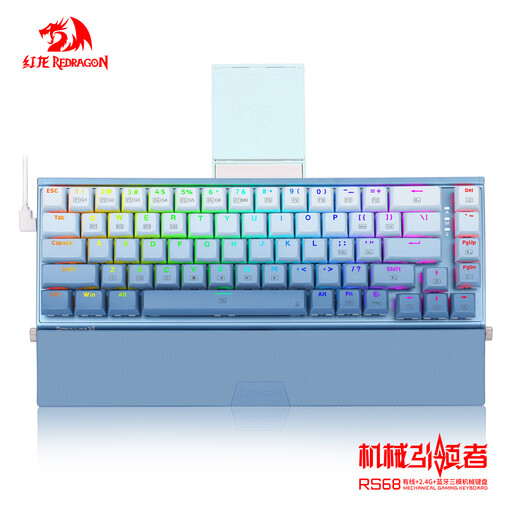
Why this product suits the profile: The 65% form factor with 68 keys is designed for compact gaming setups. Bluetooth, 2.4 GHz and USB-C cover a range of connection needs.
The connection options are clearly listed as tri-mode. The hot-swap PCB allows you to replace the switches later without soldering.
65% layout, aluminium housing, RGB lighting and a detachable wrist rest.

Why this product suits the profile: The German QWERTZ layout, low-profile MX Speed switches and compact 65% form factor combine gaming and office functionality.
The layout is explicitly identified as German QWERTZ. Tri-mode operation supports 2.4 GHz, Bluetooth and USB-C.
Per-key RGB, N-key rollover, anti-ghosting and the option to pair up to three Bluetooth devices.
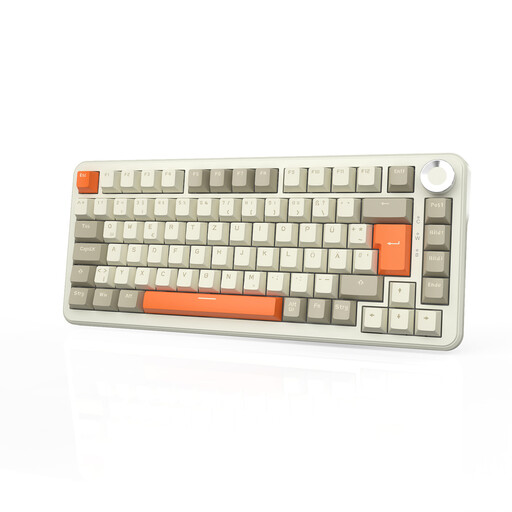
Why this product suits the profile: For switching between gaming, office work and multi-device tasks, this model offers a 75% form factor, QWERTZ keycaps and a rotary knob.
The stated 8000-mAh battery is described with specific usage figures for lighting switched on and off. Hot-swap supports 3- and 5-pin switches.
PBT keycaps, RGB lighting, tri-mode connectivity and an aluminium rotary knob with customisable functionality.
We have put together a complete, regularly updated list of products that fully meet these strict selection criteria and the safety regulations applicable in the EU.
Yes, provided it has a stable 2.4 GHz mode with a USB receiver. For particularly consistent performance, USB-C can be used. Bluetooth is convenient for office and multi-device use, but depends more heavily on the device you are connecting to.
Lifespan depends on the switches, keycaps, battery and care. An integrated battery is a wear component. Models with hot-swap functionality can be adjusted more easily with compatible switches if the typing feel changes. Liquids, heat and heavy impacts should always be avoided.
RGB lighting increases energy consumption compared with having the lighting switched off. Brightness, effects and wireless mode also have an impact. If you need longer periods of wireless use, you can reduce or disable the lighting and operate the keyboard via USB-C when necessary.