
Lieferung heute & morgen

Qualitätsgarantie
App herunterladen
Kategorien
Selecting a wireless mechanical keyboard hinges on a balance of technical parameters that define the user experience for productivity, gaming, and customisation. Key factors include connectivity protocols, internal construction, component material quality, and software flexibility. This article analyses the essential features to consider when choosing a high-end model in 2026.
Evaluating a wireless mechanical keyboard requires an understanding of its underlying technologies. The following criteria are crucial for making an informed decision.
Wireless connections are primarily achieved through two standards:
Models with tri-mode connectivity (2.4 GHz, Bluetooth, USB-C cable) offer the greatest flexibility for various use cases.
The way the printed circuit board (PCB) is mounted inside the case significantly impacts acoustics and typing feel. The gasket mount design has established itself as an advanced method. In this construction, the PCB-and-plate assembly is "suspended" between silicone or Poron gaskets located in the top and bottom halves of the case. This isolates vibrations from keystrokes, preventing them from transferring to the rigid case. The result is a more dampened, softer, and acoustically consistent sound profile compared to more rigid mounting styles like tray-mount.
The ability to personalise is a core feature of modern mechanical keyboards.
Keycaps are the primary point of contact for the user. Their material is crucial for feel and durability. PBT keycaps (polybutylene terephthalate) offer significant advantages over the less expensive ABS (acrylonitrile butadiene styrene) plastic. PBT is more resistant to abrasion and skin oils, allowing the surface to retain its matte finish longer without developing a "shine". Double-shot PBT keycaps, where the legend is moulded from a separate piece of plastic, are extremely durable because the lettering cannot wear off.
Based on the technical criteria above, we present two models that focus on different priorities.
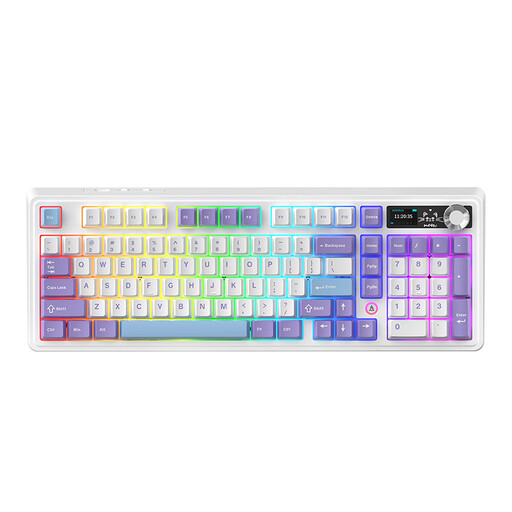
Why We Recommend It The AJAZZ AK980 V2 packs a high density of features into a compact 98% layout. Particularly noteworthy are its integrated TFT display for status updates and custom GIFs, and its exceptionally large 10,000 mAh battery. The combination of tri-mode connectivity, hot-swap capability, and a gasket-mount structure with multi-layer dampening makes it a highly versatile option.
Pros
Who It's For Users looking for a feature-rich keyboard with a numpad in a compact form factor. It is ideal for power users and gamers who value long battery life, a display for extra information, and a dampened typing experience right out of the box.
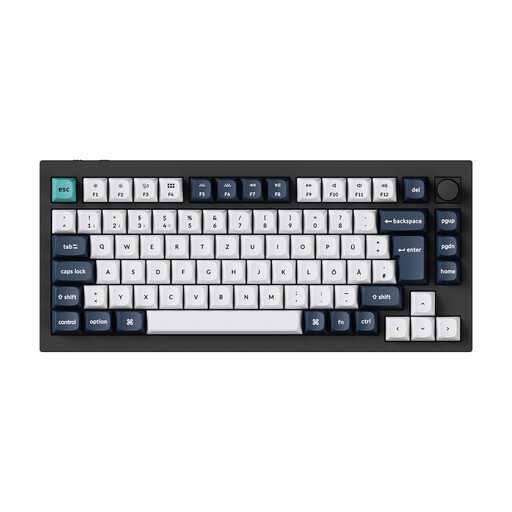
Why We Recommend It The Keychron Q1 Max is positioned as a premium custom keyboard with a focus on material quality and typing feel. Its fully CNC-machined 6063 aluminium case and double-gasket structure deliver exceptional stability and acoustics. Support for QMK/VIA software allows for in-depth programming of every key, making it especially attractive to developers and enthusiasts.
Pros
Who It's For Keyboard enthusiasts, programmers, and creative professionals who demand the highest standards in build quality, typing feel, and software customisability. The compact 75% layout is ideal for users who value a clean desk setup.
The peripherals market is diverse, offering solutions for specific needs that go beyond the models featured here. Different layouts, switch types, or form factors may be better suited for certain use cases. You can find a wider selection of keyboards and accessories in our main category for Kabelanschluss.
1. What is the advantage of a gasket-mount keyboard? The main advantage of a gasket-mount construction is the acoustic and haptic decoupling of the typing assembly from the case. This results in a more dampened, less harsh bottom-out and a more consistent sound profile across the entire keyboard, as vibrations are absorbed by the flexible gaskets.
2. Is a 2.4 GHz keyboard better for gaming than Bluetooth? Yes, for latency-sensitive gaming, a 2.4 GHz keyboard is generally the better choice. The dedicated connection via a USB dongle allows for a polling rate of up to 1000 Hz, which reduces input delay to a level that is imperceptible to humans. Bluetooth connections typically have higher latency and are better optimised for office applications and multi-device scenarios.
3. What are PBT keycaps and why are they relevant? PBT keycaps are made of polybutylene terephthalate, a durable and textured plastic. Unlike conventional ABS keycaps, they are resistant to skin oils, which means they retain their matte finish for years without becoming shiny or "greasy". This ensures a consistently premium feel and a longer lifespan for the keycaps.