
Lieferung heute & morgen

Qualitätsgarantie
App herunterladen
Kategorien
For many garden owners, installing a boundary wire is a significant barrier to adopting an automatic lawn mower. Models that operate without a physical boundary use advanced navigation technologies to automate lawn care. These devices navigate using satellite signals and visual sensors, which simplifies setup and increases flexibility in garden design.
A wire-free robotic mower virtually maps the area to be mowed via a smartphone app. Users can digitally define and adjust mowing zones, no-go areas, and travel paths at any time. This eliminates the hassle of laying, maintaining, and repairing a wire that could be damaged by gardening activities or weather.
Choosing a suitable model is based on an analysis of its technical specifications. The following parameters are relevant for making an informed decision.
The precision of a wire-free robotic mower is largely determined by its navigation technology.
The recommended area capacity, specified in square metres (m²), is a key indicator. It is determined by the battery capacity (in Ampere-hours, Ah) and the cutting width. For properties around 1000 m², a robotic mower for 1000 sqm with a battery capacity of at least 2.5 Ah and a charging time of under two hours is a practical choice to cover the area efficiently.
Modern devices use a combination of sensors for obstacle detection. Ultrasonic sensors, 3D cameras, and LiDAR scanners detect objects such as garden furniture, toys, or animals, prompting the robot to adjust its route. Lift and tilt sensors stop the blades immediately if the device is lifted. The protection class (e.g., IPX6) indicates the water resistance of the housing.
A stable connection via Wi-Fi or Bluetooth is essential for functional app-controlled robotic mowers. The app is used for initial setup, defining mowing zones and no-go areas, and setting mowing schedules and cutting height. An intuitive app user interface is crucial for practical usability.
The following models represent a selection of wire-free robotic mowers that stand out for their technical specifications and features.
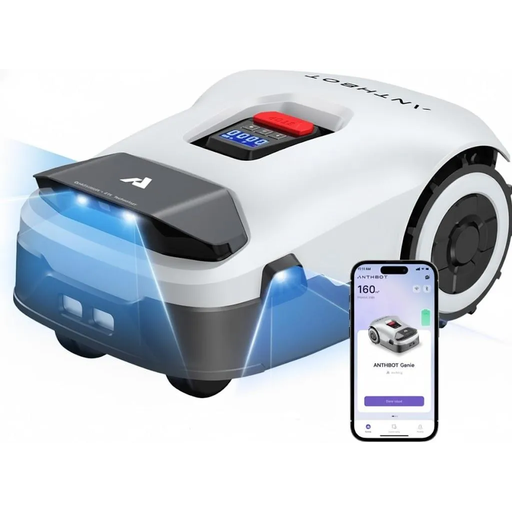
Why we recommend this product: The ANTHBOT Genie 600 combines RTK-GNSS navigation with visual camera support. This fusion enables precise positioning and stable mowing performance. The device mows in systematic paths, resulting in a uniform finish and increased efficiency. The electronic cutting height adjustment via the app and high water resistance (IPX6) are practical features for everyday use.
Advantages:
Best suited for: Users with lawns up to 900 m² who value centimetre-level accuracy, systematic mowing paths, and a robust, weatherproof design.
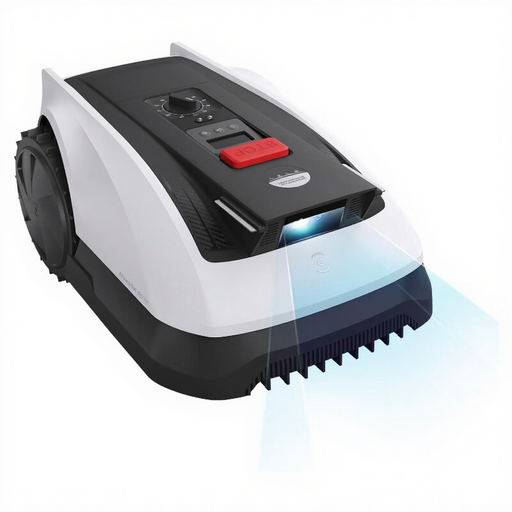
Why we recommend this product: The ECOVACS GOAT O800 is distinguished by its highly advanced sensor suite. It supplements GPS-RTK technology with LiDAR and AIVI 3D obstacle avoidance. According to the manufacturer, the system can recognise over 200 different types of obstacles. This combination is particularly beneficial for complex gardens with narrow passages (down to 0.7 m) and numerous objects. The wide 22 cm cutting width contributes to swift coverage.
Advantages:
Best suited for: Owners of gardens up to 800 m² with complex layouts, narrow passages, slopes, and numerous obstacles who require advanced and reliable object detection.
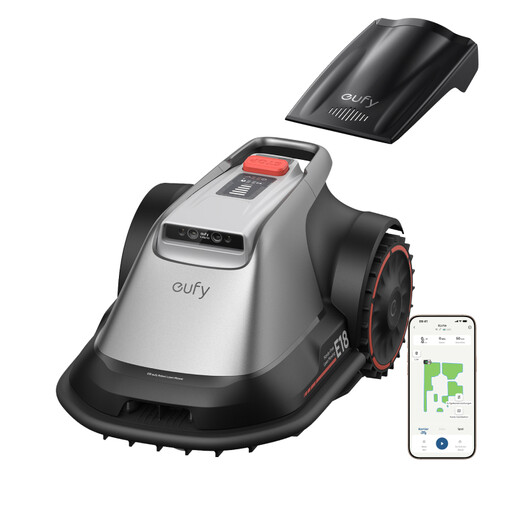
Why we recommend this product: The eufy E18 takes a different technological approach. It forgoes an RTK reference station, instead relying on TrueVision technology combined with a GNSS system. This approach aims to minimise signal interference that can occur with RTK systems due to obstruction of the base station (e.g., by buildings). With an area capacity of up to 1200 m², it is designed for larger properties.
Advantages:
Best suited for: Users with larger lawns up to 1200 m² who prefer a solution without a separate RTK base station or live in areas with potentially unstable satellite reception for a stationary antenna.
The models presented cover specific use cases for the wire-free robotic mower. If your requirements differ—for example, in garden size, budget, or desired technology—a broader market analysis may be worthwhile. This also includes models with traditional boundary wires, which remain a valid option in certain scenarios.
For a comprehensive overview of different models and technologies, visit our Garden Lawn Mowers category.
1. How accurately do wire-free robotic mowers navigate? Navigational accuracy depends on the technology. Models with RTK technology achieve centimetre-level precision by correcting satellite signals via a local base station. Systems based on cameras (Vision) and standard GPS/GNSS may have slightly higher deviation, but this is sufficient for many gardens. Accuracy is enhanced by a clear view of the sky and optimal placement of the RTK station.
2. Are GPS-enabled robotic mowers suitable for gardens with many trees? Dense tree cover can impair the reception of satellite signals (GPS/GNSS). This can reduce the navigational accuracy of both standard GPS and RTK systems. Models that also rely on visual navigation through cameras or LiDAR can partially compensate for this disadvantage, as they also orient themselves using visual cues from the environment. For heavily shaded gardens, a model like the eufy E18, which operates without an RTK station, or a traditional mower with a boundary wire may be an alternative worth considering.
3. What does RTK mean for a boundary wire-free robotic lawn mower? RTK stands for Real-Time Kinematic. It is a technique for enhancing the positional accuracy achieved by satellite navigation systems like GPS, GLONASS, Galileo, and BeiDou. An RTK system consists of two receivers: a mobile unit in the robotic mower and a fixed base station in the garden. The base station knows its exact position and sends correction data to the robot. This allows the robot to determine its own position with an accuracy of a few centimetres, ensuring precise mowing edges and systematic driving paths.