
Lieferung heute & morgen

Qualitätsgarantie

Willkommens-Angebote freischalten: KOSTENLOSE Lieferung | Bis zu 80 % RABATT | Kostenlose 30-Tage-JoyPlus-Testphase
App herunterladen
A wok pan is ideal for stir-fries, vegetables, meat, fish and noodles, as well as steaming and braising. Yet the choice ranges from lightweight aluminium to heavy cast iron, and from uncoated stainless steel to coated wok pans. If you focus only on the price or terms such as “non-stick”, you can easily overlook important details.
The following buying criteria will help you choose a wok pan that suits your household – regardless of whether you cook with gas, electric, ceramic or induction.
A 30 cm wok may measure 30 cm at the top rim, while the flat base is considerably smaller. For induction hobs, it is therefore not just the rim diameter that matters, but also the diameter of the magnetic base. On a small cooking zone, a large wok may also stand unstably or heat unevenly.
For one or two people, 28 to 30 cm is often sufficient. Families or anyone preparing larger quantities may wish to consider a wok measuring 32 to 35 cm. Before buying, check the dimensions of the cooking zone and the available space in your kitchen.
A coated wok pan may have a traditional non-stick coating, a ceramic layer or a textured surface. These variants differ in terms of temperature limits, care requirements and the kitchen utensils they are suitable for. A coating is not automatically designed for prolonged heating at the highest setting.
For this reason, look for specific information on heat resistance, oven suitability and cleaning. With coated models, wooden or silicone utensils are generally the safer choice. Do not preheat an empty non-stick wok if the manufacturer expressly advises against it.
A cast-iron wok retains heat for a long time, but takes longer to heat up and is more difficult to move. A carbon-steel wok usually responds more quickly to changes in temperature, but requires consistent drying and care. Aluminium generally heats up quickly and is lighter, while uncoated stainless steel requires a particular cooking technique to reduce sticking.
An induction wok requires a magnetic base. The description “suitable for all hob types” should be supported by specific information for gas, electric, ceramic and induction hobs. A flat base is particularly important on electric, ceramic and induction hobs. On a gas hob, a more strongly curved, traditional Chinese wok may be a sensible choice, provided you have a suitable wok ring.
With multi-layer models, such as a combination of stainless steel and aluminium, heat conduction should not be confused with completely uniform temperatures across every part of the pan. When using a wok for frying and sautéing, moving the ingredients between the hot base and the cooler sides is part of the cooking principle.
A wok with lid is practical for braising, steaming and keeping food warm. A glass lid allows you to monitor the contents, while a metal lid is often more suitable for oven use – provided the manufacturer expressly confirms this. Also check the handle material, total weight and cleaning method.
Uncoated carbon-steel and cast-iron models should generally be cleaned by hand, dried immediately and oiled according to the product instructions. With stainless steel, water marks or discolouration can be removed using mild household products such as vinegar. Coated wok pans benefit from soft sponges and avoiding sharp metal utensils.
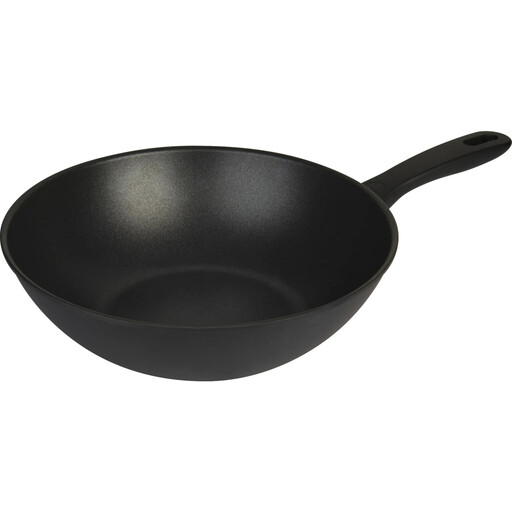
Why this product suits this profile: This 30 cm aluminium wok is designed for various hob types, including induction, and remains comparatively easy to handle at around 1.4 kg.
The product details explicitly state the diameter, hob compatibility, coating and an oven limit of 160 °C.
Four-layer KERAVIS Extreme coating, dishwasher-safe and designed for gas, electric, ceramic and induction hobs.
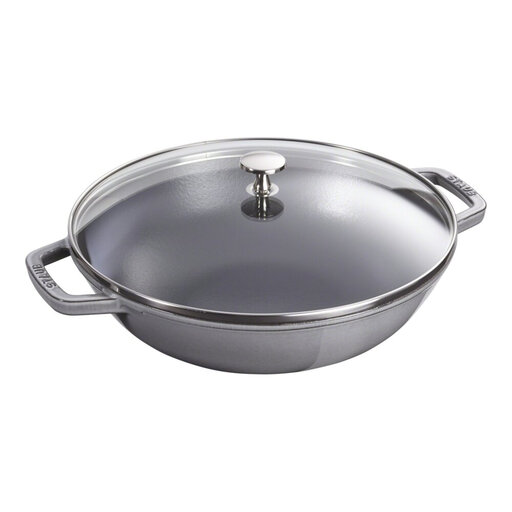
Why this product suits this profile: This 30 cm cast-iron wok combines excellent heat retention with a glass lid and is specified as suitable for all hob types, including induction.
The details clearly state the material, 4.5-litre capacity, 4.43 kg weight, oven suitability and care instructions.
Enameled cast iron, glass lid and use on gas, electric, ceramic and induction hobs.
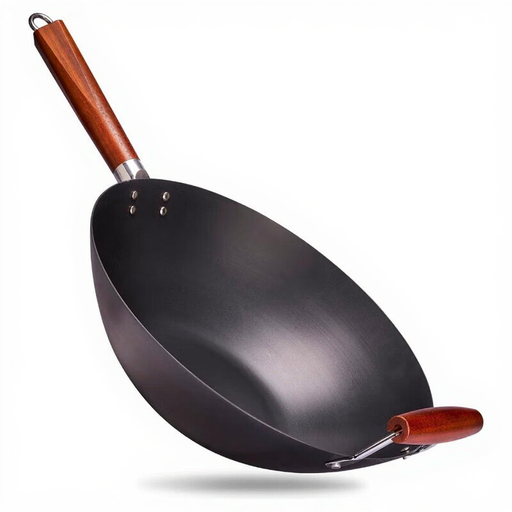
Why this product suits this profile: At 35 cm, this large carbon-steel wok offers plenty of space for family-sized portions and traditional high-heat cooking.
According to the product details, the surface is free from chemical, PFOA and PTFE coatings; care and rust protection are clearly explained.
35 cm diameter, high-temperature suitability and a surface maintained through regular oiling.

Why this product suits this profile: This uncoated stainless-steel pan with a metal lid is suitable for different cooking techniques and all common hob types.
The three-layer construction with an aluminium core and integrated steam regulator are specific technical details rather than a blanket non-stick claim.
Cromargan stainless steel, aluminium core, metal lid with steam vent and oven suitability.
We have put together a complete, regularly updated list of products that fully meet these strict selection criteria and the safety regulations applicable in the EU.
For one or two people, 28 to 30 cm is often sufficient. A 30 cm wok fits comfortably on many domestic hobs. For several people or larger portions, a model measuring 32 to 35 cm offers more capacity, but also requires more storage space.
Only if the base is magnetic and sits flat on the cooking zone. Check the manufacturer’s specific information on induction compatibility, as well as the base diameter. With a traditional, strongly curved Chinese wok, a special wok ring may be required.
Its lifespan depends on the material, coating, temperature and care. Uncoated stainless steel, cast iron and carbon steel can provide many years of use when treated carefully. With a coated wok pan, scratches, overheating and abrasive cleaners are common reasons for premature replacement. Check regularly that the surface, handles and base are undamaged.