
Lieferung heute & morgen

Qualitätsgarantie

Willkommens-Angebote freischalten: KOSTENLOSE Lieferung | Bis zu 80 % RABATT | Kostenlose 30-Tage-JoyPlus-Testphase
App herunterladen
Choosing the right footwear is crucial for tours in the mountains. On demanding routes in particular, your safety and comfort depend directly on your boots. An ill-fitting boot can not only compromise your trip but also lead to safety risks. This article serves as a guide, presenting objective criteria to consider when selecting hiking boots for women.
Finding the right boot can be complex, given the vast array of models, materials, and technologies. To make an informed decision, you should focus on a few key technical features.
For tours in changeable weather or through damp terrain, waterproof hiking boots for women are a prerequisite. Modern hiking boots use special membranes integrated between the upper material and the inner lining. These membranes prevent water from penetrating from the outside while allowing sweat to escape as water vapour. The upper material itself, often a combination of leather and synthetic fabrics, should be robust and abrasion-resistant to protect the foot from rocks and brush.
High-cut trekking boots offer a decisive advantage on rough terrain: they stabilise the ankle joint and reduce the risk of rolling it. The height of the shaft should be chosen to provide sufficient support without unnaturally restricting freedom of movement.
The sole construction is another critical factor for sturdy hiking boots. It typically consists of three layers:
A hiking boot must fit precisely. It should be snug in the heel area to prevent blisters, while the toes need enough room to avoid hitting the front on descents. Innovative lacing systems can offer added value here. In addition to classic laces, there are now also hiking boots with a quick-lacing system. These systems allow for a fast and highly precise adjustment of the fit, often with just one hand, which is especially practical when wearing gloves or during short breaks.
Based on the aforementioned criteria for functionality and technical features, we present a model designed for experienced female hikers.
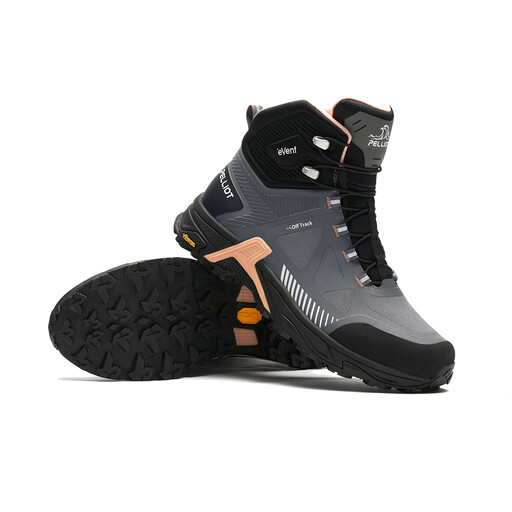
View details on the PELLIOT hiking boot now
Why this model stands out
The Pelliot hiking boots are designed for use in difficult terrain. They combine a high shaft for maximum support with modern technologies for fit and protection. The design focuses on the needs of mountaineers who are looking for a reliable partner for long and technically demanding tours.
Advantages
Who is this boot for? This model is aimed at experienced hikers and mountaineers who regularly venture into alpine or rugged terrain. Anyone looking for a technically advanced, stable, and robust boot for demanding treks or technical climbs will find a suitable option here.
The featured hiking boot is tailored to a specific requirement profile. If you are looking for a comfortable change of pace for relaxed moments after your demanding tour, it might be interesting to look at other shoe categories. For recreation and leisure, you might find a suitable option in our selection of sexy flat shoes.
1. What is the difference between mountaineering boots and hiking boots? The main difference lies in the stiffness of the sole and the height of the shaft. Hiking boots are more flexible and designed for tours in easy to moderate terrain (e.g., low mountain ranges). Mountaineering boots have a stiffer sole, often with the option to attach crampons, and a higher shaft. They are designed for alpine, rocky, and challenging terrain where maximum support and stability are required.
2. How important is a high shaft on women's hiking boots? A high shaft is a key safety feature. It encloses and supports the ankle joint, which significantly reduces the risk of twisting your ankle on uneven ground. Especially when carrying a heavy backpack or during long descents, the high shaft helps to relieve the joints and increase sure-footedness.
3. Do waterproof hiking boots need to be broken in? Yes, even modern hiking boots should be broken in before the first big tour. Although many materials are more flexible today than in the past, the boot only adapts optimally to the individual shape of your foot through wear. Start with short walks and gradually increase the duration. This allows potential pressure points to be identified early and helps prevent blisters on the actual tour.