
Lieferung heute & morgen

Qualitätsgarantie

Willkommens-Angebote freischalten: KOSTENLOSE Lieferung | Bis zu 80 % RABATT | Kostenlose 30-Tage-JoyPlus-Testphase
App herunterladen
Wood acoustic panels have become a cornerstone of modern interior design. They promise to improve room acoustics while serving as a stylish design statement. However, the market is filled with products of widely varying quality. Many buyers invest in panels that are visually appealing but remain acoustically ineffective. This guide will help you identify the crucial features and make an informed choice.
Before you make a decision, it's important to understand the most common issues that can lead to disappointment and unnecessary expenses.
wood-look wall panels consist merely of a printed plastic film on a thin backing board. These products offer no significant sound-absorbing properties and serve purely decorative purposes, even though they are often marketed as acoustic solutions.To separate the wheat from the chaff, focus on three verifiable technical specifications. These determine whether a panel is convincing both aesthetically and functionally.
The construction is crucial. Effective wood acoustic panels consist of three layers:
walnut acoustic panels) provides an authentic and high-quality look. It is more durable and aesthetically pleasing than a simple foil wrap.wood slat wall construction.improve room acoustics.The arrangement of the slats also plays a role. 3D wall panels with clearly defined gaps between the wood slats are not just a visual feature. The spaces expose the sound-absorbing felt, increasing its effective surface area. At the same time, the edges of the slats break up and scatter sound waves, further enhancing the overall effect. An arrangement that is too tight or flat diminishes this effect.
A good system offers flexibility in installation. The option to either glue the panels directly to the wall (with a suitable construction adhesive) or screw them onto a sub-frame indicates a well-thought-out product design. Pre-fabricated panels in manageable sizes significantly simplify the installation, allowing even DIYers with no prior experience to achieve a professional result for soundproofing a wall.
Based on the criteria above, we have identified products that are suitable for specific user groups and their requirements.
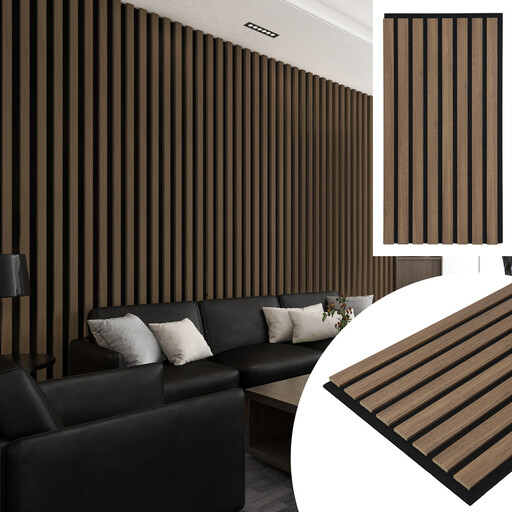
Why This Fits Their Persona: Ideal for users who want to create a quiet and professional work environment. The combination of a dark walnut look and 3D structure enhances any room while reducing reverberation during conference calls and focused work.
The product relies on a clearly defined structure of an MDF core with real wood veneer and a felt backing. This avoids the trap of purely decorative foil panels.
The set covers an area of 3.6 m? (38.75 sq ft), which is sufficient for creating a complete accent wall. Installation is possible with both adhesive and screws.

Why This Fits Their Persona: Perfect for DIY enthusiasts looking for a quick and straightforward project to upgrade their living spaces. The lightweight panels and clear installation options allow for a clean installation without professional help.
This product bypasses the complicated installation trap by being explicitly designed for easy application with adhesive or screws, with some of the necessary accessories included.
The panels are lightweight and easy to cut, which simplifies fitting them into corners, around edges, or around outlets. The wood fibreboard construction is robust yet manageable.
We have compiled a complete, up-to-date list of products that fully meet these strict selection criteria and safety standards.
A general recommendation is to cover about 25-30% of a room's wall surface to achieve a noticeable improvement in acoustics. Start with the wall opposite your main sound source (e.g., speakers or workstation) or with the two opposing walls to effectively reduce flutter echoes.
It's important to distinguish between soundproofing and sound absorption. Wood acoustic panels are primarily designed for sound absorption, meaning they reduce reverberation within a room, thereby improving speech clarity and listening comfort. They are not intended to block noise from outside or from adjacent rooms (soundproofing). Their effectiveness depends directly on the material composition, especially the acoustic felt.
Yes, most modern systems are designed for self-installation. The panels are delivered as finished modules. Installation is typically done by applying construction adhesive to the back of the felt and pressing it against the wall. For an even more secure attachment, especially on ceilings, the panels can also be screwed through the felt into a wooden sub-frame. With standard tools like a saw for cuts, a tape measure, and a spirit level, the installation is manageable for most DIYers.