
Lieferung heute & morgen

Qualitätsgarantie

Willkommens-Angebote freischalten: KOSTENLOSE Lieferung | Bis zu 80 % RABATT | Kostenlose 30-Tage-JoyPlus-Testphase
App herunterladen
Echoes, reverberation and distracting reflections can affect video calls, recordings and focused work. Wood slat acoustic panels combine decorative wall design with the potential to reduce sound reflections in a room. However, not every model is suitable for every purpose.
Before you buy, avoid these three common mistakes:
Many 3D wood acoustic panels feature an MDF core, a decorative wood veneer or finish, and a felt backing. The slats create a textured surface, while the felt can help absorb sound energy.
Important: How well they work depends on factors including room size, distance from the wall, frequency range, installation method and the area covered. Covering just a small section of wall won’t automatically give you perfectly balanced room acoustics.
Look for clear information about the materials:
The term ‘wood’ doesn’t necessarily mean that the entire panel is made from solid wood. Wood slat acoustic panels commonly use a composite construction, which is often more practical to install.
A common size is 60 × 30 cm per panel. According to the product details, four panels cover an area of 120 × 60 cm, or 0.72 m². A set of 20 covers 3.6 m² in this size, according to the product description.
Before you buy, work out:
For a home office, a targeted area behind your desk or on the wall opposite your workspace is often enough. For a podcast room or recording studio, you’ll need to plan the placement of reflective surfaces more carefully.
Depending on the model, wall-mounted acoustic panels are fixed with adhesive or screws. Adhesive installation avoids drilling, but is only suitable if the wall surface, adhesive strength and removal process are all right for your needs. Test the adhesive on an inconspicuous area first, and follow the manufacturer’s instructions.
For screw installation, choose wall plugs and screws that are suitable for the surface. Ceiling installation comes with additional requirements for weight, fixings and safety. The product description alone isn’t a substitute for checking that the surface can support the panels.
The selection below compares models by coverage, colour and intended use. Information about materials, dimensions and pack size is based on the respective product descriptions.
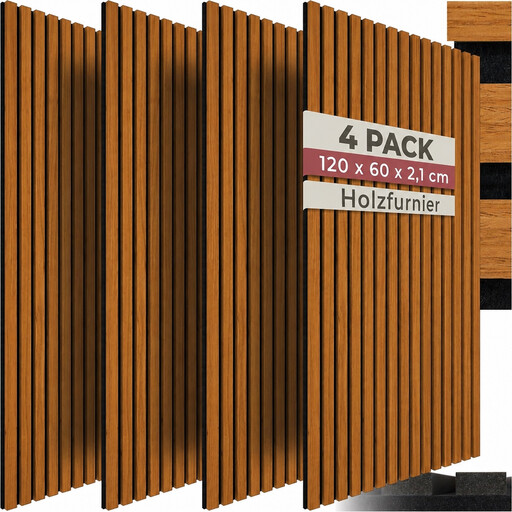
Why it suits this need: This set of four 60 × 30 cm panels is ideal for a smaller acoustic area in a home office, gaming room or living space.
The stated total coverage of 0.72 m² makes it easier to plan and removes any guesswork about how many panels you’ll need.
MDF core, walnut finish, acoustic felt and modular individual panels, according to the product description.
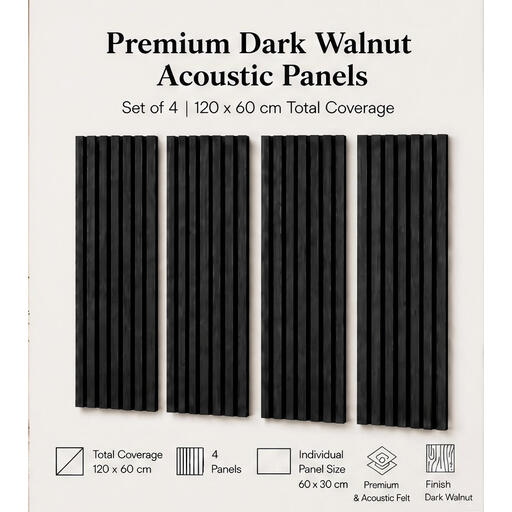
Why it suits this need: The grey oak effect works well with modern, neutral interiors and is a good fit for both work and living spaces.
The product description specifies the size, materials and installation options, making it easier to assess the appearance and technical details separately.
Four panels covering 0.72 m² in total, with a grey oak finish and felt backing, according to the product details.

Why it suits this need: With 20 panels covering 3.6 m², this set is designed for anyone looking to cover larger wall areas in a studio, podcast room or living space.
The larger coverage area, clearly stated in the product details, helps you avoid ordering too few panels for a bigger room.
20 panels measuring 60 × 30 cm, covering 3.6 m² in total, with oak veneer, according to the product description.
We’ve put together a complete, regularly updated list of products that meet these strict selection criteria and the safety regulations in force across the EU.
For a home office, acoustic panels are often best installed in a targeted area on the wall behind or beside your workspace. This can help reduce reflections during video calls, but it won’t replace correct microphone positioning.
For studio, podcast and streaming acoustic panels, you should also consider the following:
A foldable model may be useful if you need a flexible setup. According to the product description, the Foldable Wood Acoustic Panel Set consists of two 120 × 60 cm panels with a walnut finish and a foldable design. Find it here: Foldable Wood Acoustic Panel Set.
It depends on the wall surface and the fixing method you choose. Adhesive installation avoids drilling, but won’t necessarily leave the wall undamaged. Check your tenancy agreement, the wall surface and the manufacturer’s instructions. For delicate wallpaper, a freestanding or removable option may be more suitable.
First, measure the wall area you want to cover and compare it with the coverage stated for each set. According to the product details, four 60 × 30 cm panels cover 0.72 m², while 20 panels cover 3.6 m². Positioning matters too, not just the total number of panels, when it comes to room acoustics.
Acoustic panels with felt backing are primarily designed for sound absorption within a room. They can affect reverberation and reflections, but won’t automatically block voices, traffic or impact noise from neighbouring homes. Tackling noise from outside or next door requires structural measures such as wall construction, sealing and added mass.