
Lieferung heute & morgen

Qualitätsgarantie

Willkommens-Angebote freischalten: KOSTENLOSE Lieferung | Bis zu 80 % RABATT | Kostenlose 30-Tage-JoyPlus-Testphase
App herunterladen
Echoing conversations in your home office, distracting reflections in recordings or poor acoustics in your living room: wood slat acoustic panels can reduce sound reflections from hard walls while also adding a stylish design feature. However, models vary considerably in their construction, coverage and installation.
Sound-absorbing wall panels mainly work within a room. They absorb some of the sound energy that reaches them, which can help reduce reverberation and echo. Decorative wood panels generally won’t provide complete sound insulation between neighbouring rooms.
If you want to significantly reduce conversations, music or other noises from outside the room, you’ll also need structural measures such as decoupled wall systems, seals or suitable insulation materials.
A small set may be enough to create a feature behind your desk, but it could be too small for a studio or conference room. So it’s not just the number of panels that matters: check the total area in square metres.
Also check whether the stated coverage refers to finished, assembled panels or individual modules that can be arranged as you choose.
A wood veneer or slatted finish alone says little about a panel’s acoustic performance. Check whether it has an acoustic felt backing, a porous core or another sound-absorbing layer. MDF with a veneer forms the supporting structure; the felt layer on the back is often particularly important for sound absorption.
If you live in rented accommodation, also check whether the panels are designed for adhesive mounting, screws or a supporting framework. The wall’s strength and surface must be suitable for your chosen fixing method.
When comparing wood slat acoustic panels, check at least the following:
“Low-VOC” means that the product has a reduced content of certain volatile organic compounds. This information should come from the product details or technical documentation. It does not automatically mean that the product has been assessed as entirely safe for health.
For a home office, a carefully positioned panel behind your desk or opposite a reflective wall is often enough. In a studio, consider several reflection points: the walls beside the speakers, the wall behind the recording position and, where appropriate, the ceiling.
For wall panels to reduce echo, an even spread is often more effective than a single narrow decorative feature. Furniture, curtains, rugs and bookcases also affect room acoustics, so factor them into your plans.
Adhesive mounting can be practical in rented homes, but its suitability depends on the wallpaper, paint, plaster and wall surface. Before installing panels over a large area, test the adhesive in an inconspicuous spot. Screws provide a secure fixing, but leave drill holes.
Check the weight of each panel and use fixings that are suitable for your wall. For larger areas, plan the joins between modules as precisely as possible.
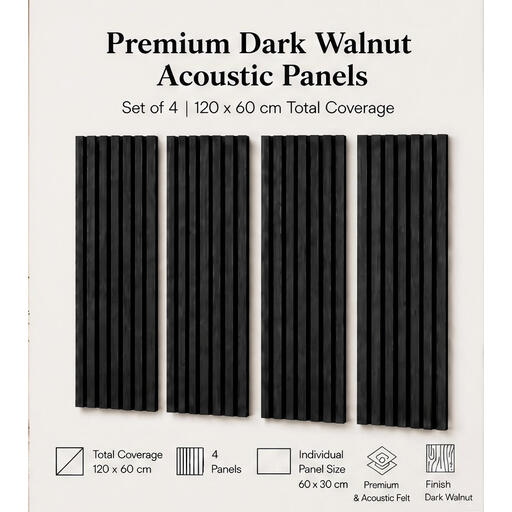
Why this product suits this need: The set contains four panels, each measuring 60 × 30 cm, with a combined coverage of 0.72 m². It’s a good starting point for planning a small feature area in a home office or living room.
The total coverage and individual panel dimensions are clearly stated. This makes it easy to check whether the set will cover the section of wall you have in mind before you buy.
MDF core, grey oak finish and acoustic felt backing. According to the product details, the panels can be installed with adhesive or screws.

Why this product suits this need: With 20 modules and a stated total coverage of 3.6 m², this set is suitable for larger feature areas in living rooms, offices or studios.
The larger set reduces the risk of buying too few panels for your planned wall. Individual modules also make it easier to arrange the coverage.
20 panels with an oak veneer finish, an MDF core and acoustic felt; according to the product details, each panel measures 60 × 30 cm.
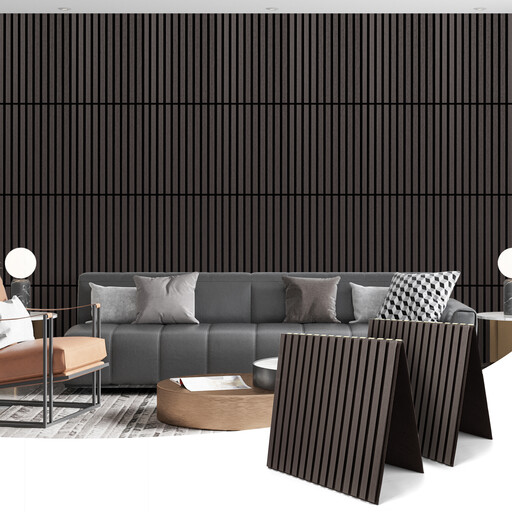
Why this product suits this need: The two foldable panels, each measuring 120 × 60 cm, are a good option if you want to arrange a podcasting, gaming or recording area flexibly.
The foldable design is intended to make installation straightforward, without requiring a wide range of tools. The dimensions and pack contents are clear before you buy.
Two large, foldable panels, a walnut-effect wood veneer and a geometric surface design.
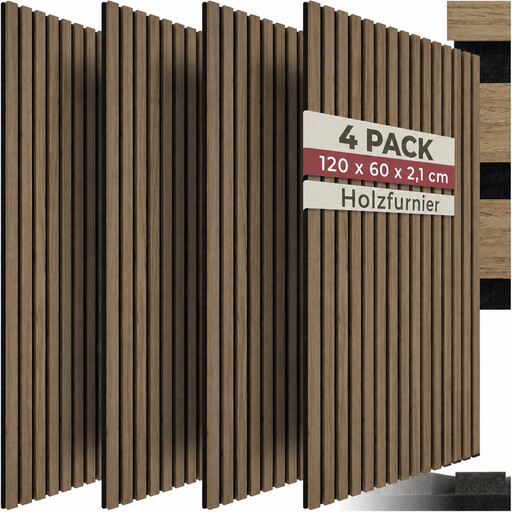
Why this product suits this need: The dark walnut finish combines sound-absorbing wall décor with a striking 3D slatted design, making it a stylish choice behind a television or on a feature wall.
As well as the finish, the product details specify an MDF core and acoustic felt. This helps you distinguish the decorative effect from the intended acoustic function.
Four modules with a total coverage of 0.72 m², a dark walnut finish and the choice of adhesive or screw mounting, according to the product details.
We’ve put together a complete, regularly updated list of products that meet these strict selection criteria and fully comply with the safety regulations in force in the EU.
First, make sure the wall is clean, dry and strong enough to support the panels. Mark out the position you want, check the alignment and test the adhesive in an inconspicuous spot. For screw mounting, you’ll need suitable wall plugs and a fixing system that’s right for your type of wall. Always follow the installation instructions for the specific product.
Their lifespan depends on the quality of the materials, humidity, UV exposure, physical wear and installation. Rooms used for everyday living are generally more suitable than damp areas. Avoid direct contact with water and significant temperature fluctuations.
Acoustic panels don’t need electricity and usually have no ongoing energy costs once installed. However, remember to include fixings, any supporting framework and the total area you need in your budget. For a realistic estimate, multiply the wall area you want to cover by the price per square metre, and allow for offcuts.